I’m writing this on Thursday morning, August 10, in my home in Kula, Maui. The short version is: We are fine. The long version follows.
Hurricane season runs from June through November. The storms generally form off Mexico’s west coast. Some swing northwest, but others move more westerly across the Pacific, and those are the ones we in Hawaii watch closely. Last week, Hurricane Dora formed and began a westward journey. This was a compact and intense storm, but the predicted track put it well south of the Hawaiian islands, so we were not worried. The track proved accurate. The storm passed hundreds of miles away and had no direct effect on the islands—but it had a massive indirect effect on the island of Maui, and also the Big Island.
The hurricane was an area of extremely low pressure. At the same time, two areas of extreme high pressure sat north of the islands. The result: As the hurricane passed south of us, air flowed from high to low, creating high winds. This was predicted. But oh my! Those winds.
It started on Monday. On that day, things were calm at our house. We live “upcountry” above 3000-feet elevation, in a rural area with small subdivisions, large pastures, and many wooded areas. When the trade winds are blowing hard at other elevations, we are often in the lee, and the air is calm. That’s how it was on Monday when Ron and I headed into Kahului to do some grocery shopping—calm at home, but very strong trade winds in town, enough to shake the car. This was what everyone expected.
Things changed overnight. The direction of the wind must have shifted, because we began getting powerful gusts around our house. In the morning we could see great plumes of dust being blown into the air at higher elevations, maybe 4000+ feet. Branches swayed, dust swirled, grit in the air—and everything tinder dry. Summer is our dry season, and here in Kula we haven’t had significant rain for weeks, probably not since May. It’s even drier over in Lahaina, on the west side. The wind blew for hours. It would moderate slightly, before the next round of prolonged gusts slammed through.
The predominant tree in our district is the black wattle, native to Australia and considered an invasive species. In Kula, black wattle will quickly take over any land that is not tended. I’ve seen bulldozed land become forest in just a few years.
A narrow band of wattle forest lies on one side of our property. It’s not on our property; it’s on the neighboring lot. This strip of forest is probably about ninety feet wide, but so dense with trees, fallen trunks, and fallen branches, it would take a lot of effort and scrambling to get through it. Below the forest, an impassable hedge of Chinese jasmine continues the barrier effect.
On Tuesday afternoon, with the wind still roaring, Ron spotted a thin plume of white smoke rising beyond this hedge. I called 911. I was told the site was already active with personnel on the ground—a huge relief! At the time, I had no idea that homes just a short distance from mine were already threatened or on fire, because by this time we had lost power and thus Internet—and cellular data is almost non-existent at our location. Moreover, the wind was blowing downslope, carrying the smoke away from us.
But that plume of smoke did not go away. It would wax and wane, appearing to move uphill. How close was it to the forest? If those trees caught fire, our home would be in extreme peril. I wanted to make my way through the forest and have a look at what was going on over there, but trees and branches had already been falling from the wind. It was not a good time to go exploring.
I’ve been through wind storms before, but this one was extreme. On Maui we have excellent, highly experienced helicopter pilots accustomed to fighting wildfire, but on that day, the wind was far too severe and too gusty to fly. In the afternoon, our massive 35+ year-old jacaranda tree split low on the trunk—it was like an explosion!—and came crashing down, its upper branches resting on an small out-building. The avocado tree survived, though it lost several branches. The koa trees, native hardwoods, withstood the assault, thank goodness. Many of the other plants were stripped bare of leaves, just as if we’d been hit by a hurricane. All the herbaceous stuff with any exposure was crushed down to the ground, and a lot of mulches were simply swept away, including some wood-chip mulch, which amazes me. Interestingly, where I have a group of trees planted—native ohia and white sapote—damage was minimal, supporting the theory that a forest protects itself. Late in the day, we tied down my precious old camellia tree to keep it from going over.
Darkness fell. Now we could see a red glow beyond the black wattle trees. How close was the fire? We couldn’t tell. But those trees were not burning. Not yet. We knew there was a narrow pasture or lawn beyond them, but if the pasture was on fire, it should have burned out already. There must be trees on fire somewhere out there, and not very far away. This fire had been going for hours! And the wind was not letting up.
By this time, we’d loaded our SUV with necessities. My son had done the same with his car. Some of the neighbors had already evacuated. We began to worry that if the koa trees fell, we wouldn’t be able to get the cars out of the carport. I had my son move his car out onto the long driveway. By around 9pm we loaded the dogs into the SUV, and drove out to the street. I called 911 again. Should we evacuate? I’d been listening to the radio for hours. Evacuation orders had been issued for other streets, but not for us. Had we been forgotten? All the 911 operator could say was that if we felt unsafe, we should leave.
We were ready to roll, but we waited. Ron and I kept going back to pick up a few more things. Around 9:30pm the red glow beyond the trees had grown more intense and I could hear crackling from the fire. The wind was still blasting and there were no firefighters in our immediate area. I did see a police car pass by, but it didn’t stop. It felt like we were on our own.
My honest feeling at the time was that a single firetruck could save our house from disaster, but none was forthcoming, and I was fairly sure we were going to lose our home. I wasn’t angry. I knew things were terrible elsewhere and that emergency personnel had been working hard and nonstop all that day and were no doubt utterly exhausted. Still, it was an incredibly frustrating feeling.
We finally left around 9:30pm. We didn’t go far though. Ron and I both wanted to return home and use garden hoses to quench hotspots, if it came to that. Our son was wiser. He pointed out that if trees fell, we could be trapped, and there was the issue of inhaling smoke. (I should mention that county crews had worked hard all day clearing downed trees to keep most roads open. This was immediately obvious as we drove.) So we eventually spent the night sleeping or not-sleeping in the car, in the parking lot of the community center in Pukalani, along with hundreds of other evacuees. From that site, we had a good look at the P?lehu fire—one of the other major fires on the island.
Wednesday morning dawned. I walked the dogs around, we picked up coffee, then headed upcountry to see what direction our lives were going to take. I really thought we had lost the house—maybe it was easier to believe that, than to face being crushed later—but there it was! Intact. Untouched. No sign that any firefighters had been around, and the visible trees were not burned. The fire had never reached the narrow woods—but it was still smoldering. The smoke was obvious.
We moved back in.
The wind had died overnight, the day was hot, and the weather remained extremely dry. Still no power or Internet of course, and now we also didn’t have running water. But we had a home, and we weren’t complaining. The county had brought water trucks up. Ron and I filled some jugs, then started on the cleanup. And that fire kept smoldering.
My daughter lives in Honolulu. She called frequently, updating us on the terrible events in our area and around the island. We have been so very lucky to keep our home. I was still worried though. How long was the fire beyond the trees going to be allowed to burn?
Then, late on Wednesday afternoon, a helicopter started flying, dropping bucket after bucket of water. A second ship joined it after a while. They kept it up until day’s end, and later we heard what sounded like a team of firefighters with chainsaws and heavy equipment. We slept well last night.
This morning there was still the smell of fresh smoke in the air, and a single helicopter has been flying, delivering more buckets, presumably working to quench all lingering hotspots. Clouds are building, so maybe it won’t be quite so hot today. We have power now, but still no water, no Internet. That’s all right. Those will come in time thanks to the hard work of many people.
This has been a horrible disaster for Maui. We don’t yet know the full extent of loss, but it will be extensive. From what I’ve heard, much of Lahaina Town, on the west side, has burned to the ground. Family homes, occupied for generations, are now gone. I don’t know what has happened in the Olinda area to the north of us, or what damage has been inflicted by the Pulehu fire. I think our main town of Kahului has fared okay; I haven’t heard otherwise. And the airport is open.
Best to keep in mind that it’s still early in hurricane season, and that fire will remain a threat for months to come. Whether you live here, or elsewhere, be aware of the potential for disaster in your area and do what you can to be prepared.
Update: August 11, 8:30am
Cellular data reception improved yesterday, and we have now seen images of the disaster in West Maui. It’s hard to accept the scale of what happened, that the historic town of Lahaina is gone.
And I have now seen an aerial image of the fire closest to our house. It’s clear from the burn line that fire fighters were on scene and stopped the blaze, which came within a few feet of a structure just beyond the trees. Helicopters flew all day yesterday, while ground crews worked to contain and suppress the fire. I want to say thank you to them and to all the emergency personnel, the firefighters, the highway personnel, the helicopter pilots, the Red Cross, and all the good people who saw a need and did what they could to help. We are grateful! Aloha!








 Today is release day for Blade, the fourth volume in my far-future series Inverted Frontier.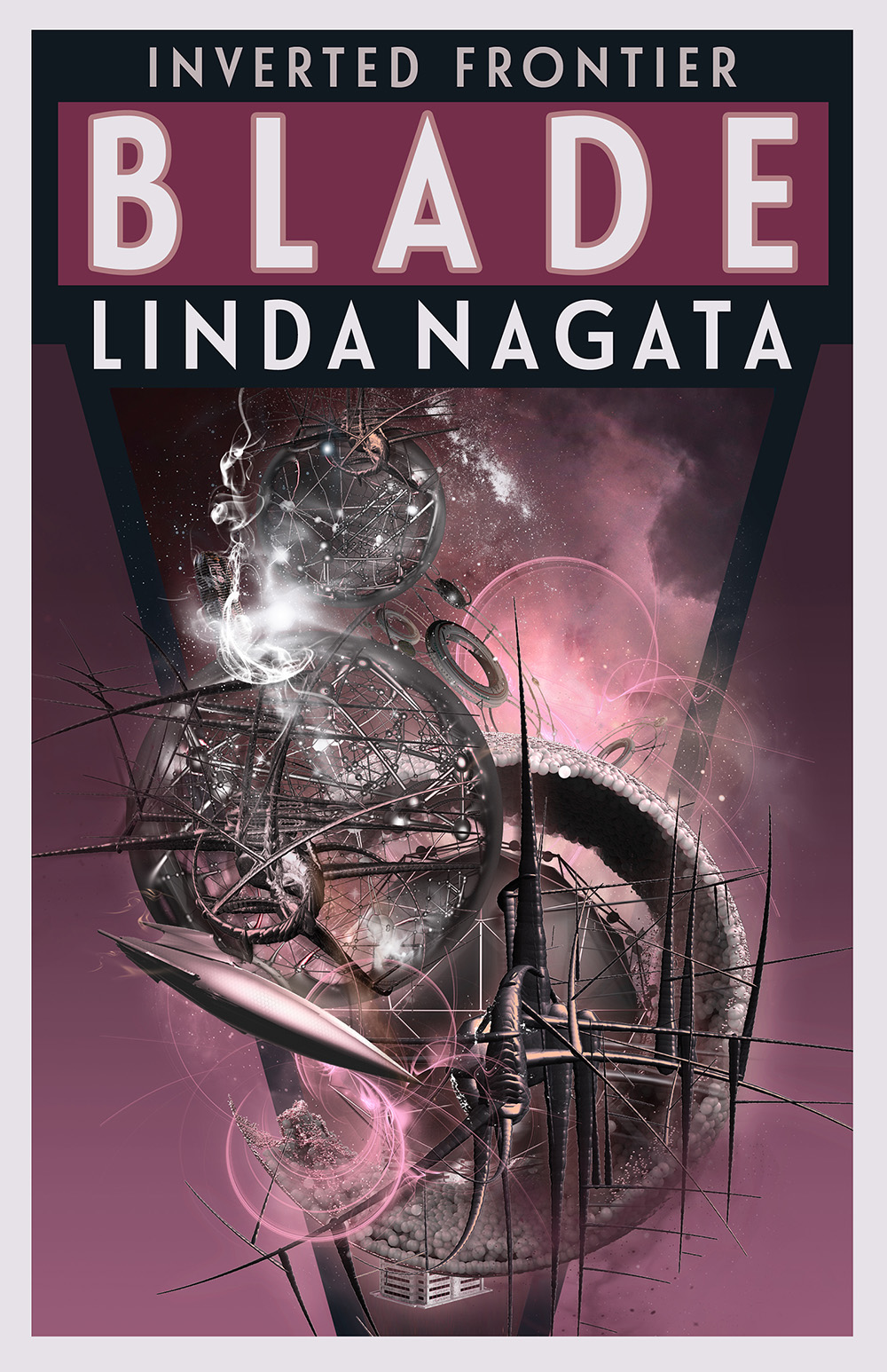

 NEEDLE (Inverted Frontier #3) has been out for almost a year. Throughout that time, many people have asked me if there would be an audiobook. My answers ranged from “maybe” to “I don’t think so” to “no.”