Linda Nagata: the blog at Hahví.net


Archive for May, 2013

Times Change: “SF” vs “Sci-Fi”

Thursday, May 30th, 2013

Long ago it was taught to me that within the science fiction genre we should never say “Sci-Fi.” If we want an abbreviation, we use the initials “SF.” Otherwise it’s “science fiction.”

The general reason given for avoiding “sci-fi” was that logically it should be pronounced “skiffy.” (Shaun Duke and Jen Zink have turned this right around by creating The Skiffy & Fanty Show).

Really though, I think it’s a tribal thing. Within the genre, “Sci-fi” was seen as a term used by dilettantes, those who might have picked up a Michael Crichton novel or two, watched some Star Trek or Star Wars, but in all likelihood knew little to nothing about the core of the genre.

I used to wince when someone would say to me, “Oh, I love sci-fi!”

But you know what? Times change. I now freely use the term “sci-fi” — and twitter is the reason.

Twitter allows a maximum of 140 characters per tweet. “SciFi” without the hyphen takes up five. “Science Fiction” requires fifteen. That’s a HUGE difference when I’m trying to tweet something like:

“There Needs To Be A War Going On Somewhere” The Red: First Light is a near-future scifi thriller. Read a sample: http://bit.ly/14Z7KSH

That’s 136 characters. Spelling out “science fiction” would break it.

So why not use “SF” which is even shorter? Because for most people “SF” stands for “San Francisco.” Yes. Truth. I have confused people by using SF in a tweet. I may be an “SF Writer” but I’m not a writer from San Francisco and The Red: First Light is not set in San Francisco.

So I have taken to heart a quotation from Neal Stephenson’s Cryptonomicon:

SHOW SOME ADAPTABILITY

I’ve put aside my tribal prejudice and, on twitter at least, I’ve adopted the use of “Sci-Fi.” I understand this is a kind of heresy, but then, I’m a fiery revolutionary indie publisher…or at any rate, I’m a pragmatist.

Ya’ gotta’ do what ya’ gotta’ do.

You know?
“…to the exclusion of all emotional experience”

Wednesday, May 29th, 2013

This morning, a post from last summer on women and hard SF got resurrected in my twitter stream. The title: Being male is not a prerequisite for hard SF.” Well, duh?

Written by Damien Walter, and published in The Guardian, the piece begins:

Despite protestations to the contrary, hard SF is a boys’ club that is undermining its own potential by resisting the contributions of women writers.

It goes on to say:

Women writers are more than welcome in hard SF, assuming they have a background in the hard sciences and value hard logic to the exclusion of all emotional experience.

Wait…what? All my hard SF novels have just been insulted! By this definition, we must conclude that there is no emotion in my work. Shame on me. And there seems to be an implied corollary that men wouldn’t read my books if there were any emotion to be found in them — which is not remotely my experience.

Update: Comments here and on twitter have made me realize that these quotes I’ve picked are leading to a misunderstanding. There is a tired old meme that says hard SF is emotionless writing. Damien is taking this meme as truth. He’s not advocating emotionless writing; he’s railing against it. So my first objection to the piece is that I simply don’t agree that hard SF is emotionless writing. But Damien says that it is, and goes on to say that the work of women is accepted by hard SF readers if it values “hard logic to the exclusion of all emotional experience.” I feel my work has been accepted as hard SF, but I don’t feel it’s devoid of emotion — so I find the argument quite insulting on multiple levels.

The tone of the piece seems intended to provoke a reaction — “hard SF” is redefined as “chauvinist SF” and on we go from there — so it’s successful in that.

I’ve been working on my own post on hard SF. I guess I should finish that up and publish.

Secondary Characters & Gender

Thursday, May 23rd, 2013

Some days–most days?–my twitter feed can feel like an ongoing scolding, with writers reiterating the need for more diversity in fiction, by which they mean characters who aren’t white, male, and straight. It sometimes feels like these young ’uns don’t realize that diversity has existed in SF for a very long time.

Today all this has gotten me thinking back to my youth, and the impact a writer had on me in the early ’80s, merely by the way she used unnamed, secondary characters. I think this writer was CJ Cherryh, though it could have been Elizabeth A Lynn. Memories fade. At any rate, the technique was simple and it went like this (I’m not quoting, just making up an example.):

The cop approached with narrowed eyes, looking ready to slam someone against the pavement. “What are you doing here?” she demanded.

What’s the big deal in this made-up passage? Well, in my early ’80s mindset, at the end of the first sentence I am visualizing a big, tough-looking male cop. Then at the end of the second sentence, my assumption gets kicked head over heels. I remember that this delighted me, and it happened over and over again. I even began to think “Oh, she got me!” every time my mind insisted on visualizing what turned out to be the wrong gender, as if it was a game the author was playing with me.

What this approach did, in a very simple way, was to illustrate a society where women are neither victims nor inferior partners, but just people who fulfill diverse roles, to the surprise of no one living in that story world. And of course the approach can be reversed to show men in what we might consider non-traditional roles.

Let me reiterate, this was in the early ’80s, and these were secondary characters.

The experience really woke me up. I took the lesson to heart and I still use the technique all the time. Here’s a quote from my recent story “Through Your Eyes”:

Cops are everywhere, all of them in armor, and their communications gear seems to be working just fine. I start to look for Elliot, but one of the cops gets in my face. She’s almost as tall as I am, and she’s used a pigment to give herself spooky gray eyes that lock on mine. “ID?” she barks.

I understand the ongoing calls for more diversity in the genre, but it’s not like we haven’t been working at it for decades–and “show don’t tell” really can work wonders for getting the point across.

Haleakala Crater Service Trip

Tuesday, May 21st, 2013
photo by Ronald J. Nagata, Sr.

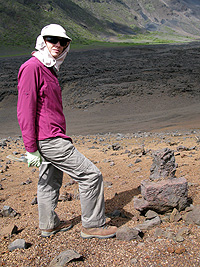
I’m modeling my usual crater attire. The elevation of the crater floor is around 7400′, so solar radiation is intense and sunburn happens fast, so I learned to hide from the sun long ago. (Photo by Ronald J. Nagata, Sr.)

A few years ago my husband, Ron Nagata, retired from his position as Chief of Resources Management at Haleakala National Park here on Maui, but he still works at the park as a volunteer. One of his ongoing projects is invasive weed control from Haleakala’s summit to Kapalaoa Cabin. Over the weekend he and I participated in a periodic service trip, aimed at knocking back the population of two target weeds. It was a fantastic weekend, with unusual weather–colder than expected for this time of year.

On the six-mile hike in, we enjoyed a constantly changing panorama of mist rolling just above the slopes and between the cinder cones. Over the last couple of miles we were spattered by a very light rain. We reached the cabin, rested a bit, and went out again into a cold afternoon to start working. Before long a dribbling rain started to fall, but slowly enough that we stayed out until evening.

The next day started off clear, but the mist and fog soon returned. We worked until mid-afternoon and then returned to the cabin for a late lunch–just before the rain arrived in earnest. It rained hard until after nightfall, so that ended our working day…I’ll admit I wasn’t complaining, because I was tired.

On Monday morning we worked for a couple of hours and then set off through the spectacular central crater scenery on our hike out.

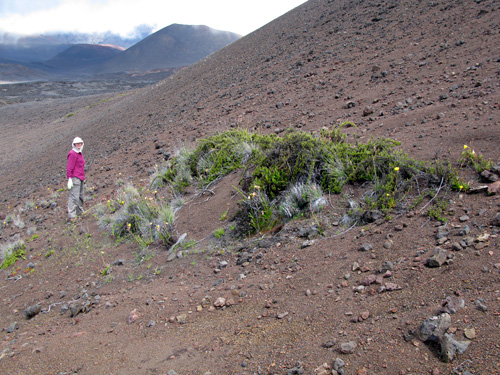
This is me, in the field. There was very little of our target weed in this area, but at the next patch of vegetation seen in the distance above my head, we discovered plenty--and pulled as many as we could. We'll be back for the remainder before too long.

This is me, in the field. There was very little of our target weed in this area, but at the next patch of vegetation seen in the distance above my head, we discovered plenty–and pulled as many as we could. We’ll be back for the remainder before too long. (Photo by Ronald J. Nagata, Sr.)

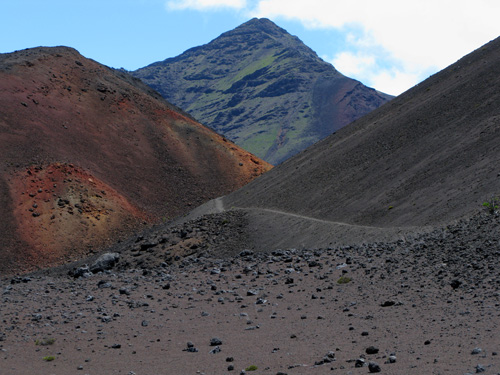
The peak in the distance is Hanakauhi, aka "Hana Mountain" as seen from Halemau`u Trail in the central crater, on our hike out.

The peak in the distance is Hanakauhi, aka “Hana Mountain” as seen from Halemau`u Trail in the central crater. (Photo by Ronald J. Nagata, Sr.)

Some Nice News

Wednesday, May 15th, 2013

I’m just back from a trip to Washington D.C., my first-ever visit to the capital. I’ll have a lot more to say on that later, but for now I wanted to mention a few nice things that happened while I was away.

First, the finalists for the 2013 Theodore Sturgeon Memorial Award have been announced. The award is for the best short science fiction of the year, and is chosen by a jury. Much to my surprise, my Analog story “Nahiku West” was on the list. Find the full list of finalists here at Locus Online.

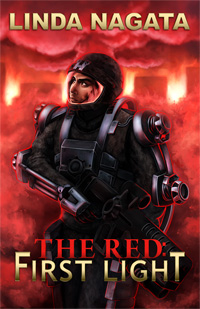
The Red: First Light by Linda NagataSecond, I was very pleased to have The Red: First Light appear on Kristine Kathryn Rusch’s monthly recommended-reading list. Here’s part of what Kris had to say:

a near-future sf thriller that’s so compelling, I couldn’t put the thing down. Excellent, well-imagined, great characters, fast-moving, great writing, everything I want in my science fiction (in my fiction really) and rarely get. I can’t recommend this book highly enough.

It’s the first in a series, but it doesn’t leave you hanging. This part of the story ends. And then, when you finish the last words, you can breathe again. Because if you’re anything like me, you’ll be holding your breath to the very final sentence.

🙂 That made my day! Find the post here.

And finally, John DeNardo has an article just out at KirkusReviews.com called “When Short Fiction Grows Into a Novel.” I’m one of the writers he interviewed along the way, since The Red: First Light had it’s start in my Asimov’s short story “Through Your Eyes.” Find the article here.

Best Science Fiction and Fantasy of the Year Vol. 7

Wednesday, May 1st, 2013

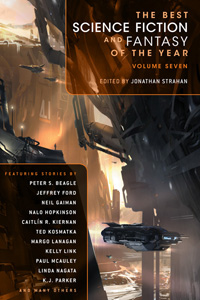
Best Science Fiction and Fantasy of the Year Vol. 7I haven’t actually seen a copy yet, but Jonathan Strahan’s Best Science Fiction and Fantasy of the Year Vol. 7 is now available for purchase. It includes my novelette “Nahiku West” originally published in Analog.

This is the first time one of my stories has been selected for a best-of-the-year anthology, so it marks a milestone for me.

Visit Nightshade Books to read about the volume, and for links to vendors.