Linda Nagata: the blog at Hahví.net


Archive for the 'Reading' Category

Book Rave: City of Stairs

Monday, December 28th, 2015
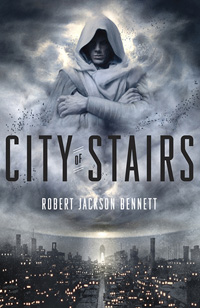
City-of-Stairs-Robert-Jackson-Bennett-2Best-of-the-year lists and award-nomination lists are fun to talk about and it’s awfully nice to have your work appear on them. But these lists are also valuable reminders that we have diverse tastes and that our reasons for reading — and for choosing what we read — are all very different. And I think it can be interesting to take note of what’s not on these lists.

I’ve been doing a lot of reading this year, some of it 2015 books, and some books from earlier years. Several months ago I posted about Claire North’s 2014 novel The First Fifteen Lives of Harry August, which was one of the best novels I’ve read in recent times. Ignore the cover. Seriously. And read it. After I finished, I was amazed at how little I’d heard about this book, and that it had not put in an appearance on either the Hugo or Nebula ballots. (It did win the John W. Campbell Memorial award.)

I just finished another 2014 novel, City of Stairs, by Robert Jackson Bennett, which is also a terrific book that, in retrospect, I am surprised I didn’t see on 2014 award ballots. (Yes, there were complications with the Hugos, but not with the Nebulas! And it may have been on best-of-the-year lists, last year, I don’t know.)
(more…)

War Stories from the Future

Sunday, November 15th, 2015

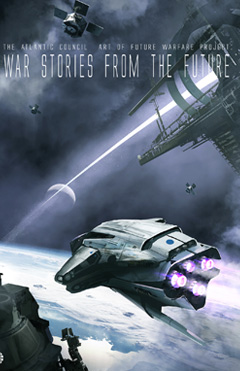
War Stories From The FutureA new ebook anthology is just out, and it’s FREE. War Stories from the Future is published by the Atlantic Council. It’s part of their Art of Future War Project, whose mission statement reads:

The Atlantic Council’s Art of Future Warfare project is driven by the Scowcroft Center on International Security’s mandate to advance thinking and planning for the future of warfare. The project’s core mission is to cultivate a community of interest in works and ideas arising from the intersection of creativity and expectations about how emerging antagonists, disruptive technologies, and novel warfighting concepts may animate tomorrow’s conflicts.

My contribution to the anthology is a reprint of my short story “Codename: Delphi,” but the anthology includes original stories commissioned from Ken Liu, Madeline Ashby, Jamie Metzl, Mathew Burrows, and project director August Cole, co-author of the World War III thriller Ghost Fleet. And there’s a reprinted story from David Brin. New voices are also included in the anthology, in the form of contest-winning stories from Alec Meden, Nikolas Katsimpras, and Ashley Henley.

Find more information and download links here. Available in EPUB and MOBI (Kindle) formats.

Book Rave: Ashley’s War

Monday, November 9th, 2015

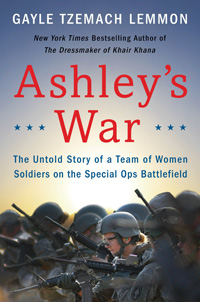
Full title: Ashley’s War: The Untold Story of a Team of Women Soldiers on the Special Ops Battlefield

Ashleys War by Gayle Tzemach LemmonAshley’s War, by Gayle Tzemach Lemmon, is a nonfiction account of the first wave of women in the US Army who volunteered to be part of the “cultural support teams” that accompanied Army Rangers and Green Berets on missions in Afghanistan.
These teams were developed beginning in 2011 because it was felt that women soldiers could interact more effectively with Afghan women, most of whom are forbidden from interacting with men who are not immediate relatives. The program proved successful. Women soldiers came to be seen as a “third gender,” one whose presence didn’t threaten the social status of Afghan men.

But Ashley’s War isn’t about Afghan culture or the politics of war. Instead it’s firmly focused on the stories of the American soldiers who volunteered for this program, and who survived the brief but rigorous training. These women came from diverse backgrounds. Some were regular army, some were National Guard. Some were on their own from a very young age, some came from strong families. Some were from families with traditional military backgrounds, and some were from civilian families. All were athletic and determined, and most joined the military because they wanted to be soldiers, and to experience combat.

As the story develops, it’s fascinating to see these women coming to terms with what it means to be a “strong woman character,” as we so frequently discuss in fiction:

(more…)

Book Rave: All The President’s Men

Tuesday, October 20th, 2015

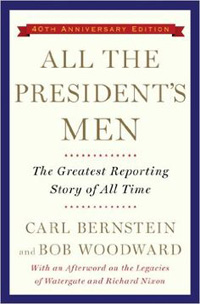
All The President's MenYes, I’m a bit behind the curve on this one, and no, I haven’t seen the movie (though I plan to).
All The President’s Men is the nonfiction memoir of Washington Post journalists Carl Bernstein and Bob Woodward, originally published in 1974. It recounts their investigation of the 1972 Watergate Hotel break-in, and the gradual revelation of scandal surrounding the 1972 presidential election, that ultimately led to the resignation of President Nixon.

These events took place when I was a child, too young to follow the slowly breaking story in detail, but old enough that nearly all the names in the book are still very familiar to me. I picked up the ebook of the 40th anniversary edition, which happened to be on sale for a ridiculously low price — and I found it fascinating. (more…)

Book Rave: The Flicker Men

Monday, October 12th, 2015

“All realities are constructed in one way or the other, are they not? Either through the work of some will, or arising as an emergent property from a system’s own underlying laws.”

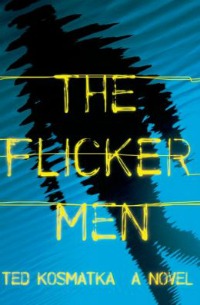
flickermen-KosmatkaTed Kosmatka’s The Flicker Men first came to my attention last summer when the publisher offered to send me a complimentary copy. I failed to follow up on that, but I kept hearing good things about the book, so last week when I was looking for a new audio book, I decided to give it a try.

It took me a little while to get hooked. The opening chapters introduce us to the first-person protagonist, Eric Argus, a young and brilliant quantum physicist struggling with alcoholism and depression, along with a past that’s only gradually revealed. But once Eric latches onto a new project, the book takes off.

The Flicker Men is a philosophical thriller. There is a lot of discussion of quantum theory and its implications, and especially the double-slit experiment. That may sound dry, but in the book, it’s utterly fascinating. It turns out that a lot of readers, myself included, are inspired to do a little outside research on some of these subjects.

Ted is a terrific writer. The story moves at a good pace, and by the standards of modern novels it’s relatively short — a big plus for me as I’ve reached a point where I greatly prefer shorter, more tightly focused books.

The audio book was very well done, but I’m sure The Flicker Men would be just as compelling if I’d been reading instead of listening.

Recommended Links For Readers and Writers

Friday, September 18th, 2015

A few recommended links of general interest:

A terrific episode of The Coode Street Podcast has just posted, this one featuring Kristine Kathryn Rusch talking about her own writing, her move away from traditional publishing, and her upcoming anthology Women of Futures Past, to be published by Baen Books in 2016.

Foreign Policy has just posted an article by Tim Requarth, “This is Your Brain. This is Your Brain as a Weapon.” It’s a survey of the rapidly accelerating field of neural technologies that includes some of the ideas behind The Red.

Extreme Tech has an article on helicopters with spider legs. Yep. Not kidding. “These robotic spider legs could let helicopters land anywhere” Be sure to watch the video!

(more…)

Links

Monday, August 10th, 2015

I’ve been reading a lot of interesting posts and articles, so I thought I’d share a few of them here.

Can we reverse the aging process by putting young blood into older people?
A series of experiments has produced incredible results by giving young blood to old mice. Now the findings are being tested on humans. Ian Sample meets the scientists whose research could transform our lives.
This is a very long read, it’s rather disturbing in more ways than one, but it’s fascinating too. Find it at The Guardian/Science.

I’m Too Old for This
A mostly cheerful and realistic reflection on the liberating aspects of middle age and beyond experienced by many women, including yours truly. The ability to “shrug off annoyances that once would have knocked me off my perch” is a huge plus. “I’m too old for this” has been one of my mantras for a while, and I’m not sixty yet! Find it at the New York Times.
h/t Morgan J. Locke (@MorganJLocke)

The tree of life gets a makeover
When I went to school, the five “kingdoms” of life were animals, plants, fungi, protista, and monera — but things are changing. This is a fascinating article discussing the effect of genetic analysis on the classification of living things. Find it at Science News.
h/t David Brin (@DavidBrin)

Storybundle:
Women In Science Fiction

Tuesday, August 4th, 2015

Women in Science Fiction Storybundle

Storybundles are themed collections of ebooks, sold together at discount, and available only for a very short period of time. They’ve been popular with readers, but this is the first time I’ve had a chance to participate in one. The newest bundle — Women in Science Fiction — was put together by Kristine Kathryn Rusch.

Why do a bundle of women science fiction writers? Here’s what Kris had to say:

I received a huge shock late last year when some younger writers told me that women didn’t write science fiction. “Present company excepted,” they said to me.

“But…but…what about…” and I listed wonderful writer after wonderful writer, whom these young writers had never heard of. I did some research and realized that even though women have written sf since the beginning of sf (in fact, you could argue that a woman started the genre. Hats off to you and your Frankenstein monster, Mary Shelley!), women and their fiction never received the press that their male counterparts did. That’s why those young writers had no idea women have always written science fiction.

So I decided to do a bunch of projects to rectify the publicity problem, including this StoryBundle.

So here we are!

(more…)

Book Rave: War Dogs by Greg Bear

Wednesday, July 8th, 2015

I picked up this book when it came out last fall, but didn’t read it until a few days ago. During the interim, I didn’t hear a lot about it, and what I did hear wasn’t all that enthusiastic, so I was a little ambivalent at the start — but that ambivalence quickly vanished.

War Dogs is told in first person, in the voice of Master Sergeant Venn, a “skyrine” — a marine delivered by orbital drop to the Martian battlefield. So why are humans fighting a war on Mars? Because an enigmatic alien race known as the Gurus insinuated themselves on Earth, got the planet addicted to their highly advanced technology, and then asked us to fight a war for them against another alien race engaged in setting up a beachhead on Mars.
(more…)

Book Rave: The Black Company

Sunday, May 3rd, 2015

There are times when I begin to think I’m jaded with fiction, that there isn’t much that can really seize my interest and draw me into a story anymore — but then I’ll find a book to change my mind. Those are the books I write about here. I just finished reading Glen Cook’s The Black Company — and I loved it. I was honestly amazed how much I enjoyed it, and how compelling it was.

I’m going to guess that most of you who are into epic fantasy first read The Black Company long ago. It was published in 1984. That was three years before my own first publication – a little short story in the magazine Analog Science Fiction & Fact — and at the time I wasn’t reading epic fantasy at all.

The reason I picked up The Black Company now was because of a post at tor.com Message Fiction: Politics in Sci-Fi and Fantasy Literature in which “The G” (@nerds_feather on Twitter) describes it as “a forebear of the gritty turn in epic fantasy and sword & sorcery”:

The Black Company explicitly and directly rejects the simple good vs. evil dynamic that has traditionally defined heroic fiction, whether fantasy or not. The Company’s war is not one of righteous truth or glorious conquest, but a war of survival and a war of profit. It is a civil war, and one whose primary victims are unarmed civilians—the exact kind of war, one notes, that has predominated in our world since 1945.

How could I resist that?

The writing style used in The Black Company is unusual in my experience, especially at the start. The storyline jumps about at times and much of the background is not explained. Imagine stepping into another world. Everyone already there knows the critical history and they assume we know it too. So like a child we are left to piece together that history from comments dropped here and there. This can be frustrating, and at times I wondered if I’d missed some critical part or if this wasn’t actually the first book in the series—and yet it works very well. I was forced to pay attention, and my interest never flagged.

The narrative voice, a physician-warrior named Croaker, is wonderfully done. And as is always the case in a compelling tale, it’s the positive relationships between the characters that power the story. The Black Company are mercenaries. Croaker recognizes their faults and sins. But in the midst of a grim and bloody civil war they are devoted to one another, and Croaker’s ruminations on good and evil add a necessary philosophical balance to the action.