Linda Nagata: the blog at Hahví.net


Archive for the 'Reading' Category

War Stories

Wednesday, June 19th, 2013

This is a press release from Andrew Liptak and Jaym Gates. They’re getting the word out on an upcoming anthology of military science fiction. If you’re a writer interested in contributing, there will be an open submissions period. If you’re a reader interested in the range of military science fiction, stay tuned!

Since 2001, the role of the military around the world has drastically changed as conflicts have raged in the Middle East, Africa and Asia. The decade long war on terror has highlighted changes in how war is conducted, and the violence has impacted millions of soldiers, civilians and families across the world. Yet, in the United States, the general public and those who serve rarely cross paths: only a small fraction of the population protects the country and fights on their behalf. As the soldiers return home, it’s vital that we understand what they did, and why it matters.

War Stories, co-edited by Andrew Liptak and Jaym Gates, will be an anthology of military science fiction, containing stories that emphasize the cultural, social, political and psychological repercussions of modern war. The anthology has been acquired by Jason Sizemore’s Apex Publications and will be funded through a Kickstarter campaign.
(more…)

Book View Cafe Welcomes David D. Levine

Wednesday, January 16th, 2013

David D. Levine's SPACE MAGICA new short story collection, Space Magic, has just been released in ebook form by Book View Café, with 15 critically acclaimed science fiction and fantasy stories by author David D. Levine.

From Book View Café:

David’s short fiction has appeared in Asimov’s, F&SF, Analog, Realms of Fantasy, and numerous other magazines, websites, and anthologies, including four Year’s Best volumes (two SF, two Fantasy). He’s won a Hugo (Best Short Story, for “Tk’Tk’Tk“) and has received many other awards and nominations.

David likes to think of himself as a writer who takes the classic ideas of Golden Age SF and gives them a fresh, up-to-date presentation… the SF equivalent of a New Beetle or Mini Cooper. He co-edits the fanzine Bento with his wife, Kate Yule, and their website is at BentoPress.com.

Read a sample story, “Wind From A Dying Star,” here.

If you’re a fan of short fiction, Space Magic might be just what you’re looking for.

Republic, Lost

Saturday, December 15th, 2012

My latest read was Republic, Lost: How Money Corrupts Congress–and a Plan to Stop It, by Lawrence Lessig. The book poses the question of why the big issues facing the United States are forever kicked down the road by Congress, and as a corollary, why the issues that Congress does spend its time on are not the issues that matter to the great majority of the American people.

The answer posed by the author in a very convincing manner is that the single greatest concern of most senators and Congressional representatives is to get re-elected, and re-election takes money, and money comes from – well, you know the answer. Money comes from corporations and well-funded organizations seeking to advance their bottom line.

The fascinating argument of this book is the author’s explanation of how this funding system works, and it’s not by outright (illegal) bribery. He describes a complex system involving personal relationships, gift culture, well-connected and well-paid lobbyists, and “donations” of a few thousand dollars that can be leveraged into millions if only the right piece of legislation is passed. And it’s all legal.

There is much more – enough to derail the most optimistic among us, I suspect. At the end of the book, Lessig offers several strategies that might solve the problem and return our representatives to what should be their true work: representing the voters who put them in office, not the contributors who made their campaign possible. None of the solutions struck me as likely to make any difference. The most promising one was to work on getting the required plurality of states to call for a constitutional convention to address campaign finance reform – and of course we’re a long, long way from that ever happening.

Strangely enough, this book affirmed the cynical worldview that’s a background element of some of my upcoming work, particularly the story due in an issue of Asimov’s Science Fiction and, sadly, it’s affirmation that I did not go too far in my extrapolations.

Story Rave: “Homecoming” by Robin Hobb

Friday, December 7th, 2012

So…I was tired last night. It seemed like a good idea to go to bed early and catch up on my sleep. I would read for just a few minutes first…

Big mistake!

When it came out not long ago, I grabbed a Kindle sample of John Joseph Adams’ anthology Epic: Legends of Fantasy. The first story is “Homecoming” by Robin Hobb, originally published in 2003. This was actually my second attempt to start the story which, oddly enough, opens with a detailed inventory of an artist’s household goods that didn’t strike me as exactly gripping. I was in a more patient mood this round and kept going. Very soon I was entirely caught up in what proved to be a novella. I got to the end of the sample, purchased the ebook, and kept going until I finally finished at midnight.

So much for getting extra sleep!

But it’s fun to be caught up and swept away by a story. Honestly, that doesn’t happen all that often anymore.

“Homecoming” is an adventure story of great trials and hardships, strange landscapes, and hard choices, but it’s the protagonist’s voice that makes it fascinating. It’s written as a series of journal entries so that we see the unfolding events entirely through the protagonist’s viewpoint, while we see her change and adapt to new circumstances.

If the rest of the stories in Epic: Legends of Fantasy are just as good, I’m going to be losing a lot of sleep.

Book Rave: Dispossession

Monday, October 22nd, 2012

BVC releases Chaz Brenchley's DISPOSSESSIONNew today from Book View Café is Chaz Brenchley’s Dispossession, an unusual, intricate, and engrossing mystery with an element of fantasy.

I picked this novel up by chance from the inner-sanctum of BVC, without knowing anything about it, not even what genre it was. It didn’t take long to hook me. The writing is gorgeous, and the story deeply intriguing: this is a tale of amnesia, as protagonist Jonty Marks wakes in hospital three months after his last recallable memory to find his staid life utterly changed.

Writers write for different reasons, for different goals, for different purposes. My own writing grew out of my love for adventure stories: lots of action, big sets, suffering heroes and antiheroes. Dispossession has its own action and determined plot, but it seems to me it’s written more to illuminate the human condition. In this age of 99-cent pot boilers, I’m almost afraid to tell you that much of this long book involves the inner reflections of the protagonist, Jonty Marks, and sadly it feels necessary to add the story is not boring at all! Here’s a quote to show you what I mean, with a few sentences snipped out that might be spoilers:

I still thought he was nineteen; still thought that was exact. Full growth but no maturity, whip-fast reflexes and not an ounce more flesh than he could need or want; fire and hunger, passion and arrogance and the habit of instant judgment with no sense of perspective, no leniency.

And beauty, of course […] and engulfing all, the certainty that there was no forgiveness, that there could be no reconciliation in this world or any other.

And that also was pure nineteen-year-old thinking, and not subject to debate.

As a writer, I deeply admire the ability to write descriptions like that.

Another interesting aspect of Dispossession for me: this is the most “British” book I’ve ever read. I was frequently asking my Kindle to provide me with definitions for unfamiliar words, and slowly realized that all the other books I’ve read by British authors must have been translated into “American.” This is the pure product.

You’ll find a more extensive description of Dispossession’s plot at Book View Café — too much description, in my opinion. Books should tell their own story, as the plot unfolds. My recommendation is to skip reading the BVC description and just grab the sample chapters. That will let you know if Dispossession is a book for you, or not.

If you do read it, let me know what you think!

Book Rave: Devil Said Bang

Tuesday, September 4th, 2012

Devil Said Bang is the fourth and most recent installment of Richard Kadrey’s Sandman Slim series. (Sandman Slim, Kill The Dead, Aloha From Hell.) I freely admit to being a fan-girl. I picked up the first book by chance last March, quickly grabbed the second, revised my principles on ebook pricing to read the third, and pre-ordered the fourth and most recent — the first time I’ve pre-ordered anything.

The books are violent and profane, but they’re also loaded with clever dialogue and compelling characters. The stories are told by “Stark” aka Sandman Slim, a young magician (actual magic, not illusion) who was betrayed by his circle of “friends” and whisked off to Hell. When he manages to escape his fate, revenge is on the menu.

Stark describes himself as “a shitstorm magnet” and this is not an exaggeration. His adventures ramp up in scope through the first three books, but Devil Said Bang brings things back to a more human scale. I think it’s the best book since the first one, but I might just re-read them all to be sure.

This is the sort of series that makes me wonder why I like what I like — lately I’ve glanced at other, much praised, books and moved on — but that’s a subject for another blog post.

If you’ve read Sandman Slim I’d love to hear what you thought. If you haven’t, grab a sample of the first book and give it a try. I’m not the only one raving.

Amazing Stories Roundtable Links

Monday, July 9th, 2012

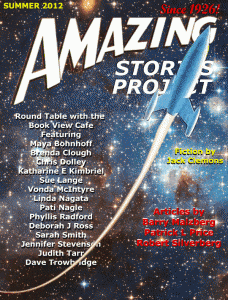
Amazing Stories, July 2012A few days ago I posted about the new Amazing Stories, featuring a roundtable discussion by members of Book View Café. More questions and answers have gone up on the website. Find the questions below, with links to the individual pages…

Part 1 – Is Science Fiction Definable?

Part 2 – Is Science Fiction Dying?

Part 3 – Is There A Divide Between Literary Fiction and Genre Fiction?

Part 4 – Is Fantasy Eclipsing Science Fiction?

Part 5 – What’s All This Talk About Squids In Space?

Amazing Stories Returns

Thursday, July 5th, 2012

Amazing Stories, July 2012Those of you who’ve been around for a while will remember Amazing Stories as one of the primary digest magazines publishing science fiction and fantasy short stories. Launched in 1926, Amazing passed through various owners, continuing to publish until 2005.

I never sold a story to Amazing when it was a regular magazine, though I did try a lot in the early years, and I think I got close a time or two. I did finally place my shortest published fiction ever in an Amazing Stories anthology edited by Kim Mohan.

So…in case you haven’t already heard, Amazing Stories is on it’s way back! Steve Davidson has taken over the helm and the “Relaunch Prelaunch Issue” is going up online throughout the month of July.

Book View Café has the honor of participating in the first new issue, in the form of a roundtable discussion on questions relating to science fiction and the new world of publishing. You can find the first issue here, along with links to the questions and responses. See “Chain Mail: Amazing Stories Interviews 13 Authors From the Book View Cafe.”

To give you an idea of what we’re talking about, here are the first questions in the Chain Mail interview:

Part 1 – Is Science Fiction Definable?

Part 2 – Is Science Fiction Dying?

Part 3 – Is There A Divide Between Literary Fiction and Genre Fiction?

Part 4 – Is Fantasy Eclipsing Science Fiction?

Check it out and please let me know what you think!

Recent Reading

Sunday, June 10th, 2012

Thumbing back through my Kindle to review what I’ve been reading, or contemplating reading, lately reveals an odd mix. I’ve been interested in shorter work, so I’ve enjoyed Lawrence Block’s collection The Night and the Music, Kristine Kathryn Rusch’s The Retrieval Artist, some of Book View Café’s anthology Beyond Grimm, and some online stories, especially at Lightspeed Magazine (check out Tim Pratt’s Cup and Table).

I’ve sampled several novels, and have a lot more lined up. I was really intrigued by Brian Evenson’s Immobility, and I went to buy it, but was put off by the price, which I think was $13 at the time. It’s not that I think an ebook can’t be worth $13, but I charge only five or six dollars for my own books. So in one of those twisted psychological moves, it feels like I’m implying my books are rubbish if I’m willing to pay more than twice their cost for a book I know little about, by an author unfamiliar to me. I think this leaves Richard Kadrey’s Aloha From Hell as the most expensive e-novel I’ve ever bought, at eleven or twelve dollars—but that was the third book in a series that I’ve really enjoyed.

The two novels I’ve finished most recently are Greg Egan’s Incandescence, and Alastair Reynolds’ House of Suns, both of which engaged in galaxy-spanning cultures, and technologies existing across vast spans of time. Both are fascinating, and recommended.

Do you have a book to recommend? I’d love to hear about it. All genres welcome.

“Nightside On Callisto”–new short story at Lightspeed Magazine

Monday, April 30th, 2012

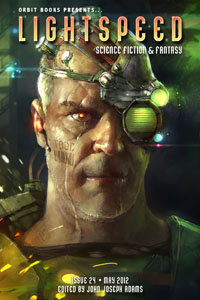
Cover of the May 2012 issue of Lightspeed MagazineAs I’m sure I’ve mentioned before, I stopped writing short fiction at the end of the last century, but last fall I took it up again. The second story I wrote, “Nightside on Callisto,” has now become my first original short fiction to reach publication since my 2000 Nebula-award winner.

This feels like a very significant milestone for me.

Look for “Nightside on Callisto” in the May issue of Lightspeed magazine, now available here as an ebook. Lightspeed is an innovative short fiction market. Please support them by purchasing a copy of the magazine!