
Linda Nagata: the blog at Hahví.net


Archive for the 'Writing' Category

Writer Process: Making a Story Shorter

Monday, July 8th, 2013

I find that each new writing project is a challenge, as I try to figure out again the process of creating a story.

Back at the end of April I set out to write a short story in one of my preexisting story worlds. I had no characters, no plot, no theme. So I did brainstorming sessions, and I tried writing bits of story just to see what might be there. Eventually I had a complete draft. I’m never quite sure how this happens, and it doesn’t always happen, but it did this time. 9900 words. Much longer than I’d hoped, but it was the first story I’d managed to finish this year, so that was something.

I sent it off for critique, got comments back that were mostly minor and full of encouragement — and then I didn’t look at the thing for a month because… I don’t know why.

When I finally started working on it again, things went in an unexpected direction. My tendency is to underwrite first drafts, so second drafts are always longer, but this story was the opposite. One comment from the beta reader was that the opening pages could be shortened, so that’s where I started and, painlessly, just by striking out excess wordage — an excess that had become suddenly obvious — the story was 500 words shorter. So I went through the entire manuscript and did a similar prune, striking out phrases and sentences. This took it down to around 9200 words.

Next I started looking for scenes to cut. Right away I found one that was clearly unnecessary. It involved a subplot/problem that contributed to a character’s difficulties without contributing in a meaningful way to the climax of the story. So I reduced it to a sentence and got rid of a few hundred words.

I found two or three places with repeated information and consolidated those.

I found a short scene that existed just so I could convey one piece of information. That information could be easily communicated in one sentence of dialog in a different scene, so that’s what I did.

I trimmed and trimmed and trimmed, one or two words at a time, and the story didn’t suffer for it. It got better. And of course not everything involved cutting words. I added them as needed to clarify character and motives, but the net word count kept dropping.

The last one hundred words were really hard, but I finally found a two-sentence paragraph that had been made irrelevant by my revisions. When that was gone, I only needed to get rid of a few more words, and then I was done. I’d brought the story down to my goal of 8000 words.

This is the first time I can remember cutting a story this hard, which just goes to show that every story is different. I’ve got at least three more that I want to write this year, along with finishing the novel. I have no idea how I’ll manage any of it, but that’s always the case.

I guess I’ll know when I get there.

Clarion West Write-a-thon:
Week 2 Progress Report

Sunday, July 7th, 2013

This year I’m participating for the first time in the Clarion West Write-a-thon, which runs from June 23 through August 2. The goal of the Write-a-thon is to raise awareness of the Clarion West Writers Workshop, along with money that will go toward funding next year’s workshop. Participating writers set their own writing goals and strive to meet them; supporters provide moral support and a donation if they can. If you’d like to donate, please visit my participant page.

Writing Goal 1: add 20,000 words to the “The Red: Trials,” my novel-in-progress.

Writing Goal 2: Have two (one remaining) short stories in solid draft. Short is a keyword. Novelettes don’t count.

Week 2 Result
Way back in May I wrote a novelette, which I then ignored for all of June and into July, but on July 4th — perhaps because I had just sent a story off to market and felt inspired — I started working on the revision. My goal was to cut it from 9900 words to 8000 words, and after working on it for all of July 4th and most of July 5th, I managed to do that, ending up with a much stronger story. But none of this effort counts toward my Clarion goals!

So…

Goal 1: This was an odd but ultimately successful week for the novel. From Sunday through Wednesday I did several brainstorming sessions, blocking out much of the action and dialog in an extremely rough and nonlinear form. Then on Friday evening and for most of Saturday I worked on making those scattered pieces coherent. The end result? I have now added 9,135 words to the manuscript out of my 20,000 word goal. 46% in two weeks, which is an excellent pace for me.

Goal 2: I spent time brainstorming a short story which may be the second short story I do for the write-a-thon. But I also blocked out the basics of a project that will likely be a novella, and which I’m very excited about — but that project will have to wait until after the write-a-thon.

Clarion West Write-a-thon:
Week 1 Progress Report

Sunday, June 30th, 2013

This year I’m participating for the first time in the Clarion West Write-a-thon, which runs from June 23 through August 2. The goal of the Write-a-thon is to raise awareness of the Clarion West Writers Workshop, along with money that will go toward funding next year’s workshop. Participating writers set their own writing goals and strive to meet them; supporters provide moral support and a donation if they can. If you’d like to donate, please visit my participant page.

Writing Goal 1: add 20,000 words to the “The Red: Trials,” my novel-in-progress.

Writing Goal 2: Have two short stories in solid draft. Short is a keyword. Novelettes don’t count.

Week 1 Result
On June 22, one day before the official start of the write-a-thon, I finished the draft of a short story. I’m bending the rules a bit, and calling that the first of the two short stories, so I’m already 50% of the way to Goal 2! Wednesday and Thursday mostly went toward polishing this story. I’m going to have one more reader look at it, but hope to send it to market Monday or Tuesday.

And the novel? Well…on June 17 I finished the first major section of the story, and then realized my outline was wildly out of date, and that I had only the fuzziest idea of what would happen next. So progress stopped while I considered everything, and contemplated, and brainstormed, and worked on other projects. That process continued through most of this past week. Then on Friday I put together a new style of outline for the next two sections of the book. This clarified things, and I was suddenly able to start writing again. Friday and Saturday combined produced 3600 new (albeit rough) words, 18% of my goal.

I have a strong suspicion I’ll be cutting a lot of wordage out of this section on second draft. This is rare for me. I tend to underwrite the first draft, not overwrite. But for now the object is to get a complete first draft, so…onward!

Clarion West Write-a-thon

Tuesday, June 11th, 2013

The number of SFF writers who’ve attended a Clarion Writers Workshop is really amazing. Sometimes it seems like “everyone” has…except of course that everyone hasn’t. Me, for example. By the time my writing reached the point where I might have qualified for Clarion, I was the mother of two young children, and there was no way I was going to leave them for six weeks–even if there had been enough money for it, which there wasn’t.

So in my mind Clarion has always been one of those things that other people do, like going to Europe, or living in a city with a literary community or something—definitely an advantage to a writing career, but not a necessity. Somehow I’ve managed without it…or have I? Maybe this has always been the missing ingredient! 🙂

At any rate, this summer I’ve decided to participate if only in an auxiliary fashion, by joining the Clarion West Write-a-thon. The goal of the Write-a-thon is to raise awareness, along with money that will go toward funding next year’s workshop. If you’d like to donate, please visit my participant page. My big goal is to force myself to stop squandering time online and instead spend more focused time writing.

I’ll be reporting on my success both here and on my participant page***. Wish me luck!

And find a list of all participants at the bottom of this page.

*** Update: I don’t think there’s a way to report progress on the participant page, so I’ll just do it here.

More On Hard SF From Ronald Zajac

Monday, June 10th, 2013

Vast by Linda NagataSeveral days ago I posted on the tired old meme that hard SF is “emotionless” writing. Since then I’ve seen this meme repeated two or three times by other writers, which is both hugely discouraging and infuriating. I strongly encourage you to go read a post by Ronald Zajac called “Can we rethink this whole “hard vs. soft” business?” Ronald’s post looks at the issue from a more historical perspective:

Clearly, if we rewrite our definitions of the genre in a way that lets readers appreciate Lem and LeGuin, Clarke and Delany, together, for their different qualities, we will be doing all of SF a favour. At the same time, perhaps, we’ll be eliminating gender divides that have no place in a forward-thinking genre.

Ronald’s post led me to a twitter debate late last night with @AthenaHelivoy, as we have different perceptions of the problems in and around so-called “hard SF.” My final conclusion to this debate is very simple: whether we like the term or not, the concept of “hard SF” exists as a marketing category, and when sweeping statements are made condemning the subgenre as “emotionless,” those statements hurt me and many other writers who are not remotely guilty of the charge. So I object, and will continue to object.

I suspect I’ll be writing more on this subject soon…

Secondary Characters & Gender

Thursday, May 23rd, 2013

Some days–most days?–my twitter feed can feel like an ongoing scolding, with writers reiterating the need for more diversity in fiction, by which they mean characters who aren’t white, male, and straight. It sometimes feels like these young ’uns don’t realize that diversity has existed in SF for a very long time.

Today all this has gotten me thinking back to my youth, and the impact a writer had on me in the early ’80s, merely by the way she used unnamed, secondary characters. I think this writer was CJ Cherryh, though it could have been Elizabeth A Lynn. Memories fade. At any rate, the technique was simple and it went like this (I’m not quoting, just making up an example.):

The cop approached with narrowed eyes, looking ready to slam someone against the pavement. “What are you doing here?” she demanded.

What’s the big deal in this made-up passage? Well, in my early ’80s mindset, at the end of the first sentence I am visualizing a big, tough-looking male cop. Then at the end of the second sentence, my assumption gets kicked head over heels. I remember that this delighted me, and it happened over and over again. I even began to think “Oh, she got me!” every time my mind insisted on visualizing what turned out to be the wrong gender, as if it was a game the author was playing with me.

What this approach did, in a very simple way, was to illustrate a society where women are neither victims nor inferior partners, but just people who fulfill diverse roles, to the surprise of no one living in that story world. And of course the approach can be reversed to show men in what we might consider non-traditional roles.

Let me reiterate, this was in the early ’80s, and these were secondary characters.

The experience really woke me up. I took the lesson to heart and I still use the technique all the time. Here’s a quote from my recent story “Through Your Eyes”:

Cops are everywhere, all of them in armor, and their communications gear seems to be working just fine. I start to look for Elliot, but one of the cops gets in my face. She’s almost as tall as I am, and she’s used a pigment to give herself spooky gray eyes that lock on mine. “ID?” she barks.

I understand the ongoing calls for more diversity in the genre, but it’s not like we haven’t been working at it for decades–and “show don’t tell” really can work wonders for getting the point across.

Writing the Near Future

Tuesday, April 30th, 2013

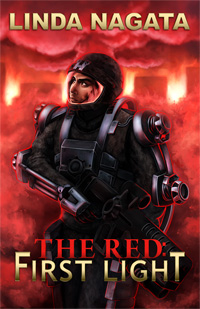
The Red: First Light by Linda NagataMy newest novel, The Red: First Light, is a very near-future military thriller that got me thinking again about the challenges of writing near-future fiction. The result is a blog post, up today over at Book View Café:

This fear of early obsolescence or “aging out” makes the near future a scary place to set a novel. What’s the lifespan of a book going to be when the associated history is changing even as the novel is written?

Click on over to BVC to read the whole thing.

Art vs. Business

Wednesday, April 24th, 2013

This is a post from last spring, but I’m going to pin it up here at the top of the blog for a few days in light of the present widespread discussion regarding those of us who like to post a list of our award-eligible work.

I started writing this post last fall, and then got distracted. I was inspired to return to it by the thoughtful comments of one my most supportive readers, addressing the relationship between business and art. I’ll be blunt and say that throughout my career I have seen money as a measure of my success and, having never made much money, I’ve never seen myself as a success. I’ve been criticized for this. More than once I’ve been assured that “success” in writing can be defined in many other ways, that I shouldn’t beat myself up over it, that my art will live on. But I remain skeptical. (more…)

New Story — “Out In The Dark”

Wednesday, April 3rd, 2013

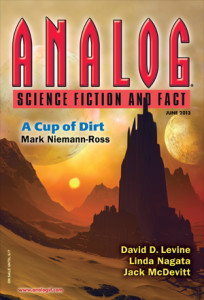
Analog Science Fiction & Fact, June 2013The June issue of Analog is now available. It includes my Nanotech Succession short story “Out In The Dark”–the second story featuring Zeke Choy.

The original story in this sequence was “Nahiku West,” first published in the October 2012 issue of Analog and now available in the ebook Two Stories. The sequence explores the early life of Zeke Choy, a minor character in my novel The Bohr Maker.

The ebook version of Analog is available at Amazon and Barnes & Noble.

Analog is also available in a print version.

Kawaii-Kon: Writer Links

Saturday, March 16th, 2013

On March 15 I gave a presentation at Kawaii-Kon 2013, Honolulu’s annual anime and cosplay convention. My topic: From Initial Idea to Printed Book: One Path to Writing and Publishing a Sci-Fi Novel.

Rather wide-ranging, wasn’t it?

As a follow up, I’m publishing a list of links that might be helpful to someone getting started in writing and publishing. As with everything, use your own judgment and your mileage may vary. Your career is in your own hands. Take care of it.

Advice for writers & indie publishers:
Dean Wesley Smith
Kristine Kathryn Rusch
John Scalzi’s “Whatever”
Writer Beware (general info)
Writer Beware Blog
The Passive Voice
David Gaughran

Short story market listings
Duotrope — nominal fee
Ralan.com

Professional Freelance Editors I’ve used
Judith Tarr
Laura Anne Gilman

Example of a flat-rate book prep company
Lucky Bat Books (I have not done business with them, but have seen them recommended.)

Because you need to know
Striking a Pose: Women & Fantasy Covers
Pose-off, round 1
Pose-off with John Scalzi

Ebook prep
Sigil — code/edit your ebook
Calibre — convert your epub file to mobi

Where to get ISBNs (USA only)
Bowker

Where to sell your ebooks
Amazon
Barnes and Noble
Kobo Books
Smashwords (I don’t sell here, but a lot of writers do.)

Print-on-demand companies
Lightning Source (an Ingram company)
Createspace (an Amazon company)