Linda Nagata: the blog at Hahví.net


Archive for the 'Writing' Category

“Through Your Eyes”

Tuesday, February 26th, 2013

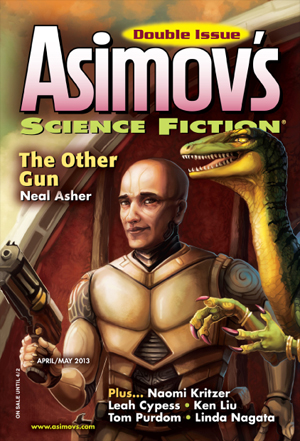
ASF_Apr-May2013webThis is a follow-up to my post from yesterday. My newest short story, “Through Your Eyes,” is now out in the April/May double issue of Asimov’s. Find the ebook edition at Amazon and Barnes & Noble. Print editions should be on the way.

When I first started writing “Through Your Eyes,” it was meant as a stand-alone short story, but by the time it was done, I felt a novel coming on. The story’s protagonist wasn’t nearly done with his time on-stage, so I took the world created in “Through Your Eyes,” combined it with an idea brewing in the back of my mind that was originally expressed in my Lightspeed Magazine story “Nightside On Callisto” and came up with the near-future novel: The Red: First Light, due out in exactly two weeks.

[Two weeks?? OMG. Copyedit and book cover are on their way, but not done yet. I’ll need to process copyedits, lay out the ebook again (did this once for the eARC, which probably should have gone out to a lot more readers, *sigh*), lay out the print book, upload to vendor sites, send to reviewers . . . ah, indie publishing. But who am I kidding? Indie publishing is fun.]

Anyway, “Through Your Eyes” is a precursor story to The Red: First Light. At first blush they may seem to be wildly different in theme, but sometimes life take us where we least expect to go.

To be notified when the novel is out, please sign up for my very occasional newsletter using the “New Book Alert” form in the right sidebar.

Short Story, First Sighting

Monday, February 25th, 2013

I’m not sure if it’s out yet, but soon…

ASF_Apr-May2013web

Creative Oxygen

Wednesday, February 6th, 2013

Brainstorming Story Ideas

It’s not unusual to hear a speculative fiction writer say something like “I have so many story ideas I could never use them all.”

That writer is not me. For me, it’s more like “I have only a few ideas, and I use them all.”

I don’t have a library of story ideas floating around in my head. At best, I might have vague concepts, or some intentionality, but I have to hunt down the actual story idea. For example, “Nightside on Callisto” exists because I wanted to write a story set among the moons of Jupiter. No other reason. I had no character, no story background, no conflict, no goal. I just wanted to write a story in that setting, so I did some research, narrowed down the setting to Callisto, and started brainstorming.

Fast forward to last November: nearly six months had passed since I’d last written a short story so, to generate more story ideas, I decided to initiate a new writing exercise. I made a folder on my laptop called “Creative Oxygen.” Then I opened up a Word doc, saved it with the day’s date (20121109.docx for example, if proper sort order is one of your obsessions), and started writing.

The goal is to come up with a story synopsis — any story at all, no genre limitations, but figure out all the pieces: character, setting, story problem, beginning, middle, end.

The rule is non-stop writing sessions of ten minutes, fifteen minutes, maybe even twenty minutes. It’s not quite Write-or-Die, but very similar. Being obsessive, I actually set the alarm on my phone to go off after ten minutes. If I feel like continuing after the alarm, of course I do. If I want to take a break because I’m not getting anywhere, I do that too, comforting myself with the thought that at least I’m trying.

I use the “directed brainstorming” method, asking and answering questions, making statements and requests, evaluating what I’ve come up with, reiterating it in a clearer form, and asking myself over and over again, “So where’s the story? Is this a story?” And if nothing is coming, I just start typing in random things.

Hey, it works for me. Not all the time, of course, but often enough that I’ve used directed-brainstorming almost from the beginning of my writing career, usually to figure out the next chapter.

So anyway, I managed to do the creative oxygen exercise for all of three days in November, but those three days produced two story synopses. Then I went back to work on the novel and forgot about creative oxygen…until the end of the year when I was challenged to write one more story before we moved into 2013. So I pulled out one of the two story ideas — the one with the most solid, detailed synopsis — and wrote it. That turned into “Halfway Home,” which just sold to Nightmare Magazine.

The wild-eyed ideal would be to brainstorm a story synopsis every day — although a synopsis every week is probably more reasonable – but at any rate, to keep hammering at it, knowing you don’t have to actually write every story you come up with. It’s just that by pushing yourself and practicing creativity your ideas are likely to get better and better, until you come up with a synopsis that simply demands to be written into a story.

It’s a theory anyway. If you’re looking to generate ideas and develop them into stories, it might be worth a try.

First Short Story Sale of 2013

Tuesday, February 5th, 2013

At the end of 2012, I posted an assessment of my writing goals for the year. I originally noted that I’d written only three short stories instead of the four I’d hoped to do. This is what happened:

3. Finish four pieces of short fiction.

Fail! I finished only three short stories, though I did get to sell all three to good markets.

Update, December 31: In the comments one of my most supportive readers, Willy B, took me to task for calling this a fail, and then pointed out I had four days to write another short story … so I did. I finished a solid draft last night, and even though I still have to read it over and (I’m sure) fix it up, it IS a finished story, so I’m switching this from “Fail” to “Done.” Thanks, Willy B!

I got some feedback on the story, titled “Halfway Home,” early in the month, and then shelved it for three weeks while frantically revising the forthcoming novel. But I finally sat down to work on the revision, and yesterday I sold “Halfway Home” — 🙂 — to editor John Joseph Adams for new online publication Nightmare Magazine by Creeping Hemlock Press.

Now, if you’d asked me last week if I write horror, I would have said “No!” That stuff is scary. I still wouldn’t call myself a horror writer. In my mind, “Halfway Home” is a dark fantasy with a here-and-now setting, or possibly it’s magic realism, or…well, it’s a short story, anyway. I’ll leave it to y’all to figure out the genre.

And an extra “Thank you!” to Willy B for encouraging me to write it!

Finished Printing At Midnight

Thursday, January 24th, 2013

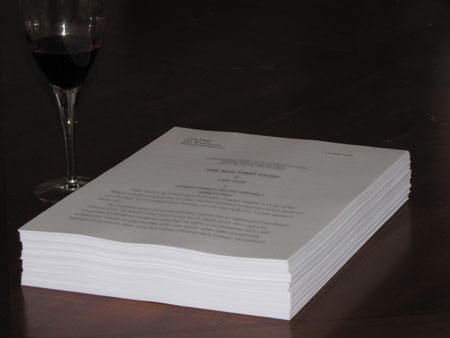
It’s been a year since I printed out the manuscript for a new novel. It’s been a lot longer than that since I printed out the manuscript for a new science fiction novel, but here it is, all 394 pages of it.

the manuscript


I get to read this over the next few days while doing final revisions. Given the additional work — and the 9,000(!) additional words — that have gone into it over the last two-and-a-half weeks, I’m desperately hoping it still hangs together. For scheduling reasons, I need it to be “done” on Monday.

Wish me luck. Wish me confidence while you’re at it, because confidence is something that tends to wax and wane on projects like this. I loved this story a month ago. I hope to find I still do.

Writing Goals For 2013

Tuesday, January 1st, 2013

In 2011 I started posting a list of writing goals for the ensuing year, and at the end of the year I started doing an assessment of what goals I’d met, or failed to meet. Here’s my assessment of 2012, published a few days ago.

I’ve come to like this goal-setting routine. It helps me stay focused on doing the work, but diversified in the kind of work I’m doing. It also lets me realize that I really am accomplishing things, because when viewed on a day-by-day basis, progress can seem painfully slow.

In the context of these posts, a goal is defined as something I can control and complete through my own effort. This is opposed to a dream. Dreams depend on the cooperation of others, or of fate. Dreams are out of my control. I might dream of being on a bestseller list, or winning an award, or getting a movie deal, but those aren’t goals, so you won’t see anything like that listed here.

So with that understanding, here are my writing goals for 2012:

1. In March, publish my first adult science fiction novel in TEN YEARS!! Yeah. I’m excited. You’ll be hearing a lot more about this later in January.

2. Write the sequel to the novel referenced above. Bonus points: publish it before the end of the year. Can I do it? Time will tell.

3. Write and finish one additional Zeke Choy short story. Bonus points: finish two more stories.

(You’ll notice how I frame these goals so that they’re relatively easy to meet, while adding a degree of difficulty through the bonus points. This way I have a good chance to succeed, even if I don’t succeed stupendously. Clever, huh?)

4. Write and finish three other short stories.

5. Write and finish a completed draft of a third Puzzle Lands book…

(Oh boy! I hesitate to include #5 because I don’t know if I can do it, or even if it’s worth doing given the low sales this series has had, but I love these quirky books, and I’d really like to continue with them.)

And that’s enough commitment for me! I’ll check back here at the end of the year and assess how I did.

What are your goals for 2013?

Writing Goals for 2012: The Assessment

Thursday, December 27th, 2012

At the beginning of the year I published my writing goals for 2012. It’s time to assess how I did:

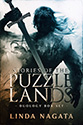
1. Re-publish my Puzzle Lands novel The Dread Hammer with a new cover, and publish the second book in the series, Hepen the Watcher, in ebook and print versions.

Done! The Dread Hammer was re-published in February, and Hepen the Watcher was published in March. My flirtation with the use of a pen name is over for now, and I’m glad to have both books out under my own name. I see these two fantasy novels as a quirky and interesting addition to my science fiction list.

2. Finish two original novels.

Technically, done! At least if “finished” refers to completed drafts. But there are caveats.

When I wrote this goal, I was 20,000 words into a new novel. Let’s call that Novel A. Things were not going well, and in March I took what I had and converted it from third person to first person point of view. Things went better after that, and by April 30 I had a first draft. I set it aside for a while, and then toward the end of May I did some edits…and after that I abandoned it.

Novel A is problematical. It reads fine, and it’s a decent story, but on reflection I think it’s just not a “Linda Nagata” story. It doesn’t have any edgy complexity to it. Ironically, I suspect for that very reason this could be my most popular work, but probably not with my usual readers. Then again, what do I know? At this point, Novel A needs a few background scenes, and then an appointment with an editor. This would be easy enough to do. What’s really holding me back is that this is not a stand-alone book. It needs a sequel — more likely two — and right now I’m not enthused about writing those. For the first time in my career I am flirting with the idea of persuading a co-writer to work with me — though I’m not at all sure that would be a good idea either.

And Novel B? Here’s how I feel about Novel B: 😀

Novel B came out of nowhere. It’s not a book I planned to write. It wasn’t anywhere in my goals for the year, but it demanded to be written. I started on it in early June, sent a draft to beta readers in October, applied their suggestions, and will be sending the nearly final draft to a professional editor in just a few days for a last look-over. Novel B will be published in March.

So, again: 😀

3. Finish four pieces of short fiction.

Fail! I finished only three short stories, though I did get to sell all three to good markets.

Update, December 31: In the comments one of my most supportive readers, Willy B, took me to task for calling this a fail, and then pointed out I had four days to write another short story … so I did. I finished a solid draft last night, and even though I still have to read it over and (I’m sure) fix it up, it IS a finished story, so I’m switching this from “Fail” to “Done.” Thanks, Willy B!

4. Consult with a professional editor on the potential and direction of my long-evolving novel The Wild, and either bring it to fruition or put it away permanently.

Done! I did consult with a professional editor early in the year on this many-times-rewritten fantasy novel, showing her the opening chapters of the last complete draft, as well as the new opening, written in a new style, that I’d done in 2011. She agreed that the new opening was better and more active…but you know what? I’ve finally moved on. I don’t want to rewrite the book again, not at this time in my life. What I’ve decided to do instead is to serialize the older version here on my blog — one chapter every Friday, beginning on January 4.

Bonus Points:
These didn’t happen. In last year’s goals I talked about possibly starting a third volume of Stories of the Puzzle Lands, as well as contemplating another book in The Nanotech Succession. On the plus side, I did make some vague notes on each, and I even started plotting a sequel to my novel Memory, but no bonus points for me this year!

How did you do this year? Did you meet your goals? Or exceed them?

Writing a Book Because It Demands to be Written

Thursday, December 20th, 2012

In January I’ll have more to say on my upcoming science fiction novel, but in the meantime, I highly recommend this post by Kristine Kathryn Rusch, Where Art Meets Commerce. It says a lot about the emotional process of writing a book that demands to be written, the market be damned. Back in September I wrote a post — still unpublished — with similar sentiments. I’ll get that one out in January, but in the meantime, here are a couple of highlights from Kris:

In her creative office, every writer should feel like she’s on a high wire twenty stories off the ground over a major highway with no net to catch her if she falls. She should worry that this book is beyond her skill level, that she might not know enough to write this one, that she might not be good enough to pull this off.

At the same time, she should be having fun—but an adrenalin-junkie kind of fun, an I-can’t-believe-I’m-up-here-trying-this kinda of fun.

Statistics and underlines and social media be damned. The sales force should be having fits if they hear about what the writer is trying to do while the book’s in progress. Because it should go against that “what everyone expects” on some level or another.

Yep. That pretty much describes what went on in the process of writing this book — not because the story itself is particularly difficult, but because the near-future setting demanded a degree of realism that I had to carefully construct since I did not have the right background and experience to draw on — while many other people do. As Kris says in the preceding quote, I had to face the doubt that I “might not know enough to write this one.”

But you know what? I love this book. Naturally enough, I hope other people do too, but regardless, I’m glad I wrote it. At this point, the beta reader comments have been processed. At the turn of the year, the manuscript will go to an editor for one last pass, and then it will be “done.”

Kris says:

Commerce comes later, after the art is finished. Then you must sell what you’ve done. As it is. And take the risk that the audience might not like it.

The risk is real, believe me, and it’s scary, but that’s the way the system works. Finger crossed!

Reader vs. Author Gender

Wednesday, December 19th, 2012

There is a meme that shows up now and then in my twitter stream (today for example) and it goes something like this: women will read books regardless if they are written by men or by women, but men tend to read books only by men.

My experience is the opposite.

My very rough estimate is that only 20% of my readers are women. This is based on such things as reader emails received over the years, “Likes” on my facebook page, people who comment on my blog, people on twitter who are interested in my work, and statistics on a recent sale of a story of mine republished as an ebook.

All of my readers are fantastic. Men and women both are incredibly supportive and I would be nothing without them…but more and more I can’t help wondering why more women don’t read my work.

Yes, it’s true that most of my work has been hard science fiction – generally assumed to be a genre dominated by male readers and I don’t disagree, but still – why don’t more women read my work? Is it simply the label “hard SF”? But don’t women read “everything,” regardless?

In the last couple of years I’ve put out two “scoundrel lit” fantasy novels, darkly humorous and very concerned with male/female relationships. So far as I can tell, mostly men have read them.

I don’t think I write for any particular gender. I write the books I want to read. I often write from the male point of view, but probably just as often I write from the female point of view. I like to think there is a great deal of emotion in my stories, and that there are meaningful relationships.

So why don’t more women read my books? What is it in general that determines if men or women will read a book?

I’d love to hear your thoughts, men and women both.

My Mind is Blown

Wednesday, December 19th, 2012

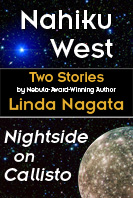
Nahiku West & Nightside On Callisto by Linda NagataIt’s been a truly gratifying year on the short fiction front. If you’ve been following this blog, you know I’ve had some short fiction sales in 2012 — five in fact. Three of those stories have been published; two are pending. Now comes the season when the contents of the best-of-the-year anthologies are announced — and I’m astonished to report that two of my stories have been included, one of them multiple times.

“Nightside On Callisto,” originally published by Lightspeed Magazine, will be in Gardner Dozois’ The Year’s Best Science Fiction, Thirtieth Annual Collection, to be released on July 23, 2013.

“Nahiku West” will be in Jonathan Strahan’s The Best Science Fiction and Fantasy of the Year Volume Seven, The Year’s Top Ten Tales of Science Fiction 5 an audiobook compilation edited by Allan Kaster, and in Rich Horton’s The Year’s Best Science Fiction and Fantasy, 2013 Edition (table of contents not yet posted).

I’ve never before had any of my stories in “best of” editions so, yeah, my mind is blown.

Both stories are currently available together, in ebook form, from the usual vendors:
Book View Café (worldwide)
Amazon.com USA
Amazon UK
Kobo Books (international)
Barnes & Noble