Linda Nagata: the blog at Hahví.net


Archive for the 'Writing' Category

So Nice…

Friday, March 16th, 2012

Mostly, I’m a nice person. Odds are excellent that I won’t cheat you, sabotage you, or stab you in the back. I’m not very good at holding grudges either. Frankly, grudges, old hates, enemies, that sort of thing, just take up so much emotional energy, why bother? Unfortunately, this attitude sometimes gets in the way of my writing. While I find that it’s not all that hard to destroy worlds in the course of a story, allowing my characters to behave badly, or inflicting true tragedy on them — that takes work!

In one of my early novels I reached a point, maybe two-thirds through, when I just couldn’t write anymore. This went on for some time until I realized the problem: I was conflicted about the fate of a beloved character. The plot called for one ending, while my heart longed for another. Eventually, I skipped ahead and wrote the necessary ending. After fate was set, finishing the draft was easy.

My tendency toward “nice” also gets in the way of developing secondary characters — I do so like reasonable, thoughtful people! In the current work-in-progress I was developing a secondary character who was nice: logical, reasonable, considerate—but I wasn’t making any progress with the section and finally it occurred to me that maybe nice wasn’t what I needed. I can assure you the character isn’t nearly so nice now, and I’ve been able to move on to the next part of the story.

Probably my most intense conflict with “nice” came about in the writing of my just-released novel Hepen The Watcher, a sequel to The Dread Hammer. Both books follow the adventures and tribulations of an antihero protagonist named Smoke.
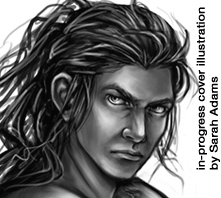
Like many of us, I love antiheroes. They don’t worry at all about “nice,” but deep down they’re decent respectable people. Sort of. At least occasionally. Well, anyway, in Hepen The Watcher I reached a point where I couldn’t go on. (Yes, we’ve got a theme going here. For me, lack of progress generally means I’m trying to progress in the wrong direction.) This time around, I knew exactly what the problem was: Smoke had to deal with the fate of a secondary character. He could (a) show some extreme character development and be nice; or he could (b) show a bit of character development by feeling a rare twinge of guilt for what he was doing.

My natural inclination was to go with (a). But as I thought about it, I reminded myself that it wasn’t a question of what I would do, it was a question of what Smoke would do…and in the end I opted for (b). Writing that scene was wrenching, for me, the nice writer. I still cringe a little when I think about it—but sometimes it takes a ruthless character to insist on the necessary ruthless course of action.
One More to Lightspeed

Thursday, March 1st, 2012

I’m very pleased to announce the sale of a second short story to Lightspeed Magazine. It’s called “A Moment Before It Struck” and is a prequel story set in the world of my Stories of the Puzzle Lands novels.

One thing that particularly pleases me about this story is that it’s only 4,300 words! Yes, I know that sounds shallow and trivial, but my typical length for short fiction runs between 7,000 and 9,500 words, so it’s a personal victory to come up with a solid story at a much shorter length.

The other aspect of this story that I especially like is its structure, which is more formal and less linear than what I generally do. It’s very gratifying to try a new approach and have it work out.

The publication date for “A Moment Before It Struck” hasn’t been set yet, but my first Lightspeed story, “Nightside On Callisto” will be in the May issue.

New Tricks

Friday, February 24th, 2012

The work-in-progress has been sullen and stubborn, progressing in short, rare bursts. So this week I skipped ahead and started writing scattered scenes that define and clarify the second half of the story. I don’t think I’ve ever worked this way before**, but the method is working for me right now, so I’m going with it.

** Way back when I was writing Vast I got seriously stuck maybe two-thirds through. That time I skipped ahead and wrote the end, then went back and finished it off in a linear fashion.

In The Tide Now a Free Short Story

Saturday, February 18th, 2012

In The Tide is an older story of mine, and the first short that I put out in ebook form. The idea was to sell it for the minimum price allowed at Amazon: 99-cents, which would earn me 35%, or 35-cents on every sale. I note that John Locke managed to get rich on that same margin! Unfortunately, I can’t yet say the same.

I would have priced the story at “free” if it were an easy thing to do. It’s not. Various backdoor machinations are required to accomplish it, and I don’t want to play. So I’ve taken the story down from Amazon and am now offering it free on my website, in both epub and mobi versions. The package includes a five-chapter sample from my novel The Bohr Maker. So if you’ve never read a short story of mine, or want an easy, no-commitment way to sample The Bohr Maker, please snag a copy. And if you know anyone else who might be interested, I urge you, please, PLEASE send them over to MythicIsland.com.

Find the link to the free story in the upper right of the landing page, in that box that says “Free Fiction” 😉

At Lightspeed

Sunday, February 5th, 2012

I’m very pleased to announce that I’ve made another short story sale, my second since I started writing short fiction again last fall. This one, titled Nightside on Callisto, has gone to Lightspeed Magazine, and is tentatively scheduled for the May issue.

This sale was a completely new experience for me. I’m used to waiting weeks for a response on a story, but this round took roughly 22 hours from submission to acceptance, thanks to editor John Joseph Adams’ policy of acting fast on all submissions. That’s a policy I could easily get used to!

Writing Expertise, aka Practical Meerkat’s 52 Bits of Useful Info for Young (and Old) Writers

Friday, February 3rd, 2012

Like most writers, it took me a long time and a lot of rejections before my first novel sold. This was a good thing. I am so very, very glad that the first book an agent ever took to market for me never found a buyer. In these modern days I suppose I would have gone ahead and published it myself—and then I would be faced with the fact of its existence ever after. We hate to admit it, but often, a rejection is a good thing.

The second novel of mine that ever went to market was an early version of The Bohr Maker. It was turned down many times, and with the most painfully “almost but not quite” rejections I ever hope to see.

For some reason I was flipping through the file a few months ago and discovered this gem of a rejection, addressed to my agent and later forwarded to me:

“This is the worst situation I can think of: really liking a book, and having to pass on it…The author has a very complicated vision working here, and I’m not sure that it works. There are so many threads, and so many changing viewpoints, that it becomes difficult to see where it all comes together, or how – or why…”

This was written by Laura Anne Gilman, who was then an editor at Berkley—and Laura Anne knows of what she speaks! Because of notes like this one I finally pulled the manuscript from the market and rewrote it from beginning to end. When it went out into the world again, it sold to the first publisher that saw it, and went on to win the Locus award for best first novel.

But it never would have been rewritten if I didn’t have experts in the field like Laura Anne telling me in very clear terms that something was lacking and it needed to be rewritten.

Expert advice is a great thing to have, even if it’s painful in the moment.

Laura Anne and I recently crossed paths again at Book View Café, and shortly after that I discovered that she works as a freelance editor. This past fall I hired her to edit my soon-to-be-released novel Hepen the Watcher. She gave me a great critique, asking me to explain things, fill in holes, and take advantage of dramatic opportunities that I’d missed on my own, and the book is much stronger for it.

Over the past year, Laura Anne has been writing a weekly post at Book View Café’s blog on a wide range of practical aspects of writing and publishing. Those posts are now available in ebook form under the title Practical Meerkat’s 52 Bits of Useful Info for Young (and Old) Writers. If you’re at all interested in writing professionally, I urge you to take advantage of Laura Anne Gilman’s writing and publishing expertise by picking up a copy at Book View Café. I’ve got mine! At only $2.99, how can you go wrong?

Short Fiction Sale!

Thursday, January 19th, 2012

The first short fiction I’ve written in years has sold to Analog Science Fiction & Fact! (Yes, there is a big grin on my face.)

I wrote the story last September. This was a milestone for me, because the last original story of less-than-novel length that I ever wrote was published in 2000–so it had been a while.

The new story was a little bit too long to be called a short story–at 8,900 words it’s technically a novelette, but fortunately, Analog is okay with that length, and Analog was also the home of my first four pro sales, way back when, so I decided to send it there first. Just after New Year’s the very welcome news arrived that editor Stanley Schmidt is buying the story.

No publication date yet, but I’ll post when I know.

If you’d like to read more about the story and the process of writing it, check out this blog post.

More!

Wednesday, January 11th, 2012

Over on twitter, Alma Alexander asks “What are the words that you’d banish from the Oxford English Dictionary?” The links lead on to an article on words that people would like to see dropped from English.

Personally though, I want more words, not less.

Every now and then when I’m writing I come to a point where I need a particular word. I know exactly the definition of that word. The only problem is, that word, so far as I know, doesn’t exist. So I have to write my way around it.

I think I’ll start keeping a list of those definitions. It will be like Jeopardy for dictionaries. I provide the definition, the dictionary produces for me a shiny new word, known to everyone, that perfectly communicates the nuance I’m striving for.

If only.

Cross-Blogging At Book View Café

Monday, January 9th, 2012

Book View Café has a very active blog, with contributions from many members of the co-op. Back in November I agreed to take on a weekly slot, posting something every Wednesday. The idea was that I would get to recycle things from this blog, and at the same time get my name out there at least a little more prominently on a busy website. At that point I was blogging fairly often anyway, so I thought, Why not?

Things went smoothly at first. I had some posts that worked out well enough for BVC’s very diverse blog, but it wasn’t all that long before those ripe and ready posts were used up. I realized that a lot of what I have here is an exploration of indie publishing seen through my own direct experience, and most of it doesn’t feel general enough for BVC’s blog.

Now, around Friday every week, I start thinking, I need to come up with something for BVC. Then on Sunday, Google Calendar emails me a warning, Do BVC blog post.

By Monday morning I’m either desperately combing through past posts here or, more and more often, trying to come up with some topic of “general interest.”

I write down potential blog topics all the time, but when I really consider them, a lot don’t hold up. Either I don’t have any coherent thoughts on the subject, or it would entail research that I don’t have time to do, or it winds up being a little too personal, or to do the topic justice, I would have to include spoilers to books and movies that I like.

On the other hand, having to meet a weekly deadline for the first time in my life is leading me to exercise a level of creativity I never would have otherwise. So if you start seeing odd little posts like the preceding one “Born to Wander,” the reason for it is that I need something up in my slot at Book View Café, and if I’m going to the trouble of writing it, I might as well post it here too.

If you’ve got suggestions on blog topics you’d like to see me try, please do let me know.

Why I Didn’t Try to Sell Hepen the Watcher to Traditional Publishing

Thursday, January 5th, 2012

Last spring (for those who haven’t been following this blog) I self-published a short, quirky fantasy novel called The Dread Hammer, putting it out in both ebook and print versions. I had three main reasons for self-pubbing: the book didn’t slot well into any typical subgenre category, it was short for a traditionally published novel, and it had been so long since I’d had anything original published that I didn’t want to wait years to get this book out, which would have been the case if I’d taken it to the traditional market.

Sales were slow, and in hindsight I think I made a mistake publishing it under a pen name. (That mistake will be corrected shortly, when I re-issue the book under my own name.) At any rate, by August I was finishing up the first draft of a sequel, titled Hepen the Watcher, just as talk in the indie publishing community was shifting to the idea of a hybrid career that takes advantage of both traditional and indie publishing. I love indie publishing, but I’m willing to try different approaches. So I started thinking seriously about taking both The Dread Hammer and Hepen the Watcher to market.

In the end I decided against it. The two main reasons: Everything I’ve read and heard indicates that most advances are very low, and that contract terms are often horrible.

I write novels, it’s my nature to tell myself stories, and here’s the story I told myself on what would happen if I took these two books to market:

Months will pass before you hear anything. Maybe you will eventually get requests for the complete manuscripts. If so, more months will pass before you get a decision. Maybe you’ll get an offer. It will be low. Maybe you’ll consider it. Then the contract will come. It will have terms you cannot accept. Months of negotiations will ensue. In the end, neither you nor the publisher can agree on terms. You will walk away, and publish the book yourself.

During this time I knew I’d be feeling frustrated, angry, and resentful. I won’t argue if that’s appropriate; I just know it’s true. I like being in control of my books, and I’m not in control if I’m waiting desperately on a publisher to tell me if I have a future. As I told my husband, Why should I make myself miserable?

The other blow against taking these two books to market is my past experience that books do not earn out. This isn’t true for all writers at all times of course, but it’s been my experience, and it’s the same for many, many other traditionally published writers. Publishers are in the business of selling books, and sometimes they manage spectacularly, but quite often, they don’t. So I would have to be okay with giving up these books, possibly in perpetuity, for whatever small advance I might be offered. In contrast, if I published them myself there would be no advance, but if my work ever “hits” with readers, the potential upside is big. This is important to me. I’m far less concerned with having an “immediate” advance in my pocket (and “immediate” is a relative term in publishing), than with having a steady income over the long term, and the only way I see to have that steady income is to keep writing and keep control over my work, and hope that I eventually “hit.”

And that’s why neither book has gone to the traditional market. At this point, indie publishing looks like the best option to me.

I was feeling good about my choice, but I’m feeling even better now. Kris Rusch has a blog post just up titled “Writers: Will Work For Cheap” that confirms my rationale for staying indie, at least for now. Of course it makes perfect sense that my thought processes reflect what Kris has to say in her business blog, given that I’m an avid reader. (Yes, I’ve donated, and yes, I’ve bought The Freelancers Survival Guide.) I find The Business Rusch to be one of the most useful sites on the web for writers interested in a career. If you’re a writer and you’re not reading it . . . well, why not?