Linda Nagata: the blog at Hahví.net


Archive for the 'Writing' Category

True Hemingway

Thursday, August 4th, 2011

Someone in my twitter stream–I don’t know who–posted this Ernest Hemingway quote this morning…

“All you have to do is write one true sentence. Write the truest sentence that you know.”

…and my first gut response was– “Shit.” That’s the truest sentence I know. At which point I literally laughed out loud, realizing I may have ventured a little too far toward cynical.

For some reason this incident has remained stuck in my head all day, so to exorcise it, I’ll offer instead an even more perfect sentence, not written by me, but by Hemingway himself:

“Isn’t it pretty to think so.”

Eighty Days. . .

Tuesday, July 19th, 2011

…and I’m calling this a completed draft.

Specifically, a completed first draft of Hepen the Watcher, the sequel to The Dread Hammer, which I started writing on May 1st.

Right now the draft is an untidy, 74,000-word mess, but it’s a story, with a beginning, a tumultuous middle, and a pretty decent end. There’s a lot to do in round 2, but not tonight.

What’s in a Name?

Tuesday, July 19th, 2011

I wrote the original version of the following post last winter and then decided not to publish it because, frankly, I don’t like to deal with questions surrounding the issue of women writing science fiction. Then, a couple months ago, a sudden, viral, Internet conversation started on this subject. A lot of writers in the hard science fiction field have since commented. So, emulating the group, I guess I’ll add my experiences to the conversation before the subject dies away entirely. This is an updated version of last winter’s post, describing the trajectory of my career as a woman writing hard science fiction in the nineties and early 2000s.

I haven’t done a lot of interviews in my career, but the question I least like to answer goes something like this: Do you feel it’s hurt your career being a woman writing hard science fiction?

I’m sure I get this deer-in-the-headlights expression before breaking eye contact and muttering something self-contradictory. Because really, how does one answer a question like that?

To say, “Yes, I think it has hurt my career” sounds like whining and finger pointing without any evidence to back it up, and risks offending the men who are the core readers of the genre.

To say, “No, I’m sure that’s not it” would be untruthful and would imply that my books didn’t sell because they were bad. My hard SF books may not be for everyone, but I don’t believe they’re bad.

So in my own mind I mostly ignored the question. Some writers succeed, others don’t. That’s just the way it is.

But of course the only true answer is that I can’t know. I can’t go back and change my name to Greg or David or Alastair and re-publish the books and see how things go.

But oh my how I wish I could.

Here’s the thing:

I had a lot of good breaks. (I had a lot of really bad breaks too, but we won’t go there.) I had cover quotes and great support from Greg Bear, Gregory Benford, and David Brin. I had some really great reviews. For the early books, I had great covers. I won awards. My books were offered by the Science Fiction Book Club. Some were on the Locus Recommended list. I had fantastic support from people like Charles N. Brown. Wil McCarthy was my good buddy.

Men in the hard SF field were friendly and open to my work, to the point I can say that I never met a hard SF writer who was not supportive of me, a woman, writing what I wrote. Other women will claim a different experience. I only give you mine.

And outside the pro circle? I would guess that 80+ percent of the fan mail I’ve ever received has been from men. More men read hard SF than women, so I guess it’s only natural.

What I’m trying to say is that in my personal, face-to-face (or nearly so) experiences, it didn’t feel like being a woman was any sort of disadvantage. If anything, it made me a bit more unique and interesting.

But then comes the dissonance.

“The dissonance” is my personal term for the difference between what other writers and some avid fans will say about my work (really nice things) and the value the market (and agents, publishers, and editors) have placed on my work. It’s a pretty extreme difference.

Despite all the advantages listed above, my books never sold in numbers anywhere close to what could support a writing career, and the Bantam books went out of print with impressive speed. Honestly, there didn’t seem to be much point to it all. I mean, the Nanotech Succession books together, all four volumes, brought in a total of $27,500 in advance money. I recall The Bohr Maker brought in a couple tiny royalty checks thereafter, in the hundred dollar range, and that was it. The other three books never earned out.

Meanwhile, if my memory serves me, Locus was reporting eye-popping advances for, well, other newish hard SF writers who were not me.

So why was I doing this writing thing again? Why was I knocking myself out to create another book that just a few people would read? As much as I appreciated the fans that I had, there was a mortgage to be paid!

So around 2000 I packed my metaphorical bags and moved out of the writing world—this despite that one of my best books, Memory, was still pending from Tor. I already knew it was doomed and I was right. Four years after publication it had sold only a bit more than 10,000 copies.

Did I crash and burn because I was a woman? Or was it just bad luck, a failure of nerve, giving up too soon, not appearing in enough venues, living on a remote island isolated from the writing community? Who knows? Not me.

Now I’ve gotten back into the writing game. Since November, I’ve republished all the SF novels as ebooks. They’re selling slowly. I check sales figures often, so it’s easy for me to tell when a fan from the old days discovers the books, because they’ll buy one each of the Nanotech Succession, and sometimes all six novels in a single shot. (And may I say, thank you! I want you to know how truly gratifying and encouraging that is.)

That said, seven months after they came out as ebooks, my novels are not selling anywhere near the scale enjoyed by other, well, you know, male writers whose backlist is similarly priced. To be fair, I’ve been out of the field for a long time, and these other writers haven’t. So there are no hard conclusions to be found here. The one fact I do have is the knowledge that now, in 2011, women writing original hard science fiction are choosing to use gender-obscuring pen names.

Anyone reading this blog isn’t going to care if my name is Linda or Larry. But the question remains: Does Linda or Larry matter out there in the scary real world where buyers peruse long lines of titles at Amazon, and employ an unknowable process of elimination to narrow down their selections?

I have no way to know.

But if I had it to do over again, then yes, I would change my name.

Binge Writing

Monday, July 18th, 2011

Writing binges–twelve or thirteen hours in a row of working on a manuscript–are rare for me. I don’t usually have that level of endurance and, well, people in your family expect you to, you know, pay attention to them.

But I had one of those days yesterday. The husband was in Honolulu and the son brought home Subway sandwiches, so I was able to work from maybe 1pm to 1:30am on the novel-in-progress. (Of course, I’m in that lucky situation where I don’t have to get up early for a job or to take care of small kids.) Anyway, it was a lot of fun, and I’m much, much closer to the end of this draft.

Speaking of which, I’d better get back to work on it.

Plot Threads

Friday, June 24th, 2011

The work-in-progress has reached the point where I’m holding quite a few plot threads in my metaphorical hands while trying to decide just how to weave them together as I approach the story’s climax. Each plot thread needs to make sense all the way up to the big event at the end. Each character needs to have something logical, meaningful, and interesting to do. It all can’t be too obvious and it can’t happen too easily. At the same time I must resist introducing anymore complexities or characters than those I’m already dealing with. The goal is to wind it up, not wind it out through more and more pages.

Over the last couple days I’ve been writing bits and pieces of narrative and dialog, trying to figure out what everyone’s doing, and how all their little events, conflicts, needs, and desires fit together. I’m getting closer, but this would be a really good time for my subconscious to present me with an “Ah ha!” moment that sends he on a long, exhausting writing binge.

Then again, I’m exhausted right now from just thinking about it.

Father’s Day

Sunday, June 19th, 2011

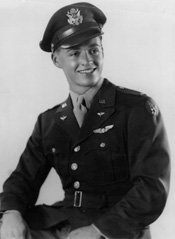
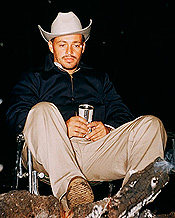
Jack Webb, age 20, US Army Air Corp


1950s: the cowboy hat disappeared in later years


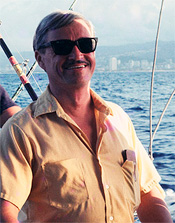
Fishing off Honolulu


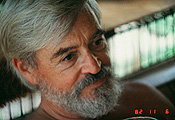
1982

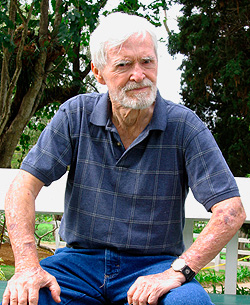
There’s been a widespread discussion on the web these past few weeks about women writing science fiction. Today is Father’s Day here in the USA, so I’d just like to say the person most responsible for getting me interested in science fiction was this man right here, my dad, Jack Webb.

These days I think most dads know they need to encourage sons and daughters both to believe in themselves, to try new stuff, to be smart, self-reliant, and to develop an adventurous spirit. Back in the sixties and seventies, when I was a kid, that was still fairly rare if you were a girl.

My dad though, was ahead of his time. Because he was always looking for the next adventure, I grew up variously on the back of a motorcycle, riding horses, getting ill on fishing boats, hiking, camping, and flying between the Hawaiian Islands in little two and four-seater airplanes. My dad was also always sharing his interest in science and gadgets, and would never bat an eye when I would proclaim that I was going to grow up to be a primatologist, or an aeronautical engineer, or go to the air force academy. Never once do I remember hearing, “Girls don’t do that sort of thing.”

He was also always reading, fiction and non-fiction both, but always lots of science fiction, and naturally I followed along.

So for better or worse I blame my dad for setting me on the path to writing science fiction. It starts at home, guys, as most of you young dads already know.

My dad read all my books. He was my biggest fan and quite convinced I was the best writer out there, as a loyal dad should be.

He passed away five years ago at the age of 82. He lived a very full life.

Alastair Reynolds on Vast

Saturday, June 18th, 2011

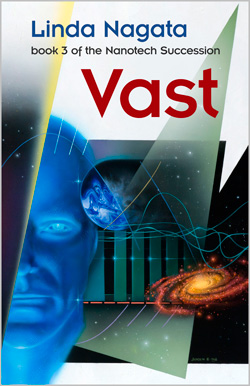
I started noticing a definite uptick in the ebook sales of my novel Vast this past week and wondered why. Google Alerts proved useless in tracking down the reason, but my blog stats provided a clue that led me back to Alastair Reynolds’ blog, who has some really kind things to say about the book–and so do his commenters. Check it out here.
You can sample the book at the links below. Vast, in ebook form, will also be available from BookViewCafe.com in July, and the print version will be out later this summer.

Amazon.com USA
Amazon UK
Barnes & Noble


The Pen Name: My Experience So Far

Friday, June 17th, 2011

@DannieC_Hill on twitter just asked me my thoughts on pen names** and if I’d done a blog post on the subject, so here I am.

Until very recently I’ve always written under my own name, Linda Nagata. This was done largely out of naivete and partly out of defiance (see the very current and continuing discussions around the Internet of women writing science fiction). Suffice to say that the intervening years have convinced me that “Linda Nagata” might not be the best name I could be writing under.

With my latest book, The Dread Hammer, I did a radical genre change from hard science fiction to unabashed fantasy. What better time to try out a pen name? So I published TDH under the name Trey Shiels. There’s nothing secret about it. I want my long-time readers to know that’s me, but I also want to see if having a different name on a book might make a difference in sales to people who have never heard of either of us. (Not that this is in any sense a scientific experiment. Whether the book is a roaring success or an abysmal failure, there’s no way to isolate the contribution of the pen name.)

That said, pen names are a pain! On my first pass at a print version for The Dread Hammer I managed to put “Linda Nagata” at the top of every left hand page in the book, instead of “Trey Shiels.” This cost me $110 and a couple weeks of time to fix. When I go to sign the book, I have to repeat over and over “Trey Shiels” — “Trey Shiels” — “Trey Shiels” — or you know what I’m going to write. Someone won a copy of the ebook, and I realized afterward that the name of the file I sent was “The Dread Hammer-Linda Nagata.epub.” (now fixed)

I do not ever think of myself as “Trey Shiels.”

Other authors have multiple pen names, but if I did that I think I’d have to have an assistant at my side to keep reminding me who I am at the moment.

It’s only been a couple of months. I suppose that in time I’ll adapt. And maybe, in the end, “Trey Shiels” will be a more successful author. But my advice, where pen names are concerned, is tread cautiously!. Better to pick the right name from the start.

**every time I start to write “pseudonym” I have this deep fear I won’t spell it right, so I write “pen name” instead

A Good Reason to Write Short Stories

Monday, June 13th, 2011

I’m a novelist by nature. I’ve only ever written a handful of short stories–and most of those are on the long end of a short story–plus a few novelettes and novellas.

Word count is the deciding factor on which category a piece of fiction falls into. According to the Science Fiction and Fantasy Writers of America:
Short story: under 7,500 words
Novelette: 7,500 to 17,500 words
Novella: 17,500 to 40,000 words
Novel: over 40,000 words

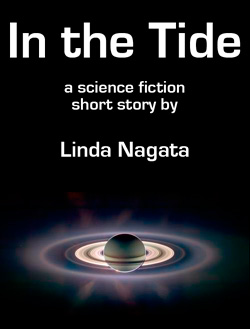
I’ve just published in ebook form a 7,000 word short. In the Tide was an Analog cover story back in the day, which was quite a coup for me at that stage of my career.

Here’s a tip for new writers: In the Tide was actually a “study” in much the same way that a painter will do sketches before tackling the big oil painting. I used this story to develop a feeling for the nanotech-drenched story world that later led to The Nanotech Succession books. I also used it to develop the type of evolved-human character that ultimately led to Nikko in The Bohr Maker. It’s a scheme I heartily recommend! Get paid developing the ideas for your novels. Where’s the downside of that?

In the Tide is a 99¢ short story. Here are the links:

Amazon USA
Amazon UK (£0.69)
Barnes & Noble

UPDATE: “In The Tide” is now available for free on my website, MythicIsland.com. Look for the box labeled “FREE FICTION”

Triage

Friday, June 10th, 2011

The To-Do List is like triage. Goals shift depending on who/what needs me the most. The top level tier of stuff I’m working on includes:

1-At least 1000 words/day on the work-in-progress

2-Tweak all the ebooks, prepping them for my upcoming launch at Book View Café

3-Upload new cover for Memory and do some promotion on this neglected novel.

4-Write a long overdue blog post for someone

5-Prepare print versions of The Nanotech Succession books (about 30% into this)

6-Proof and upload the first short story I’ve converted to ebook

7-Get more active in the marketing class I’m taking from Who Dares Wins Publishing

Not necessarily in that order.