Linda Nagata: the blog at Hahví.net


Archive for the 'Writing' Category

The Wounded Man

Wednesday, June 8th, 2011

Reading Martha Well’s terrific novel The Cloud Roads got me thinking about the archetype of the wounded man, because the hero of this book definitely qualifies, at least under my definition.

The “wounded man” isn’t physically wounded of course. Neither is he weak or incompetent and he can be wonderfully, overwhelmingly manly. But on some level he’s emotionally scarred from the mistreatment he’s received from life, and he’s got emotional issues, and usually he isn’t good at establishing relationships with men or women. So the inner plot is usually about our wounded hero learning to open up to others, in particular the love interest.

My thesis is that women tend to love the wounded man archetype, and men are much cooler toward it. Am I right? Am I wrong? Is it a generational thing? What do you think?

In my own work I’m going to point to two of my novels, Deception Well and Vast, which share two male characters named Lot and Urban. Lot sort of fits the definition of the wounded man. He has emotional issues (though he’s usually good at relationships, ha ha). Lot’s BFF, Urban, is emphatically not a wounded man. He’s cocky and confident. No self-esteem issues here.

My guess is that men prefer Urban’s character, and women tend to prefer Lot. Yes? No? Let me know what you think on the question of “the wounded man,” whether you’ve read the books or not. I always suspect I’m kind of “off” when it comes to being representative of my gender. I’d love to hear some opinions.

From Scene Sketch to Scene

Sunday, June 5th, 2011

I usually “outline” a story by writing a general tell-don’t-show description of the key points. This makes me feel secure. I know what’s going on. All I have to do is write it!

But my outlines are summaries. Actual scenes are often lacking. So I sketch out scene summaries, in which stuff happens. An example of a scene summary follows. It’s from the work in progress, but it’s pretty incoherent and I’ve left out a detail or two, so by the time you read the book I doubt it will qualify as a spoiler.

That morning, Ui is sitting beside Beyel, who is driving the wagon. The country is getting more rugged. The road is climbing. The oxen are slow. A carriage passes them. Ui freaks, because it’s the master’s carriage, and Hammond is driving. She scrambles back into the wagon to avoid being seen—not that Hammond is looking. She lands on Smoke, waking him from his long, exhausted sleep. “I think Eleanor is here!” “Where?” Smoke senses her in the threads. He hears her despairing prayer. He goes to find her.

I felt pretty good about this scene sketch. It’s got action and dialogue and is the catalyst for Something Important. Upon reviewing it, I nodded in satisfaction. The actual scene would be easy to write!

Then I sat down to write it, frowned, and suddenly suspected I was lacking a whole lot of information. For starters, whose point of view is this? There are three viewpoint characters in this little sketch. Smoke is sleeping at first, so logically, he should be counted out, except the last bit is clearly from his point of view. I could try it in Beyel’s point of view and utilize his sardonic observations. Or tell it through Ui’s eyes. She is the most active character, at least at first. She’s the only one actually doing something, even if it’s only falling on top of Smoke. So yeah. Ui…segueing into Smoke? Hrmmm…

And where exactly should I start? This scene takes place on the next morning after the last scene. Or maybe it’s already the middle of the day? Decisions, decisions.

And to properly set up this little incident, I need to know if Beyel made a command decision and set out on the road while Smoke was still sleeping, or if Smoke was awake earlier, agreed to the day’s plan, and has only since gone back to sleep. Such things matter in the context of the characters’ relationships, but nevertheless I don’t want to spend a lot of time on it, and I suspect the details would be tedious to cover in a separate scene.

And there’s yet another problem. In the scene just before this, I left Eleanor in an emotional state that makes it unlikely she’ll actually be whispering this “despairing prayer.” Without that prayer (or even with it) will Smoke be sufficiently motivated to do something? Would it be in character for him to do something? His character is evolving, true, but has it evolved enough to make this plausible?

Hmm….uh, ah….

Just write it,” whispers the task master in the back of my head.

Several hours and 1400 words later…

As it turns out, I went against both of my initial inclinations. I decided to start the scene earlier in time, and I wrote it from Beyel’s point of view, except for a small, separate section at the very end.

So, yes, I do outline. And no, I don’t necessarily follow my outlines.

But no matter how I get there, I’m always happy to have a finished scene.

It’s the Relationships

Tuesday, May 24th, 2011

Bill Clinton’s presidential campaign was famous for the campaign staff’s irreverent slogan, “It’s the Economy, Stupid.” I’m getting very close to posting the writer’s corollary above my desk: “It’s the Relationships, Stupid.”

This was brought home to me in what might sound like an odd way: my son recently introduced me to Riddick, the Vin Diesel character originated in the movie Pitch Black and reprised in The Chronicles of Riddick.

Pitch Black is a classic monster movie. It uses the typical plot skeleton of a diverse group of characters brought together by a disaster who have to learn to work together as they get picked off, one by one. Sounds cliché, but it was very well done. The characters, each with their own skills and quirks, were quickly building relationships–caring about each other, or fighting with each other, but definitely working on those human connections. The biggest driving force of the internal plot was the dual question of whether the outcast/criminal Riddick would be accepted by the group, and whether he would in turn accept a responsibility for helping the group. I enjoyed this movie a lot.

The Chronicles of Riddick was more problematical. This movie looks great. Think of an anime performed with live action characters–that’s what it looked and sounded like to me. Clearly a lot more money was spent on this movie than on Pitch Black. But about two-thirds of the way through I started wondering why I wasn’t emotionally involved in the story, and for me the quick answer was that the relationships were transient or entirely missing. In this movie Riddick is most often entirely on his own. Other characters come and go—way too many characters, honestly—without any real work done on the push and pull of relationships that matter. Yes, in the last third or so of the movie Riddick reconnects with a character from Pitch Black, but it felt like too little, too late, with too much hostility anyway.

I really like Vin Diesel on-screen and I think both movies are worth watching, but for me, Pitch Black is the better of the two.

In recent years I’ve dealt with some problems in my own writing, and what I’ve learned from it is that it’s not only a matter of having meaningful relationships between your characters, but also having tension and questions in those relationships. Will they get together? Will they have a falling out? Will a third party upset the balance? Will jealousy cause things to blow apart?

A story needs more than great adventure. It needs risk-filled human relationships to ignite the reader’s emotions.

The Fun Stops Here

Wednesday, April 13th, 2011

The indie publishing process has been tremendous fun right up to this point, but the fun has suddenly stopped and doubts have come crashing in.

Here’s what’s going on: On February 28 I posted about finishing the initial draft of a new fantasy novel. I put it through a quick and dirty re-write and got some nice feedback from three writers–strangers to me, who generously offered their time. After a re-write, my writers group looked at the first thirty pages and gave it a thumbs up, along with a few suggestions and line edits.

Since then I’ve been on my own. I haven’t exactly discussed the title with anyone. I’ve gotten some input on the back cover copy, but not from people who, well, sell books. Only the artist and I have been involved in the cover concept and the artist hasn’t read the book. She’s doing a great job, exactly what I asked her to do…but is my concept any good? Who is my prospective audience anyway? Will the cover and title appeal to them? Will the story? Will my pen name? Did I mention this book is totally unlike anything else I’ve done?

Also, no woman (except me of course) has read the entire novel yet, and for some reason this really bothers me.

And I’m hoping to publish next week.

So yeah. Lots of room for doubt at this stage, and doubt is not fun.

This would never happen in traditional publishing. At minimum, writer and editor would agree the book was good and the title was effective, and realistically a lot more people would be involved, especially in cover art and cover copy. I think that’s part of the “validation” authors talk about when they speak fondly of traditional publishers. The team might not get it all right, but confidence goes up in committee.

Personally, I do far better work at a much faster pace when I’m feeling confident.

The lesson here, I think, for anyone out there working on their own book, is to ASSEMBLE YOUR INDIE TEAM EARLY. Develop a reliable, go-to group of interested people who have the time, the knowledge, and the experience to offer prompt feedback on work in your genre, and who will let you bounce ideas off them. And BE that person for other writers. We’re all tremendously busy, but personally I could spend less time reading the Interwebs (or writing blog posts), and devote that time to a TEAM.

When the cover art is ready, I’ll post it here.

Time to Start a New Project

Monday, April 11th, 2011

I’ve got two projects in process–one almost done–but I’m feeling the need to start something entirely new, so today I pulled out notes on a project that came to mind last December. It’s science fictional–though working on a strict definition of science fiction as involving scientific realities, it’s more a technological fantasy (I just made that term up).

I had originally intended to write the story as a screenplay, but my current hankering is to write another short novel, so that’s what I’m going to do. Screenplay later. Maybe.

The great thing about not being under contract is you get to do what you damn well please.

Today’s goal: Develop a more solid outline.

Update: Well, that was an interesting session. I wound up going off in a new direction. Complexity? Yes. Long term potential? Could be. Looking forward to exploring more of this story world!

Waiting On Feedback

Monday, April 11th, 2011

1. I just sent the manuscript/ARC/screenplay/cover concept; of course I haven’t heard anything yet.
2. They’re probably really busy.
3. I’ll just email to make sure they got it . . . yep, they got it. Okay.
4. . . .
5. . . .
6. Why would they offer to look at it and then not look at it?
7. They must have looked at it, hated it, put it aside, and forgot to follow up.
8. I would never take this long to get back to someone. (Umm, I’m not talking about those emails that have been in my inbox for nine months.)
9. Should I email?
10. . . .
11. Should I email?
12. . . .
13. They’re just fricking insulting me.
14. I suck.
15. Should I email?
16. Maybe they’re just busy.
17. I’ll email.
18. Not again! It happens all the time–when I send people things their lives suddenly go haywire or fall apart. It’s like I’m cursing them.
19. . . .
20. The Universe is against me.
21. Something is definitely seriously wrong with my personality.
22. . . .
23. Deal with it: If they had liked it I would have heard by now.
24. . . .
25. Whatever

The Care & Feeding of Writers

Wednesday, April 6th, 2011

This post is not about me–not about just me, anyway–but about any and all writers whose work you enjoy. Readers are awesome. I still find it pleasantly mind boggling when I get email from readers who have really enjoyed my work, and I’m thankful for that, and thankful that you’ve read my work. Who would we be without you?

But you know it’s a tough world out there. It’s hard to get noticed. And most of us writers need all the help we can get, so that’s what this post is about–or what it was going to be about. I’ve been planning on writing this for the last week or too, but then Keith Brooke over at Infinity Plus beat me to it with a much more coherent post than I could ever pull off. So check it out–please!

The basic idea Keith describes is that if you want to help out an author, do the little things. Post a review on Amazon (or Barnes & Noble). A star rating and a “I really enjoyed this book” is fine. You don’t have to use your real name.

On the same Amazon page, click the facebook “Like” button, and add some new tags to the book or affirm existing ones.

If you blog or twitter or do facebook, suggest the book to your social circle. Mention it to your friends in real life.

This all probably sounds like tiny stuff, but tiny stuff can get bigger stuff rolling. I love being an “indie” writer, but thus far the “Do what you love” philosophy is not putting much food on the table. If you like what I’m doing, if you like what I’ve done, if you like other writers and want to give them a hand, word-of-mouth is a simple and wonderful way to do it.

Thanks for listening!

The Sadness of Memory

Sunday, March 6th, 2011

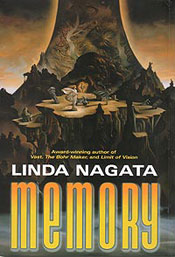
I finally started working on the manuscript for my novel Memory, getting it ready for conversion to ebook and print-on-demand. The process involves cleaning up the styles, converting manuscript punctuation to print punctuation, and adding in the copy editor’s changes—which means going through it page by page.

In the process I’ve been re-reading a lot of the story and it’s left me feeling very sad today. Not because it’s a sad book. Memory is poignant at times, but it’s not written to leave you weeping. The dedication sums it up: “A quest, a puzzle, and multiple lives.” This is an action story set in a unique story world. My sadness is for the book itself. Memory may well be my best book and I think it deserved better than it got. I’m also sad because I honestly can’t see myself ever attempting to write anything on this level again. There just doesn’t seem to be any point to it. Here’s why:

Memory was originally published in April 2003 by Tor. Below are the most recent sales figures I pulled out of the file, as of June 2007. (I’m sure I have more recent figures, but they were probably sent as PDFs and I didn’t bother to print them out and I’m not going to look them up. The figures likely just got worse anyway as more returned books came in.)

Hardcover: 1822
Ebook: 50
Trade paper: 1574
Mass Market Paperback: 7097

That’s 10,543 total units four years after publication—a spectacular market failure by any measure. (On the positive side this means there’s a huge potential market that could still be persuaded to buy the book when it’s resurrected by my publishing company Mythic Island Press.)

I used to want to write a great novel. Now I just want to write an amusing one.

I truly respect the person who wrote Memory, but—you knew this was coming right?—that earlier version of me is just a memory now. I’ll be writing shorter, simpler books for the foreseeable future, hopefully in more viable genres.

I still can’t bring myself to write about zombies though.

Sorry.

Book As Event

Monday, February 28th, 2011

The most useful post on writing that I’ve read in recent times is here: Killing the Sacred Cows of Publishing: Book as Event

Thank you Dean Wesley Smith!

I don’t agree with absolutely everything in this post of course, but most of it makes perfect sense to me. The core thesis is, and I quote, “Myth: All books need to be events, need to be something special.”

That was my belief for essentially my entire writing career. If the story wasn’t big/meaningful/ground-breaking/a potential home run, don’t bother starting it.

This worked for me for a while. I produced six novels that I’m still quite proud of. And then all of a sudden I wasn’t producing novels anymore. I started developing novel ideas several times, but either the ideas went nowhere, or I could see no way of doing the research, or the idea just wasn’t big enough to bother with.

Then I read the article cited above, recognized myself, and decided to try something new.

In mid-December (yes, this past December) I spent a couple of writing sessions developing a plot for a story idea that had just popped into my head. It’s an off-the-wall kind of fantasy in a vaguely medievalist setting. Editor self sneered: “You have got to be kidding me.” New experimental self replied: “Leave me alone. It’s just a story.”

The goal was a 60,000-word novel in three months, aiming at 1000 words a day. (FYI: words-per-day math follows its own obscure rules.)

My first serious writing session was on December 21, but I only managed another couple of sessions before year’s end. In January I got serious, and started writing nearly every day.

I hit a wall on January 27th. Here’s the blog post: For Me, Writing Fast ≠ Writing Well

February 24 was another roadblock. I spent most of this day re-plotting the last part of the story. By the evening I had short, very sketchy versions of every remaining scene in the book.

From there everything just worked. As of yesterday I had the last chapter in place and my word count was 60,300—so close to my goal it astonishes me.

I still have holes to fill in, but not a whole lot of them. I still need to fix some terminology. And yes, I will read it all over and clean it up. Oh, and no one else has read a word of it yet.

But the point is, I wrote a novel in slightly over two months, I had a lot of fun doing it, and I like the result.

So again—Thank you Dean Wesley Smith!

Visualizing Environments

Tuesday, February 8th, 2011

When I’m writing a scene it’s not uncommon for me to get the wrong sort of environment stuck in my head. For example, the scene I’m working on now takes place on and around a mountain pass. The piece is fairly brief and I’m not expecting to use the location again, and, since I’m trying to write fast, I didn’t spend anytime at all thinking about the specifics of the setting until after I got going.

Once I did start, I realized I’ve been visualizing an austere, treeless, virtually barren summit area–which doesn’t make any sense given the general environment where this story takes place.

For me, shifting that mental image requires real effort. Sometimes it helps to go to Google and do an image search (“forest mountain pass”). With luck, a photo comes up of a setting similar to what I’m trying to envision. But luck is fickle, and when Google fails me, it’s time to take a deep breath, close my eyes, and try to rebuild the setting in my head, this time with proper features–because if I can’t see the scene map, what hope is there for the reader?