Linda Nagata: the blog at Hahví.net


My First Computer

August 4th, 2013

(This post is part of a series at Book View Café, and is cross-posted there.)

Gather round children, and let me tell you a frightening truth: I got through four years of college without a personal computer.

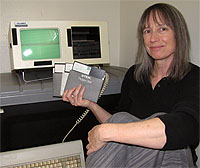
Everyone did in those days, but within a year of graduating, the personal computer revolution had taken off. This was 1983. I was getting married. The husband-to-be wondered if I wanted an engagement ring. I considered it for about a second-and-a-half and said, “Get me a computer instead.” Because by this time I’d decided I was going to be a writer.

So we decided on a Columbia VP Portable, mostly, as I recall, because it was significantly cheaper than the “IBM Clone” desktops of the time. “Portable” is a slight exaggeration on the part of the manufacturer. It’s really a crushingly heavy 35-pounds, not something you’d want to carry with you while commuting on a bus, but it served my purposes. Read the rest of this entry »

First “Official” Review

August 1st, 2013

(Update: August 28, 2013 — the review is now available online.)

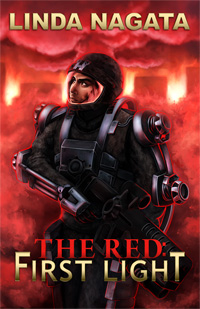
The Red: First Light by Linda NagataWhen I decided to indie publish The Red: First Light — the first adult science fiction novel I’d released in ten years — I knew I could handle the production, including professional editing, copyediting, cover development, ebook creation, and print book creation. I also knew that the online distribution was easily within my reach.

The remaining questions were:

• Could I get the book into bookstores?
So far as I know, the answer to this remains “no.”

• Could I do the publicity?
Among other things, this blog post talks about what I’ve managed. Has it been enough? Nope.

• Could I get the book reviewed?
Despite wonderful reader reviews posted at Amazon and other venues, to my knowledge The Red: First Light has not been reviewed at any standard book review site or publication — until today. The August issue of Locus is just out and contains a full review of The Red: First Light by long-time reviewer Russell Letson.

Locus is “The Magazine of the Science Fiction & Fantasy Field.” It’s a trade publication covering science fiction and fantasy since 1968 and available in print and digital editions.

And what did Russell Letson have to say about The Red: First Light? Here are a few pull quotes:

…the novel’s vision of the military – or at least of the soldier and his or her most immediate context of competence, loyalty, dedication, and courage – is anything but disrespectful or dismissive. The setting in which these virtues are employed, tested, and sometimes betrayed, however, is something else again.

…a series of operations, described in enough detail to satisfy any mil-SF enthusiast, and with a sour enough attitude towards official and actual power structures to keep old lefties from feeling too guilty about enjoying the action.

…the same post-Vietnam sense of discontinuity that separates The Forever War from Starship Troopers, updated for the post-9/11 world.

The August 2013 issue of Locus contains reviews of many other books, along with an interview of Kim Stanley Robinson. Find it here.

And if you’ve read and enjoyed The Red: First Light, please consider reviewing it at Amazon, Barnes & Noble, or your own blog. Getting the word out is the most challenging part of publishing — whether indie or traditional. Thanks!

Shop for the Ebook
Amazon USA
Amazon UK
Mythic Island Press LLC
Barnes & Noble (USA)

Shop for the Print Book
Amazon USA
Amazon UK
Mysterious Galaxy
Barnes & Noble (USA)

Clarion West Write-a-thon:
Week 5 Progress Report

July 28th, 2013

This year I’m participating for the first time in the Clarion West Write-a-thon, which runs from June 23 through August 2. The goal of the Write-a-thon is to raise awareness of the Clarion West Writers Workshop, along with money that will go toward funding next year’s workshop. Participating writers set their own writing goals and strive to meet them; supporters provide moral support and a donation if they can. If you’d like to donate, please visit my participant page.

Writing Goal 1: add 20,000 words to the “The Red: Trials,” my novel-in-progress. DONE!

Writing Goal 2: Have two (one remaining) short stories in solid draft. Short is a keyword. Novelettes don’t count.

Week 5 Result
(Disclaimer: I’m composing this a day early, on Friday, since I’ll be away over the weekend.)

Five weeks in, and one week to go!

This was a tough week, with a lot of hours spent in front of the computer. Many of those hours were frustrating and unproductive, but on most days, by late afternoon, I had a decent word count.

Goal 1:
To my surprise I not only completed Goal 1 this week, I roared right past it. I’ve added 23,000 words to the manuscript since the start of the write-a-thon, with 8600+ over the past week.

Goal 2:
As of late Friday afternoon, I have done no work on my second short story. I’ve got eight days left to produce a draft. I’m not confident, but I’m going to give it a shot.

The Year’s Best Science Fiction:
30th Annual Collection

July 23rd, 2013

This has been an amazing year for my story “Nahiku West” which has been included in a few best-of-the-year anthologies and was the second place finisher for the Theodore Sturgeon Memorial Award. But for his 30th iteration of the annual collection The Year’s Best Science Fiction, Gardner Dozois chose my other science fiction story published in 2012 — “Nightside On Callisto” — which originally appeared in Lightspeed Magazine.

The Year's Best Science Fiction - 30th edited by Gardner DozoisGardner has been successfully presenting his collection for a full three decades, and the 30th brings together many stories by diverse authors. If you’re behind on your short fiction, here’s a chance to make it all up at once! Stories included in this volume are:

“Weep For Day” by Indrapramit Das
“The Man” by Paul Mcauley
“The Memcordist” by Lavie Tidhar
“The Girl-thing Who Went Out For Sushi” by Pat Cadigan
“Holmes Sherlock” by Eleanor Arnason
“Nightfall On The Peak Of Eternal Light” by Richard A. Lovett And William Gleson
“Close Encounters” by Andy Duncan
“The Finite Canvas” by Brit Mandelo
“Steamgothic” by Sean Mcmullen
“In The House Of Aryaman” by A Lonely Signal Burns” by Elizabeth Bear
“Macy Minot’s Last Christmas On Dione, Ring Racing, Fiddler’s Green, The Potter’s Garden” by Paul Mcauley
“Twenty Lights To “the Land Of Snow,” Michael Bishop
“Astrophilia” by Carrie Vaughn
“What Did Tessimond Tell You?” by Adam Roberts
“Old Paint” by Megan Lindholm
“Chitai Heiki Koronbin” by David Moles
“Gods Of Risk” by James S. A. Corey
“The Water Thief” by Alastair Reynolds
“Nightside On Callisto” by Linda Nagata
“Under The Eaves” by Lavie Tidhar
“Sudden” by Broken And Unexpected” by Steven Popkes
“Fireborn” by Robert Charles Wilson
“Ruminations In An Alien Tongue” by Vandana Singh
“Tyche And The Ants” by Hannu Rajaniemi
“The Wreck Of The Charles Dexter Ward” by Sarah Monette And Elizabeth Bear
“Invisible Men” by Christopher Barzak
“Ship’s Brother” by Aliette De Bodared
“Eater-of-bone” by Robert Reed

Clarion West Write-a-thon:
Week 4 Progress Report

July 21st, 2013

This year I’m participating for the first time in the Clarion West Write-a-thon, which runs from June 23 through August 2. The goal of the Write-a-thon is to raise awareness of the Clarion West Writers Workshop, along with money that will go toward funding next year’s workshop. Participating writers set their own writing goals and strive to meet them; supporters provide moral support and a donation if they can. If you’d like to donate, please visit my participant page.

Writing Goal 1: add 20,000 words to the “The Red: Trials,” my novel-in-progress.

Writing Goal 2: Have two (one remaining) short stories in solid draft. Short is a keyword. Novelettes don’t count.

Week 4 Result
Four weeks in, and progress has slowed to a crawl. I have one small excuse. A couple days were devoted to revising a short story, which subsequently sold to Lightspeed Magazine. But mostly, I’ve been trying to get the novel moving, with mixed success.

Goal 1:
Very limited progress this week in actual word count. Being very generous with myself by counting a section which is almost entirely dialog at the moment, without any scene or mood-setting, I have now added 14,733 words out of my 20,000 word goal.That’s 74% with two weeks left, so there’s still a realistic chance I’ll make it. Despite the paltry increase in word count since last week, I made real progress on the novel by replotting. I figured out how to do without a whole, long tedious section, and move on almost directly into action–and that’s always a good thing.

Goal 2:
The best I can say is, I thought briefly about a story that I need to write, but I got nowhere with it. Drafting another short story in the time remaining is starting to feel very intimidating. It’s not going to happen if I don’t make it a priority. Hopefully I’ll have better news to report next week.

Short Story Sale: “Codename: Delphi”

July 19th, 2013

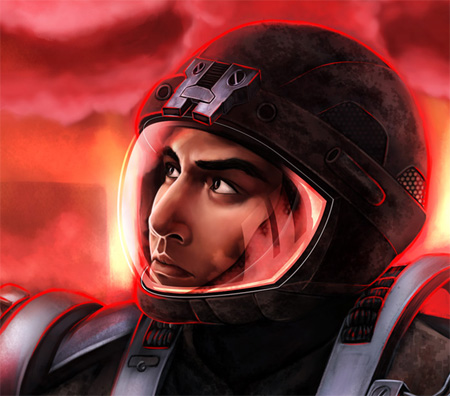
Cover detail for The Red: First Light; digital painting by Dallas Nagata White “Codename: Delphi” is the first — and so far only — short story I’ve completed as part of the the Clarion West Write-a-thon. It’s part of The Red: First Light‘s story world, and has just sold to Lightspeed Magazine!

This is my second short story sale of 2013.

The first story sold this year, “Halfway Home,” will be published online in the September issue of Nightmare Magazine.

An Audio Book Edition of “Nahiku West”

July 15th, 2013

And also nine other science fiction stories!

This is the fifth year that Infinivox has released an unabridged audio book anthology of The Year’s Top-Ten Tales of Science Fiction (link is to Amazon US).

Stories included in the audio anthology are:

“Invisible Men” by Christopher Barzak
“Close Encounters” by Andy Duncan
“Bricks, Sticks, Straw” by Gwyneth Jones
“Arbeitskraft” by Nick Mamatas
“The Man” by Paul McAuley
“Nahiku West” by Linda Nagata
“Tyche and the Ants” by Hannu Rajaniemi
“Katabasis” by Robert Reed
“The Contrary Gardener” by Christopher Rowe
“Scout” by Bud Sparhawk

I haven’t yet heard the audio rendition of “Nahiku West” but I’m looking forward to it.

Clarion West Write-a-thon:
Week 3 Progress Report

July 14th, 2013

This year I’m participating for the first time in the Clarion West Write-a-thon, which runs from June 23 through August 2. The goal of the Write-a-thon is to raise awareness of the Clarion West Writers Workshop, along with money that will go toward funding next year’s workshop. Participating writers set their own writing goals and strive to meet them; supporters provide moral support and a donation if they can. If you’d like to donate, please visit my participant page.

Writing Goal 1: add 20,000 words to the “The Red: Trials,” my novel-in-progress.

Writing Goal 2: Have two (one remaining) short stories in solid draft. Short is a keyword. Novelettes don’t count.

Week 3 Result
Nothing to brag about this week. There is a persistent “romantic” myth that the best art is made by suffering artists. In my own experience and in discussion with others I’ve found this to be utterly untrue. For myself, when confidence flags, so does my work, both in quality and quantity. This was not a week filled with confidence, and my productivity reflects that. So it goes.

Goal 1:
The bright point this week was that after quite a bit of struggle, a scene took an unexpected turn giving me fresh insight on what-is-going-on. In other words, a minor breakthrough. Even so, my feeling as I sat down to write this progress post was that I had added very little to the manuscript. As it turns out, my progress was better than I thought. I have now added 13,640 words to the manuscript out of my 20,000 word goal. That’s 68%, and time-wise I’m at the halfway point, so there is still hope.

Goal 2:
Nothing accomplished here! I was determined to make progress on the novel before tackling a new short story…and I got stuck on the novel. I’ll try to do better in Week 4.

Writer Process: Making a Story Shorter

July 8th, 2013

I find that each new writing project is a challenge, as I try to figure out again the process of creating a story.

Back at the end of April I set out to write a short story in one of my preexisting story worlds. I had no characters, no plot, no theme. So I did brainstorming sessions, and I tried writing bits of story just to see what might be there. Eventually I had a complete draft. I’m never quite sure how this happens, and it doesn’t always happen, but it did this time. 9900 words. Much longer than I’d hoped, but it was the first story I’d managed to finish this year, so that was something.

I sent it off for critique, got comments back that were mostly minor and full of encouragement — and then I didn’t look at the thing for a month because… I don’t know why.

When I finally started working on it again, things went in an unexpected direction. My tendency is to underwrite first drafts, so second drafts are always longer, but this story was the opposite. One comment from the beta reader was that the opening pages could be shortened, so that’s where I started and, painlessly, just by striking out excess wordage — an excess that had become suddenly obvious — the story was 500 words shorter. So I went through the entire manuscript and did a similar prune, striking out phrases and sentences. This took it down to around 9200 words.

Next I started looking for scenes to cut. Right away I found one that was clearly unnecessary. It involved a subplot/problem that contributed to a character’s difficulties without contributing in a meaningful way to the climax of the story. So I reduced it to a sentence and got rid of a few hundred words.

I found two or three places with repeated information and consolidated those.

I found a short scene that existed just so I could convey one piece of information. That information could be easily communicated in one sentence of dialog in a different scene, so that’s what I did.

I trimmed and trimmed and trimmed, one or two words at a time, and the story didn’t suffer for it. It got better. And of course not everything involved cutting words. I added them as needed to clarify character and motives, but the net word count kept dropping.

The last one hundred words were really hard, but I finally found a two-sentence paragraph that had been made irrelevant by my revisions. When that was gone, I only needed to get rid of a few more words, and then I was done. I’d brought the story down to my goal of 8000 words.

This is the first time I can remember cutting a story this hard, which just goes to show that every story is different. I’ve got at least three more that I want to write this year, along with finishing the novel. I have no idea how I’ll manage any of it, but that’s always the case.

I guess I’ll know when I get there.

Clarion West Write-a-thon:
Week 2 Progress Report

July 7th, 2013

This year I’m participating for the first time in the Clarion West Write-a-thon, which runs from June 23 through August 2. The goal of the Write-a-thon is to raise awareness of the Clarion West Writers Workshop, along with money that will go toward funding next year’s workshop. Participating writers set their own writing goals and strive to meet them; supporters provide moral support and a donation if they can. If you’d like to donate, please visit my participant page.

Writing Goal 1: add 20,000 words to the “The Red: Trials,” my novel-in-progress.

Writing Goal 2: Have two (one remaining) short stories in solid draft. Short is a keyword. Novelettes don’t count.

Week 2 Result
Way back in May I wrote a novelette, which I then ignored for all of June and into July, but on July 4th — perhaps because I had just sent a story off to market and felt inspired — I started working on the revision. My goal was to cut it from 9900 words to 8000 words, and after working on it for all of July 4th and most of July 5th, I managed to do that, ending up with a much stronger story. But none of this effort counts toward my Clarion goals!

So…

Goal 1: This was an odd but ultimately successful week for the novel. From Sunday through Wednesday I did several brainstorming sessions, blocking out much of the action and dialog in an extremely rough and nonlinear form. Then on Friday evening and for most of Saturday I worked on making those scattered pieces coherent. The end result? I have now added 9,135 words to the manuscript out of my 20,000 word goal. 46% in two weeks, which is an excellent pace for me.

Goal 2: I spent time brainstorming a short story which may be the second short story I do for the write-a-thon. But I also blocked out the basics of a project that will likely be a novella, and which I’m very excited about — but that project will have to wait until after the write-a-thon.