Linda Nagata: the blog at Hahví.net


Pondering Cloud Atlas, the movie (minor spoilers)

November 3rd, 2012

I finally saw the movie Cloud Atlas yesterday and have been pondering it since, but probably not for the reasons the creators would like.

Background: I read a sample of the novel on my Kindle, enough to know some details of the initial setting, and I had heard that the film takes place across a wide span of time, with interconnected lives. Other than that, I didn’t know much about it, as I prefer reading reviews and analyses after seeing a movie, and not before.

Also, I have some pretty serious facial recognition issues, so the identity of actors in multiple roles was not at all obvious to me, which pretty much guaranteed the story would be over my head. I had to read an IMDB summary afterward to get the core idea.

But it’s not the intricate story that leaves me pondering. It’s the treatment of race and setting. A lot has been written about Caucasian actors playing Asians in the film. The logical reason for this is pretty straightforward: people are reincarnated with varying racial backgrounds and for continuity the same actors were used regardless. It’s probably fair to ask why Caucasian actors were chosen—and the film might have done better with more mixed-race actors come to think of it. Halle Berry seemed able to pull off the various roles better than most, from my perspective.

But for me personally, the 1940s fake-“Asian” look was very unsettling, very distracting. For me, it doesn’t even trigger the meme “Asian.” More like “Romulan,” or “Vulcan,” or “holy cow, what in the world are they doing…?” I am told this was an indie movie and maybe they didn’t have the budget to do it right, but given the lush, eye-candy settings throughout the film, that’s a little hard to parse.

One racial aspect that I found almost no mention of online was that the people in the opening chapters of the book who were Maori, became people of African descent in the movie. I can come up with possible reasons for this, but it still seemed like Polynesia was being “disappeared,” written out of world history and replaced by another people.

And then there was “The Big Isle.” I gather from comments I’ve heard and from Wikipedia that in the book this actually does refer to our “Big Island,” Hawaii, the largest island in the Hawaiian Archipelago. But I can tell you that was not the Big Island. There was nothing about it that recalled the Big Island: not the geology, not the flora, not the people, nothing.

I raise my hand and plead guilty to writing about places I haven’t been, but I have to presume the makers of this film could have gone to the Big Island if they wanted to. So I have to assume they found a more budget friendly location, which is fine, I understand that.

But why is every post-apocalyptic survivor on the “Big Isle” seemingly pureblood Caucasian? I don’t think it’s a big secret that here in Hawaii there are a lot of people of Hawaiian ancestry, along with many other racial groups. I also don’t think it’s a secret that here in Hawaii we tend to marry across racial lines very, very frequently (I volunteer myself as an example). For at least twenty years the standard couple in banking commercials has been Asian/Caucasian. These days it seems more unusual to see people of the same race marrying, than to see mixed marriages. So…what happened during the apocalypse to erase our mixed race society? The science-fictional mindset kicks in and I find myself wondering if a racially targeted, engineered virus wiped out all but the Caucasian purebloods…but that has nothing to do with the story. So again, I’m distracted from the actual story by the (to me) inexplicable world-building choices–which goes to show the importance of world-building.

I will try to stop pondering now. I have my own stories to write, my own world-building choices to make. I’m sure I won’t always get it right, but I’ll keep trying.

Book Rave: Dispossession

October 22nd, 2012

BVC releases Chaz Brenchley's DISPOSSESSIONNew today from Book View Café is Chaz Brenchley’s Dispossession, an unusual, intricate, and engrossing mystery with an element of fantasy.

I picked this novel up by chance from the inner-sanctum of BVC, without knowing anything about it, not even what genre it was. It didn’t take long to hook me. The writing is gorgeous, and the story deeply intriguing: this is a tale of amnesia, as protagonist Jonty Marks wakes in hospital three months after his last recallable memory to find his staid life utterly changed.

Writers write for different reasons, for different goals, for different purposes. My own writing grew out of my love for adventure stories: lots of action, big sets, suffering heroes and antiheroes. Dispossession has its own action and determined plot, but it seems to me it’s written more to illuminate the human condition. In this age of 99-cent pot boilers, I’m almost afraid to tell you that much of this long book involves the inner reflections of the protagonist, Jonty Marks, and sadly it feels necessary to add the story is not boring at all! Here’s a quote to show you what I mean, with a few sentences snipped out that might be spoilers:

I still thought he was nineteen; still thought that was exact. Full growth but no maturity, whip-fast reflexes and not an ounce more flesh than he could need or want; fire and hunger, passion and arrogance and the habit of instant judgment with no sense of perspective, no leniency.

And beauty, of course […] and engulfing all, the certainty that there was no forgiveness, that there could be no reconciliation in this world or any other.

And that also was pure nineteen-year-old thinking, and not subject to debate.

As a writer, I deeply admire the ability to write descriptions like that.

Another interesting aspect of Dispossession for me: this is the most “British” book I’ve ever read. I was frequently asking my Kindle to provide me with definitions for unfamiliar words, and slowly realized that all the other books I’ve read by British authors must have been translated into “American.” This is the pure product.

You’ll find a more extensive description of Dispossession’s plot at Book View Café — too much description, in my opinion. Books should tell their own story, as the plot unfolds. My recommendation is to skip reading the BVC description and just grab the sample chapters. That will let you know if Dispossession is a book for you, or not.

If you do read it, let me know what you think!

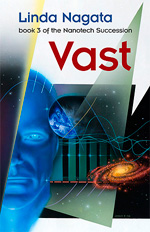
Snippet: Vast

October 20th, 2012

Vast by Linda Nagata

POINT ZERO: INITIATE.

A sense kicked in. Something like vision. Not because it emulated sight, but because it revealed. Himself: Nikko Jiang-Tibayan. An electronic pattern scheduled to manifest at discrete intervals. Nikko Jiang-Tibayan. He’d been an organic entity once. Not now.

Point one: identify.

Personality suspended on a machine grid: He is the mind of the great ship, Null Boundary. His memories are many, not all accessible. He’s locked much of his past away in proscribed data fields. He interrogates his remaining inventory, seeking an explanation. It comes in an amalgam of cloudy scents: the clinging stink of living flesh parasitized by aerobic bacteria. All defenses down. “Don’t be sad, my love,” she whispers. “Whatever the cost, you know we had to try.”

He explores no farther.

Point two and counting: status check.

A scheduled mood shift floods his pattern with easy confidence. He confirms that Null Boundary has long ago reached maximum velocity, four-tenths lightspeed. The magnetic scoops have been deactivated; the solenoids folded to a point piercing the increasingly thick interstellar medium. Duration? Over two centuries ship’s time have elapsed since Null Boundary left Deception Well.

Two more centuries.

His past has become unconscionably deep for a man who’d been condemned to die at the age of thirty standard years.

* * *
“VAST lives up to its name–big, important, yet written to a human scale so the perspectives of science emerge all the more strongly. Among hard sf writers, Linda Nagata is a pearl, able to render her complex landscapes in moving, quick-paced stories that linger in the mind.”

–Gregory Benford

“…one of the most enjoyable SF books I’ve read in the last 12 years…I can safely say that it is one of the very novels that has literally haunted my dreams, in that the book exerted such a powerful hold on my waking imagination that come nighttime I found my sleeping brain racing ahead with the story. It’s awesome!”

–Alastair Reynolds

“…Nagata’s vision broadens our sense of who we are and what we might one day become as few others have done before her. Recommended.”

–Tom Easton, Analog

“VAST blends solid reasoning, lyrical prose, and an almost mythic suite of characters to form one of the most satisfying sf novels of the decade.”

–Wil McCarthy

Available in print and ebook editions.

Snippet: “Nahiku West”

October 14th, 2012

Nahiku West by Linda Nagata

A railcar was ferrying Key Lu across the tether linking Nahiku East and West when a micro-meteor popped through the car’s canopy, leaving two neat holes that vented the cabin to hard vacuum within seconds. The car continued on the track, but it took over a minute for it to reach the gel lock at Nahiku West and pass through into atmosphere. No one expected to find Key Lu alive, but as soon as the car re-pressurized, he woke up.

Sometimes, it’s a crime not to die.

o0o

I stepped into the interrogation chamber. Key had been sitting on one of two padded couches, but when he saw me he bolted to his feet. I stood very still, hearing the door lock behind me. Nothing in Key’s background indicated he was a violent man, but prisoners sometimes panic. I raised my hand slightly, as a gel ribbon armed with a paralytic spray slid from my forearm to my palm, ready for use if it came to that.

“Please,” I said, keeping the ribbon carefully concealed. “Sit down.”

Key slowly subsided onto the couch, never taking his frightened eyes off me.

Most of the celestial cities restrict the height and weight of residents to minimize the consumption of volatiles, but Commonwealth police officers are required to be taller and more muscular than the average citizen. I used to be a smaller man, but during my time at the academy adjustments were made. I faced Key Lu with a physical presence optimized to trigger a sense of intimidation in the back brain of a nervous suspect, an effect enhanced by the black fabric of my uniform. Its design was simple—shorts cuffed at the knees and a lightweight pullover with long sleeves that covered the small arsenal of chemical ribbons I carried on my forearms—but its light-swallowing color set me apart from the bright fashions of the celestial cities.

I sat down on the couch opposite Key Lu. He was a well-designed man, nothing eccentric about him, just another good-looking citizen. His hair was presently blond, his eyebrows darker. His balanced face lacked strong features. The only thing notable about him was his injuries. Dark bruises surrounded his eyes and their whites had turned red from burst blood vessels. More bruises discolored swollen tissue beneath his coppery skin.

We studied each other for several seconds, both knowing what was at stake. I was first to speak. “I’m Officer Zeke Choy—”

“I know who you are.”

“—of the Commonwealth Police, the watch officer here at Nahiku.”

The oldest celestial cities orbited Earth, but Nahiku was newer. It was one in a cluster of three orbital habitats that circled the Sun together, just inside the procession of Venus.

Key Lu addressed me again, with the polite insistence of a desperate man. “I didn’t know about the quirk, Officer Choy. I thought I was legal.”

The machine voice of a Dull Intelligence whispered into my auditory nerve that he was lying. I already knew that, but I nodded anyway, pretending to believe him.

The DI was housed within my atrium, a neural organ that served as an interface between mind and machine. Atriums are a legal enhancement—they don’t change human biology—but Key Lu’s quirked physiology that had allowed him to survive short-term exposure to hard vacuum was definitely not.

I was sure his quirk had been done before the age of consent. He’d been born in the Far Reaches among the fragile holdings of the asteroid prospectors, where it must have looked like a reasonable gamble to bioengineer some insurance into his system. Years had passed since then; enforcement had grown stricter. Though Key Lu looked perfectly ordinary, by the law of the Commonwealth, he wasn’t even human.

I met his gaze, hoping he was no fool. “Don’t tell me anything I don’t want to know,” I warned him.

I let him consider this for several seconds before I went on. “Your enhancement is illegal under the statutes of the Commonwealth—”

“I understand that, but I didn’t know about it.”

I nodded my approval of this lie. I needed to maintain the fiction that he hadn’t known. It was the only way I could help him. “I’ll need your consent to remove it.”

A spark of hope ignited in his blooded eyes. “Yes! Yes, of course.”

“So recorded.” I stood, determined to get the quirk out of his system as soon as possible, before awkward questions could be asked. “Treatment can begin right—”

The door to the interrogation room opened.

I was so startled, I turned with my hand half raised, ready to trigger the ribbon of paralytic still hidden in my palm—only to see Magistrate Glory Mina walk in, flanked by two uniformed cops I’d never seen before.

My DI sent the ribbon retreating back up my forearm while I greeted Glory with a scowl. Nahiku was my territory. I was the only cop assigned to the little city and I was used to having my own way—but with the magistrate’s arrival I’d just been overridden.

* * *

Here’s what Locus says about “Nahiku West”:
“A complex mystery, with an intricate plot… Well conceived and well executed. RECOMMENDED.”

“Nahiku West” is a 9,000-word novelette. Find it at Book View Café Use coupon code NW1012 for $1 off through October 30, 2012.

Update on the novel-in-progress

October 11th, 2012

This has been the process for the current novel-in-progress:

Draft 1: trust the process, tell the story, make up stuff as needed.

Draft 2: fill in holes, add details, consult reality**.

(** this means “research stuff” or “use Google to consult the global hive mind.” The Internet is awesome.)

As of today I’m not quite 2/3 of the way through draft 2. So far the manuscript has grown about 7,000 words since draft 1. That number surprises me. I would have guessed maybe 4,000 at most.

Soon I’ll be rustling up beta readers…

My First–Maybe My Last–Writer’s Retreat

October 10th, 2012

I just got back from Oahu last night. I was there for five days, house-sitting — well, okay, dog-sitting — for my daughter and son-in-law. The idea was, this would be a writer’s retreat: five days of intense revision on the novel-in-progress, with occasional dog walking.

I’d never done a writer’s retreat before, nor had much desire too. Generally, when I decide “Now I will do hours of mind-expanding writing” that will be the exact moment that all desire to write suddenly leaves me. So why set myself up for failure? I write well-enough at home.

But in this case dog-sitting was needed, and my philosophy is “try new stuff.” Besides, I actually got a lot of useful writing done when I was traveling alone in July. So I packed up my Netbook and my folder of “to-do notes” and headed over to Oahu, where it was really hot.

Okay, that’s an unfair statement, because it’s not just Oahu that’s hot. Hawaii, at sea-level, is hot. Sure, there are warmer, more humid places, but the truth is I am spoiled. I live at a relatively high elevation on the island of Maui where the air temperature rarely if ever exceeds eighty degrees, and is much more commonly in the low seventies. Sure, it can be hot in the sun, but it’s almost always cool in the shade, and if the upstairs of the house gets kind of warm on a blazing summer day, well, the downstairs is still cool. So, yeah, spoiled.

Also, I grew up on Oahu, living at sea-level in a house without air-conditioning, and going to a school without air-conditioning. I know what it is to live and work in constant heat and humidity, and I’m not fond of it. The funny thing is, it really wasn’t that hot for the first three days, but regardless, I had a hard time settling into work. In the end, I managed two decent days of revision, but I did get to read a long and fascinating novel by Chaz Brenchley, which I will post on in more detail next week, when it’s released by Book View Café.

And next time I go to Oahu to dog-sit? I’ll plan on sightseeing and hiking, not writing. And if I happen to get some writing done on the side, that’s “cool” too.

Short story “Nahiku West”
now at Book View Café

October 3rd, 2012

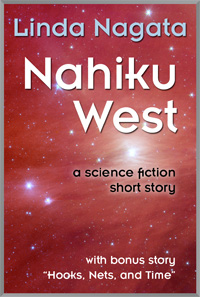
Nahiku West by Linda NagataThe October issue of Analog was published back in August and contained my novelette “Nahiku West.” The period of exclusivity has expired and I’m now free to re-publish the story — so I’ve done so, in ebook form. If you haven’t had a chance to read it yet, now’s the time.

For now the ebook is available only at Book View Café, but it can be purchased there in either mobi or epub versions.

Set in The Nanotech Succession story world, “Nahiku West” takes place in a nanotech-drenched future, where anything is possible, but not everything is allowed. Police officer Zeke Choy is charged with enforcing molecular law — but his first task is to determine if a crime has taken place. “Nahiku West” is set in the same world as the award-winning novel The Bohr Maker.

The list price of this story is $2.99, but for that handful of readers who visit my blog, use coupon code NW1012 for $1.00 off.

Click here to read the opening paragraphs.

Here’s what Locus says about “Nahiku West”:
“A complex mystery, with an intricate plot… Well conceived and well executed. RECOMMENDED.”

Snippet: Skye Object 3270a

September 29th, 2012

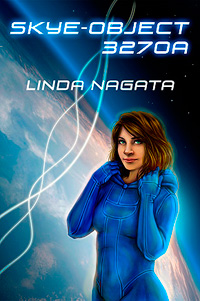
Cover of SKYE OBJECT 3270a

The pit was an ugly chunk of a room, weirdly lit by panels set between the three sets of elevator doors along its curving back wall. Faint shadows shifted and rippled across the floor, leading Skye to glance up, at the domed observation bubble, and the faces of nearly two hundred ados staring down at her. Buyu was there. He gave her a thumbs-up. Skye pretended not to see.

She straightened her shoulders, glancing nervously at Commandant Penwo’s office, sheltered behind a transparent wall on one side of the jump pit. She could see him, dressed in street clothes and rocking in a high-back chair. He didn’t look happy. He wanted to veto this jump, but Skye was fourteen now, and by Silk’s city charter that meant she was free to do any activity approved for ados. It was a giddy freedom that she had been cherishing over the five days since her birthday.

Penwo caught her glance. He shook his head. “Somewhere between six and sixty people lose their good sense,” he said. “We don’t call this phase ‘dumb ado’ for nothing.”

Skye’s fingers twitched. “Can you remember that far back, Commandant?”

Penwo grinned. “Have fun, Skye Object. Hope you live.”

“Forever.”

* * *

Advanced middle-grade / young-adult science fiction, available in print and ebook versions. More Info.

Short Fiction Sale: Asimov’s

September 26th, 2012

I’m very pleased to announce that a short story I wrote last spring has been accepted at Asimov’s. “Through Your Eyes” is scheduled for the April/May 2013 double issue. This will be my first publication in Asimov’s, which is a milestone for me.

In the post linked to above I mention that “The protagonist of this story is proving rather troublesome. He’s in my head, lobbying for his own novel…” Uh-huh, and since then he’s gotten his own novel. That’s the one I’m presently working on, with the first draft just finished a couple weeks ago.

Snippet: Limit of Vision

September 23rd, 2012

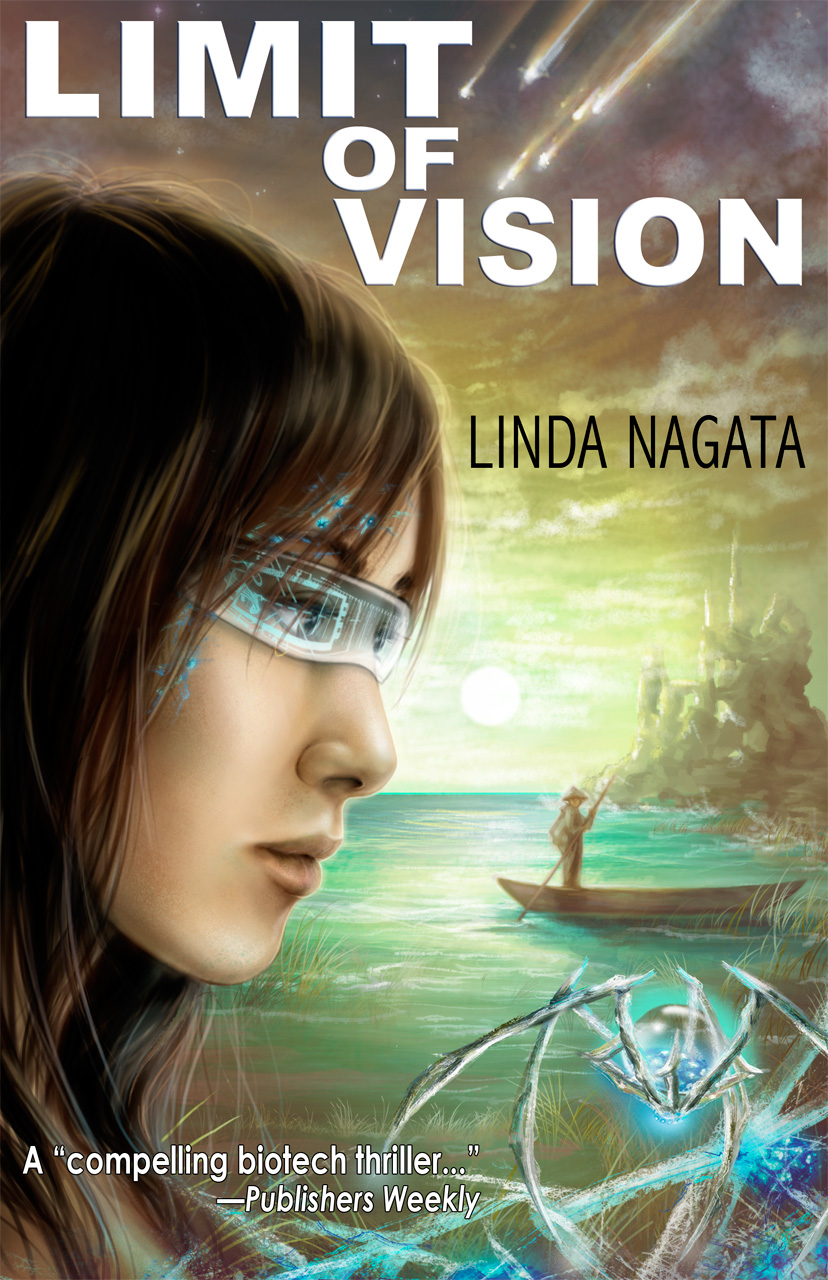
Limit of Vision - cover art by Sarah AdamsLimit of Vision was originally published in 2001 by Tor Books. It begins in Honolulu, but most of the story takes place in the Mekong Delta of Vietnam.

“I will tell you a story of these children,” Ky Xuan Nguyen said, startling Ela again with his voice so intimate in her ear. “It is said the Roi Nuoc are not human. Some say no children are truly human anymore. They are invaders, living in disguise among us. Aliens. They hope to keep us unaware until they reach breeding age, at which time they will bear only alien-type offspring. At that point the world as we know it will end. If we are unlucky, or undeserving, they will murder us all. If we have shown the proper deference and respect, they may choose to see us through an honored old age, but even so, we will be the last human generation. Any children we bear will belong to them.”

Ela caught herself barely breathing. She had heard this same story in Bangkok, after Sawong left with his lover and she was alone. “If you want to be afraid of something,” she said softly, “it’s easy to find an excuse.”

“I’m not afraid.”

No. Why should he be?

She spoke to the green-tinted mud. “People like to talk. But these are not evil spirits. Not alien invaders.”

“You’re sure?”

Her mouth felt dry. Sawong had left her with a thousand baht, a set of farsights, and the keys to his apartment. She’d been twelve. “They are just children.” She tapped her fingers, wishing she could see Nguyen’s face so Kathang could read him. “They are just children. I should do an article on them. That would be a good thing, if I show—”

“No, Ms. Suvanatat, that would not be good. You will not write about the Roi Nuoc. Not now. Not ever.”

Ela stood still, gazing back at the village and the silhouettes of distant women working in their platform houses, feeling as if she stood on the rotten floor of an abandoned tenement. Only a fool would take another step. So. “You think you can make it forever?”

“You are much like the Roi Nuoc, Ela. You are very like them. You could have found Sawong, or waited for him to return. But you didn’t. Why not?”

Anger blended with her surprise. He should not know about Sawong. He should not have bothered to know. “Say, did you want to do an article on me?”

“That would be difficult. There’s not much to tell, is there?”

“Sure. Aliens lead dull lives.”

“I take it we understand each other, Ms. Suvanatat?”

Oh yes. She understood him. He had made a mistake, talking to her about the Roi Nuoc, and now he wanted to pretend that mistake was repaired. Fine. “Of course, Mr. Nguyen.”

So what was his connection to the Roi Nuoc anyway?

With a few quiet finger taps, she passed the question on to Kathang for investigation. After all, she was not going to stay trapped in the Mekong forever. Someday soon she would be in Australia — and beyond Nguyen’s reach.

* * *

Publishers Weekly:
[A] compelling biotech thriller. Nagata…enlivens this extended chase through the steamy murk of Mekong swamps and the monsoons of the southeast Pacific with fascinating biotech hardware and gadgetry as well as clever extrapolations into nanotech potential…an idea-provoking narrative that is genuinely innovative in conception.