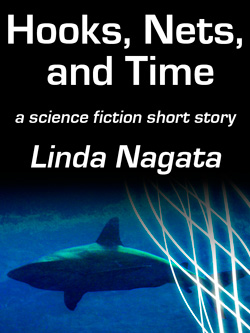
Hooks, Nets, and Time is a near-future science fiction short story originally published in The Magazine of Fantasy & Science Fiction and now available in ebook format for 99¢. Here’s how the story opens:.
 The ocean ran through his dreams. The panting breath of the wavelets as they rose and fell against the pylons became his own breath, a slow, deep rhythm in his lungs that forced him to run. His footfalls reverberated against the black plastic photovoltaic field that doubled as a deck: a square track five kilometers long, encompassing the perimeter of the shark pen. Starlight glinted off the water; glistened in the film of sweat that coated his pumping arms. The rubber soles of his running shoes beat out an ancient cursorial rhythm, a telling vibration transmitted through the deck to the perforated steel walls of the shark pen and then to the coral foundations of the station some twelve fathoms below. Crippled Tiburon would be lurking there near the bottom, listening, measuring the vibrations in his ancient, clever mind, waiting for the hour when his fins had fully regrown and his strength was at once new . . . and old.
A thin wail twisted through the humid night. Tiburon heard it in the depths and thrashed his powerful tail. The wail grew into a distant howl of terror.
A faint splash.
Zayder sat up abruptly. The dream peeled away like burned film, leaving him in another version of the night. He’d fallen asleep on a lounge chair again, in the open air, on the deck of the Ocean Hazards Collection Station that he managed alone. The blocky silhouette of the shed rose behind him. The structure seemed to be an ugly afterthought to the automated design of the UN mandated OHC Station. Still, it served him for housing, and storage for the shark farm: luxury quarters compared to the fishing boats he’d grown up on.
Out on the water, the distant lights of a freighter interrupted the blanket of starlight. In the pen, the swish and splash of a shark fin accented the peaceful wash of the ocean.
Zayder leaned forward, ignoring the dry moss of a hangover that clung to his tongue and the roof of his mouth. He listened, unsure if the howl had been part of his dream. His pulse still hammered in his ears. He’d heard howls like that before: once as a kid, when a man fell off the shark boats in the Sulu Sea. And again, one night when Mr. Ryan came to the station. Zayder had only feigned drinking the cordial that should have sent him into a drugged sleep. That night he’d watched surreptitiously as a bound man went screaming to the sharks.
He listened. He thought he could detect a distant, angry voice from the direction of the freighter, but that was all. And what if he heard more? What was he supposed to do if he discovered mayhem and murder on the high seas? Call Mr. Ryan and complain about the neighbors?
He chose to believe that it had been a dream.
#
Dawn came. Zayder woke, washed his face, put on his running shoes. Another day. He would spend the morning doing maintenance on the robotic garbage trawlers that had come into the station overnight from their long forays into the South China Sea. In the afternoon he would mutilate sharks, harvesting the regrown fins of the captive beasts for sale on the Chinese market—the prized ingredient in shark fin soup. So much to look forward to.
But first he would run.
He set off at an easy pace on the only route the station offered: a 5K lap around the photovoltaic decking built atop the steel mesh wall of the shark pen. At high tide the deck was a meter above the water, with the open sea on one side and the enclosed waters of the pen on the other.
Zayder had run this makeshift track twice every morning for almost a year. Boredom had been left behind long ago. Now, his mind automatically faded into a passive altered state before he finished the first hundred meters. Conversations rose from his past to fill his consciousness, insignificant exchanges: a joke offered to college acquaintances in a bar; polite questioning of a professor; a cautious response to the inquiries of a government personnel officer hiring biologists for the wildlife refuge at Moro Bay; and yet another personnel officer, hiring for the marine sanctuary in the Gulf of California, and another and another, until they all seemed to be different versions of the same bad news: I’m sorry. You have an excellent record and your thesis is impressive, but I’m afraid you’re not quite right for us.
He studied every word, searching for some point where—if only he’d phrased things differently—events would have taken a more positive path. An absurd exercise. He already knew the point when his career in marine biology had been lost. It had happened even before he knew what a career was, when he’d been arrested at seventeen for poaching.
It had meant nothing to him at the time. He’d been working for his Dad, hunting pelagic sharks for a dealer, who preserved the bodies and sold them as dramatic ornaments for coastal mansions. Zayder’s family had been deep water fishermen for generations. But as natural resources dwindled, what had been an honest occupation gradually became a crime, and an arrest for poaching just another risk of the business.
But the wealthy patrons who supported refuges and sanctuaries around the world didn’t see it in that practical light. No refuge manager would want his patron’s newsletter to ring with the headline: Former poacher hired as field biologist.
It had never mattered how well he did in school.
But he’d come too far in life to go back to the boats, so he’d taken a job with Mr. Ryan instead. Ryan did not believe in nonprofit enterprises. When a U.N. mandate required every corporate entity that generated potential ocean garbage to construct and maintain an Ocean Hazards Collection Station, Ryan had expanded on the design by adding the shark pen.
Shark fins were much in demand and now nearly unobtainable since the wild populations had been hunted almost to extinction. Tiburon’s fins alone would fetch twice Zayder’s yearly wages each time they could be regrown and harvested. Ryan’s select market held the great white shark in high esteem: no other great white had been reported in nearly five years. Speculation held the captive animal to be the last of its species.
But beyond the income from fins, the station was useful to Ryan in other ways. So Zayder finally found himself employed again, master of a remote world built on a reef in the South China Sea.
#
The deep blue sky lightened as he ran. The pink fair weather clouds that hugged the horizon gradually brightened until they were bathed in brilliant white. A moment later the rim of the sun appeared above the water. Zayder ducked his head, his thoughts blown back to the present by the sudden blast of daylight.
A hundred meters out on the sun burnished water a black torpedo armed with a spine of pentagonal fins scudded towards the station: one of the robotic garbage trawlers being driven home by a combination of the light breeze against its adjustable fins, and a solar powered engine. Its collecting tentacles trailed a hundred meters behind it: some on the surface, some searching out the depths below. Most of them were laden with a motley collection of old plastics, netting, glass, metal and organic debris bound for the station’s recycling bins.
Zayder slowed to watch the trawler come in. At the same moment a white noise explosion of water erupted from the pen, scarcely a body length away. Startled instinct slammed him backward as the geyser of white water lunged toward him. A solid shape appeared as the pearly water fell away. He recognized the massive, lead gray profile of a great white shark, its fins fully grown and its maw open, its upper jaw thrust forward to expose rows of triangular teeth. Tiburon!
Spray washed over Zayder as he threw himself back, a split second before the five meter shark slammed onto the deck. The whole structure shuddered. Fracture lines bloomed in the photovoltaic panels beneath Tiburon’s belly. The shark fixed him with its manic black eyes. It thrashed on the deck, jaws snapping in an effort to get at him. He felt the rush of air as the teeth closed within centimeters of his ankle.
“You bastard!†he screamed. He jumped back again. The shark thrust forward. Its torso was draped on the deck, but its great tail was still in the water, fanning the surface into a violent foam. “Back in, you fucker!†Zayder screamed.
The shark snapped twice more, then grew still. Its eyes still fixed on him, it slid silently back into the water.
Zayder stood on the deck, his shoulders heaving, a torrent of curses spilling from his mouth. Tiburon was the oldest, biggest monster in the pen. Zayder had harvested his fins five times, each time salving the wounds with a regenerative balm that forced the valuable fins to regrow. Five times he’d nursed Tiburon in the recovery channels, where pumps forced a steady torrent of water over the helpless shark as it writhed on the bottom of a narrow steel chute.
“I’ll take your fins again this afternoon,†Zayder growled. Cautiously, he stepped forward, to peer over the edge of the deck. Tiburon was a skulking shadow a fathom down.
Suddenly the shark turned, cruising slowly out about fifty meters toward the center of the pen until Zayder lost sight of it. A moment later Tiburon reappeared, still a fathom below the surface, his great tail flailing as he charged the wall of the shark pen. Zayder got ready to dodge a second lunge. But Tiburon had his own designs. He rammed the wall of the pen with his snout. The blow shook the structure. Zayder stumbled, swaying to keep his balance. He almost went down.
What the hell was going on? Was the damn fish trying to knock him off the deck?
Tiburon took off again for the center of the pen. Zayder turned, ready to run for the shed and his tranquilizing harpoon, when a low moan reached his ears. “Help, man. Help me,†a tired voice croaked.
It came from the ocean side of the deck. Zayder glanced over his shoulder. Tiburon had turned. Quickly, Zayder dropped to his knees and leaned over the decking to spy a young man—probably no more than twenty—adrift in the light swell, a few meters outside the steel mesh. The sun shone full in his pale face as his bare feet tread the water in quick, frantic strokes. His dark hair floated like an ink cloud around his shoulders, blending imperceptibly with his black shirt. He sputtered, his eyes pleading with Zayder for help.
Looking at him, Zayder grinned in sudden relief. No wonder the shark had been pumped into a manic state. Tiburon had smelled game in the water. And just where had this stray fish come from? He could guess. The garbage trawlers had brought bodies in before—though never live ones. The trawler tentacles were designed to detect and avoid living organic structures. But Zayder knew that clothing could confuse them.
Just then, the shark rammed the wall of the pen again. The deck shuddered. “Not this time, you man eating bastard,†Zayder muttered.
He dropped to his belly and reached out a hand to the foundering stranger. The water was a meter and a half below. “Here,†he barked. “See if you can reach me. I’ll pull you up.â€
The kid shook his head, his mouth twisting in pain. “Can’t,†he panted. “Hands are bound.â€
Zayder scowled. And who had bound his hands and dropped him into the sea? Maybe it was better not to know. Zayder didn’t want to get sucked into the personal affairs of men like Ryan.
The stranger seemed to read his thoughts. He closed his eyes, leaned back farther in the water and stopped kicking, as if waiting for Zayder to decide whether he would live or die. Zayder cursed softly.
Men like Ryan might have a choice. But he wanted never to be a man like Ryan. Quickly stripping off his shoes, he slipped over the side of the deck and into the water.
The ocean’s cool and pleasant hand enfolded him, quenching his doubts. He stroked to the stranger, hooked an arm across his chest and dragged him along the pen wall, nearly sixty meters to a maintenance ladder. He tried not to see the huge shadow that cruised back and forth, back and forth, just a few meters away on the other side of the steel mesh. But he could feel the kid watching.
Zayder didn’t blame him. The mesh wasn’t designed to inspire confidence. It had a gauge wide enough to allow Zayder to wriggle through if he had to. The shark seemed appallingly near.
To distract the kid, he asked: “How’d you get the garbage trawler to let you go?â€
The kid’s eyes squinched shut. Then in hoarse English, dignified with a slight British accent, he explained: “I was floating motionless in the water when the trawler took me. It grabbed me around the chest, and dragged me. It was moving so fast, I couldn’t fight it. I thought I was going to drown. Then it stopped here. I twisted and kicked until it let me go . . . why? Motion . . . characteristic of living organisms. The trawler’s . . . not supposed to be hazard to sea life . . . so I suspect motion . . . stimulated my release.â€
Zayder began to regret asking the question. Who the hell was this kid?
He reached the ladder, then hooked an arm around the lowest rung, heaved the kid over his shoulder and climbed out. “I think I can walk,†the kid gasped. Zayder didn’t believe him. He laid him carefully on the deck, then checked for Tiburon. The fish was cruising out toward the center of the pen again, so Zayder took a moment to check the bindings that held the kid’s arms pinioned behind his back.
He discovered two ropes: one at the elbows, one at the wrists. The kid’s palms were pale and wrinkled from exposure to water. A lacy network of blood seeped across them from his finger tips. His finger tips? Zayder felt a chill across the back of his neck. This kid had no finger tips. His fingers were torn, bloody stubs, taken off at the first joint. “Holy mother,†he whispered. “Who did this to you?â€
The kid blinked, an odd look of wonder on his face as he lay on the deck. “The shark,†he whispered in his cultured accent. “I was holding onto the mesh. My fingers were inside. I didn’t see it coming.†He turned his head, to look out across the pen. Zayder followed his gaze. Tiburon had turned. He was driving hard for the mesh again. “I never saw a shark before.†He smiled in a dizzy, distracted way. “I can’t believe how lucky I am to see one.â€
Zayder scooped him up and ran for the shed as Tiburon hit the mesh one more time.
Shop for the ebook at:
Amazon.com USA
Amazon UK
Barnes & Noble
99¢ / £0.71