Linda Nagata: the blog at Hahví.net


Archive for the 'Recommended Reading' Category

Story Raves

Wednesday, February 5th, 2014

Tis award season in the writing world, and while I don’t read nearly as much fiction as I’d like — I am a slow reader — I do like to share the novels and stories that I’ve especially enjoyed. Here are three impressive pieces of short fiction:

OLD MARS, edited by George RR Martin and Gardner Dozois“The Wreck of the Mars Adventure” by David D. Levine
This is a novelette published last fall in the anthology Old Mars, edited by George R. R. Martin and Gardner Dozois. The idea behind the anthology is a return to the fantastical, early days of science fiction, and David does this with no-holds-barred. “Mars Adventure” is a fantasy — it involves a 19th-century airship voyage between the planets in a solar system where there is breathable atmosphere everywhere. The setup reminds me a little of Karl Schroeder’s world of Virga, but “Mars Adventure” is a different sort of story, fun, swashbuckling, and very clever. For SFWA members, reading copies are available in the forum.

“In Joy, Knowing the Abyss Behind” by Sarah Pinsker
As you can gather from the title, this is a more serious story, a tale of human relations and the secrets we keep from one another. Published by Strange Horizons, it’s available to read online.

“The Schrödinger War” by D. Thomas Minton
This is a war story: a quantum tale of battles fought and re-fought, and fought again. I thought it was very well done and I’ve been surprised and perturbed by how little notice it’s gotten. So go check it out! Published by Lightspeed, it’s available to read online.

Republic, Lost

Saturday, December 15th, 2012

My latest read was Republic, Lost: How Money Corrupts Congress–and a Plan to Stop It, by Lawrence Lessig. The book poses the question of why the big issues facing the United States are forever kicked down the road by Congress, and as a corollary, why the issues that Congress does spend its time on are not the issues that matter to the great majority of the American people.

The answer posed by the author in a very convincing manner is that the single greatest concern of most senators and Congressional representatives is to get re-elected, and re-election takes money, and money comes from – well, you know the answer. Money comes from corporations and well-funded organizations seeking to advance their bottom line.

The fascinating argument of this book is the author’s explanation of how this funding system works, and it’s not by outright (illegal) bribery. He describes a complex system involving personal relationships, gift culture, well-connected and well-paid lobbyists, and “donations” of a few thousand dollars that can be leveraged into millions if only the right piece of legislation is passed. And it’s all legal.

There is much more – enough to derail the most optimistic among us, I suspect. At the end of the book, Lessig offers several strategies that might solve the problem and return our representatives to what should be their true work: representing the voters who put them in office, not the contributors who made their campaign possible. None of the solutions struck me as likely to make any difference. The most promising one was to work on getting the required plurality of states to call for a constitutional convention to address campaign finance reform – and of course we’re a long, long way from that ever happening.

Strangely enough, this book affirmed the cynical worldview that’s a background element of some of my upcoming work, particularly the story due in an issue of Asimov’s Science Fiction and, sadly, it’s affirmation that I did not go too far in my extrapolations.

Story Rave: “Homecoming” by Robin Hobb

Friday, December 7th, 2012

So…I was tired last night. It seemed like a good idea to go to bed early and catch up on my sleep. I would read for just a few minutes first…

Big mistake!

When it came out not long ago, I grabbed a Kindle sample of John Joseph Adams’ anthology Epic: Legends of Fantasy. The first story is “Homecoming” by Robin Hobb, originally published in 2003. This was actually my second attempt to start the story which, oddly enough, opens with a detailed inventory of an artist’s household goods that didn’t strike me as exactly gripping. I was in a more patient mood this round and kept going. Very soon I was entirely caught up in what proved to be a novella. I got to the end of the sample, purchased the ebook, and kept going until I finally finished at midnight.

So much for getting extra sleep!

But it’s fun to be caught up and swept away by a story. Honestly, that doesn’t happen all that often anymore.

“Homecoming” is an adventure story of great trials and hardships, strange landscapes, and hard choices, but it’s the protagonist’s voice that makes it fascinating. It’s written as a series of journal entries so that we see the unfolding events entirely through the protagonist’s viewpoint, while we see her change and adapt to new circumstances.

If the rest of the stories in Epic: Legends of Fantasy are just as good, I’m going to be losing a lot of sleep.

Book Rave: Dispossession

Monday, October 22nd, 2012

BVC releases Chaz Brenchley's DISPOSSESSIONNew today from Book View Café is Chaz Brenchley’s Dispossession, an unusual, intricate, and engrossing mystery with an element of fantasy.

I picked this novel up by chance from the inner-sanctum of BVC, without knowing anything about it, not even what genre it was. It didn’t take long to hook me. The writing is gorgeous, and the story deeply intriguing: this is a tale of amnesia, as protagonist Jonty Marks wakes in hospital three months after his last recallable memory to find his staid life utterly changed.

Writers write for different reasons, for different goals, for different purposes. My own writing grew out of my love for adventure stories: lots of action, big sets, suffering heroes and antiheroes. Dispossession has its own action and determined plot, but it seems to me it’s written more to illuminate the human condition. In this age of 99-cent pot boilers, I’m almost afraid to tell you that much of this long book involves the inner reflections of the protagonist, Jonty Marks, and sadly it feels necessary to add the story is not boring at all! Here’s a quote to show you what I mean, with a few sentences snipped out that might be spoilers:

I still thought he was nineteen; still thought that was exact. Full growth but no maturity, whip-fast reflexes and not an ounce more flesh than he could need or want; fire and hunger, passion and arrogance and the habit of instant judgment with no sense of perspective, no leniency.

And beauty, of course […] and engulfing all, the certainty that there was no forgiveness, that there could be no reconciliation in this world or any other.

And that also was pure nineteen-year-old thinking, and not subject to debate.

As a writer, I deeply admire the ability to write descriptions like that.

Another interesting aspect of Dispossession for me: this is the most “British” book I’ve ever read. I was frequently asking my Kindle to provide me with definitions for unfamiliar words, and slowly realized that all the other books I’ve read by British authors must have been translated into “American.” This is the pure product.

You’ll find a more extensive description of Dispossession’s plot at Book View Café — too much description, in my opinion. Books should tell their own story, as the plot unfolds. My recommendation is to skip reading the BVC description and just grab the sample chapters. That will let you know if Dispossession is a book for you, or not.

If you do read it, let me know what you think!

Book Rave: Devil Said Bang

Tuesday, September 4th, 2012

Devil Said Bang is the fourth and most recent installment of Richard Kadrey’s Sandman Slim series. (Sandman Slim, Kill The Dead, Aloha From Hell.) I freely admit to being a fan-girl. I picked up the first book by chance last March, quickly grabbed the second, revised my principles on ebook pricing to read the third, and pre-ordered the fourth and most recent — the first time I’ve pre-ordered anything.

The books are violent and profane, but they’re also loaded with clever dialogue and compelling characters. The stories are told by “Stark” aka Sandman Slim, a young magician (actual magic, not illusion) who was betrayed by his circle of “friends” and whisked off to Hell. When he manages to escape his fate, revenge is on the menu.

Stark describes himself as “a shitstorm magnet” and this is not an exaggeration. His adventures ramp up in scope through the first three books, but Devil Said Bang brings things back to a more human scale. I think it’s the best book since the first one, but I might just re-read them all to be sure.

This is the sort of series that makes me wonder why I like what I like — lately I’ve glanced at other, much praised, books and moved on — but that’s a subject for another blog post.

If you’ve read Sandman Slim I’d love to hear what you thought. If you haven’t, grab a sample of the first book and give it a try. I’m not the only one raving.

Book Rave: Sandman Slim

Tuesday, March 6th, 2012

(cross-posted from Book View Café)

Richard Kadrey’s Sandman Slim was released to wide acclaim in 2009, but I only discovered it last week, and that happened in a roundabout way:

My own novel Hepen the Watcher: Stories of the Puzzle Lands – Book 2 should be out later this month. When Book View Café authors have a new release, one of the promotional strategies we use is to give away a hundred copies of the ebook via the Early Reviewers program at LibraryThing.com. One of the requirements of this program is to supply a list of five titles somewhat similar to the book being promoted so that, with luck, the book will find those reviewers most likely to enjoy it.

Hepen the Watcher and its predecessor The Dread Hammer are unusual books. They’re sort of like sword and sorcery, because they have swords, and, well, sorcery — or magic anyway. But they’re not very traditional. Both are short, fast-paced, violent, and shot through with dark humor and feminist themes. I asked a couple of people who’d read them if they had any suggestions for similar books. The answer in both cases was, “Um, not really.”

So I turned to Google, searching on terms such as “fantasy” and “dark humor.” Sandman Slim kept showing up in the results, so even though the setting was entirely different from my books, I downloaded a sample, started to read it, and was immediately hooked.

The book is the story of James Stark, who was spirited away to Hell through the machinations of “friends” who turned out to be not-so-friendly after all. Stark is the only living human to ever set foot “Downtown,” and he survives there for eleven years before escaping back into the world in search of revenge.

And that is all I’m going to tell you about the plot, but I will add that if you’re offended by the movie Dogma, you probably won’t like this book. Sandman Slim is irreverent, violent, funny, clever, and so compelling that it’ll probably take me a couple days to catch up on my sleep.

It’s also a wonderful example of the sympathetic antihero. Not long ago I started to read another acclaimed book whose title shall go unmentioned. This one was also violent, but not at all funny, and I found no sympathetic or likable characters anywhere at all in the opening chapters. I didn’t finish that book. By contrast, James Stark, despite his violence, is a character to root for because he really does give a damn, he knows when he’s done wrong, he feels guilt, and he’s capable of love.

And for the writers out there, if you ever want a lesson on how to weave in the back story in a first-person narrative, Kadrey does a wonderful job of it in this book.

My only complaint about Sandman Slim is on the quality of the ebook. I read the Kindle version, and found it loaded with an unbelievable number of repeated, out-of-place, and incorrect words. Any competent proofreader should have picked up most of these, so I can only surmise there was no proofreader for the ebook.

But don’t let this stop you. If you read ebooks, then grab a sample. You’ll know within a few pages if this is a book for you. Print versions are also available, of course.

Book Rave: Bloom
by Wil McCarthy…

Tuesday, January 3rd, 2012

…and the value of writer support groups

Long ago, when the Internet was young and an overabundance of email was never a problem, I returned home from a vacation to find over twenty messages in my inbox. This was unheard of! And I knew at once that something was up.
What had happened was that the young and upcoming science fiction writer, Wil McCarthy, had decided to pull together a group of other writers who were still early in their careers, for the purpose of mutual support and information exchange. The queue of emails reflected an enthusiastic response from the invited writers. The last email in the queue was from Wil, saying something like “Well, we haven’t heard from Linda, so I guess she’s not interested.” To which I replied instantaneously with “Yes, I am interested! I just haven’t been home!”

Hooking up with this little group of writers was one of the best things that ever happened to me, as a writer. Yes, I learned an incredible amount, but just having friends who understood, who I could turn to when things went wrong in the business—that was invaluable, especially to me, living in isolation from other writers out here in the middle of the Pacific. I’m sure it’s the same for many who live in small towns. Finding people who share your passion can make all the difference, and I encourage all writers, especially if you’re just starting out, to find your team, your support group. You won’t regret it.

In my group we often served as beta readers for one another (although I don’t think the term “beta reader” had actually been invented yet). So I had the opportunity to read Wil’s novel Bloom in manuscript. I honestly don’t remember what I said about it, but in the acknowledgements, Wil thanks me and Kathleen Ann Goonan “for not pulling punches.” Hmm….

At any rate, Bloom was published in 1998 to terrific reviews, and it was a New York Times “Notable Book.” Its premise is that a runaway nanotechnology has destroyed all life as we know it on Earth and has made the inner solar system uninhabitable, leaving people to survive in small pockets among the asteroid belt and the moons of Jupiter.

Perhaps inspired by a need to stroll down memory lane, I pulled Bloom off my shelf a few days ago and started reading. I finished it last night, and I have to say, I’m more impressed than ever by this book. If you’re into hard science fiction, I encourage you to grab a sample and give Bloom a try.

I’m glad I can say “grab a sample.” I did not know this before I sat down to write this post, but it looks like Bloom was re-published as an ebook only a little over a week ago. Here’s the Amazon link. Enjoy!

As an addendum, I should add that after many years our group finally drifted apart, as most of us moved on to other ventures, but I still think fondly of everyone involved.

Book Rave: Anthony Pignataro’s Small Island

Sunday, November 6th, 2011

Confession: The only reason I grabbed a Kindle sample of this book was because it was written by a Maui author–not someone I know, but there aren’t all that many of us, and I’d like to be familiar with who’s out there.

Small Island, falls, I think, in the thriller genre. It features a former army officer working as a bartender on Maui’s westside, who reluctantly gets drawn into a personal investigation of illicit goings-on on the island. I started this book feeling pretty skeptical, since one of the prominent characters was described as a former porn star, but the author handled that aspect quite well, and I’m pleased to report this turned out to be an impressively good book.

This isn’t my genre. I really don’t know how Small Island compares to other PI/thrillers, but I enjoyed it. It explores a seedier side of Maui than the one I live in, but the descriptions mostly rang true to me. I thought the writing was smooth and effective and the character portrayals had just the right depth.

So if a book set in modern Maui appeals to you, do give Anthony Pignataro’s Small Island a try.

Book Rave: Bio of a Space Tyrant, Vol 1: Refugee

Sunday, October 16th, 2011

Rating books from one to five stars is useful for developing a quick consensus on how good a book is, and every author loves to get four and five star ratings. But as a reader I find star ratings problematical. I can greatly admire a book without loving it. I can be utterly intrigued by a book while feeling ambivalent about it. Should I give such a book three stars? Four? Five?

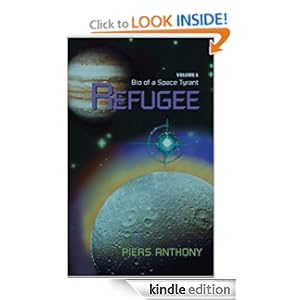
Bio of a Space Tyrant, Volume 1, Refugee by Piers Anthony is the present example. Someone, somewhere–on twitter or G+ or facebook–mentioned this book and, wanting to read some older science fiction, I picked it up. The copyright date is 1983.

I’ve never read anything like this before. The story takes place on and around the moons of Jupiter. Science and technology are often carefully and clearly explained in a style that feels dated and yet works very well. Bio is a first person tale, told from the point of view of a fifteen-year-old refugee fleeing political oppression, and has clear parallels to real-world stories of refugees fleeing Cuba or Haiti.**

At its core, Bio is a brutal, horrific tale, made readable because of the detached, analytical tone of the young narrator as he comes to terms with the worst of human nature and struggles to retain a belief in the best of human nature. There is an obsession with rape and male violence throughout, with every bit of it discussed and analyzed, and none of it remotely titillating. Despite all this, the book is not nihilistic. It’s very much concerned with love, loyalty, human relationships, and doing what you have to do to survive.

Still, with a book like this I can’t say, “Go read it! You’ll love it!” because it’s not that kind of book. But I can say that I was fascinated by this story almost from page one and that I knew I’d be blogging on it long before I finished. Oh, and I’ll be starting in on volume 2 very soon.

So if you’re up for something powerful and different and, yes, grim, go read it–and let me know what you think.

** This paragraph was written before I had quite finished reading the novel. In a postscript within the book, Piers Anthony confirms this was the case.

Book Rave: Cold Fire by Kate Elliott

Wednesday, September 21st, 2011

Last fall I wrote enthusiastically about Kate Elliott’s Cold Magic. I’ve just finished Cold Fire, the second book in the trilogy. Consider this post my emphatic thumbs-up!

Cold Magic was set in glacial Europe. In complete contrast, Cold Fire takes place mostly in the Caribbean, in a world that is like Earth, but is not Earth in many critical ways. I loved both the setting, centered around the tropical city of “Expedition,” and the wonderfully detailed culture of that city. I loved the way the lead characters adapted and bloomed in this new world.

As in Cold Magic there are all sorts of adventures to be had along the way, not least of which is the evolving relationship within our protagonist’s forced marriage.

And the ending? I need to drop back in time and borrow from a unrelated third party for the appropriate response:

BANG-A-RANG!

Oh, and I hear you can order a signed copy of Cold Fire from Powell’s Books.