Linda Nagata: the blog at Hahví.net


Archive for the 'Writing' Category

Book Rave: Bloom
by Wil McCarthy…

Tuesday, January 3rd, 2012

…and the value of writer support groups

Long ago, when the Internet was young and an overabundance of email was never a problem, I returned home from a vacation to find over twenty messages in my inbox. This was unheard of! And I knew at once that something was up.

What had happened was that the young and upcoming science fiction writer, Wil McCarthy, had decided to pull together a group of other writers who were still early in their careers, for the purpose of mutual support and information exchange. The queue of emails reflected an enthusiastic response from the invited writers. The last email in the queue was from Wil, saying something like “Well, we haven’t heard from Linda, so I guess she’s not interested.” To which I replied instantaneously with “Yes, I am interested! I just haven’t been home!”

Hooking up with this little group of writers was one of the best things that ever happened to me, as a writer. Yes, I learned an incredible amount, but just having friends who understood, who I could turn to when things went wrong in the business—that was invaluable, especially to me, living in isolation from other writers out here in the middle of the Pacific. I’m sure it’s the same for many who live in small towns. Finding people who share your passion can make all the difference, and I encourage all writers, especially if you’re just starting out, to find your team, your support group. You won’t regret it.

In my group we often served as beta readers for one another (although I don’t think the term “beta reader” had actually been invented yet). So I had the opportunity to read Wil’s novel Bloom in manuscript. I honestly don’t remember what I said about it, but in the acknowledgements, Wil thanks me and Kathleen Ann Goonan “for not pulling punches.” Hmm….

At any rate, Bloom was published in 1998 to terrific reviews, and it was a New York Times “Notable Book.” Its premise is that a runaway nanotechnology has destroyed all life as we know it on Earth and has made the inner solar system uninhabitable, leaving people to survive in small pockets among the asteroid belt and the moons of Jupiter.

Perhaps inspired by a need to stroll down memory lane, I pulled Bloom off my shelf a few days ago and started reading. I finished it last night, and I have to say, I’m more impressed than ever by this book. If you’re into hard science fiction, I encourage you to grab a sample and give Bloom a try.

I’m glad I can say “grab a sample.” I did not know this before I sat down to write this post, but it looks like Bloom was re-published as an ebook only a little over a week ago. Here’s the Amazon link. Enjoy!

As an addendum, I should add that after many years our group finally drifted apart, as most of us moved on to other ventures, but I still think fondly of everyone involved.
Writing Goals For 2012

Sunday, January 1st, 2012

Last year on January 1st I published my list of writing goals for the year, and a few days ago I assessed how I did. Some of my goals were less successful than I’d hoped, some more so, and some simply changed over the course of the year. Overall, I think I did fine, and I enjoyed having a list of concrete goals to work toward.

Recently, Dean Wesley Smith blogged on the difference between goals and dreams and I highly recommend you read what he has to say. In short, a goal is something you can control and complete by your own perseverance, while a dream is something that depends on the cooperation of another, or of fate…which is why you won’t see any sales goals in the list below. I can’t control sales, but if things go well, I can produce books and stories.

So here are the writing projects I’m hoping to do in 2012:

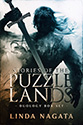
1. The Dread Hammer, published in 2011, is the first book in the series I’m now calling Stories of the Puzzle Lands. Early in 2012 I plan to re-publish it with a new cover, and shortly after that publish the second book, Hepen the Watcher, in ebook and print versions.

2. Finish two original novels. Of the two I have in mind, neither are related to anything I’ve done before or to each other. One is already 20,000 words along and one is in concept stage.

3. Finish four pieces of short fiction, with short fiction being defined as any story less than novel length (but trying really hard for true short stories 7500 words and less).

4. Consult with a professional editor on the potential and direction of my long-evolving novel The Wild, and either bring it to fruition or put it away permanently—though I’m not sure the latter is possible. This is definitely the book I can’t let go of.

Bonus Points
If I get these first four goals done, I’ll be happy, but a really productive year would include initiating two more books, at least in concept if not in actual word count. One would be a third volume of Stories of the Puzzle Lands. The other is just a vague notion, hovering well out there on my mental horizon, but maybe it’s time to contemplate another book in The Nanotech Succession.

And that’s all I’m going to commit to!

I’ll check back here at the end of the year to see how I did. In the meantime, what are you planning for 2012? Let me know–I love to hear from you.

Writing Goals for 2011: The Assessment

Tuesday, December 27th, 2011

Last year, on January 1st, I published my writing goals for 2011. At the time I knew I was being pretty easy on myself, but I thought it was better to put up a target that I had a chance of hitting, then to lock myself into misery and failure. So here’s the result:

1. Publish my indie novel, The Wild, in both print and ebook versions, and PROMOTE!

Didn’t happen! In fact, 2011 started off with massive failure. Reader feedback on this novel was so unenthusiastic that I decided early-on not to publish it. But I haven’t given up on it. Expect to see The Wild involved in my goals for 2012.

2. Complete a draft of a new novel.

Done! In fact, I drafted, revised, and published The Dread Hammer by May of 2011. Over the summer I drafted the sequel, Hepen the Watcher, and have that nearly ready to publish. I’m also 20,000 words into another novel, and have a rough outline on a fourth that I’m looking forward to working on as soon as I’ve cleared some other projects. So novel writing in 2011 was a win! I also managed to write two pieces of short fiction, which wasn’t even on my list of goals last year.

3. Release ebook versions of Limit of Vision and Memory.

Done! I also published two of my old short stories as ebooks, and late in the year, put out a collection of all my previously published short work, titled Goddesses & Other Stories. So putting out ebooks was a win.

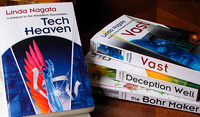
4. Release print-on-demand versions of Tech-Heaven, The Bohr Maker, Deception Well, Vast, Limit of Vision, Memory, and my YA novel Skye Object 3270a.

This was a win because I changed my goal along the way. I decided there wasn’t enough demand at this time to justify POD versions of Limit of Vision and Memory. When they start selling in better numbers, I’ll reassess. But all the other books listed above are now available in print.

5. Finalize and market my first screenplay.

This is a technical win. I did finalize the screenplay, but it never got past the west coast agent, and by the time I had any feedback on it, my interests had moved entirely to novel writing, so I didn’t pursue it.

6. Write a second screenplay.

Nope. Didn’t happen. The idea I’d been toying with for a second screenplay is now on its way to becoming a novel.

7. Keep up with this blog

I’ll call this a win. There have been quiet periods, but I did much better at blogging in 2011 than I’ve done in past years. I see this as a very casual, random sort of blog. I hope that works for you.

8. Meet lots of great people in the reading and writing communities!

If “meet” means “meet online” than this is a win. I’ve also become part of a local writing group for some actual face time with other writers.

How did you do this year? Did you meet your goals? Or exceed them?

Writing Mantras

Friday, November 18th, 2011

Other writers will tell you they have such a surplus of story ideas, they will never live long enough to write them all. Sadly, that’s not me. Usually I have just the current project. Sometimes there’s a hazy next-project, but often not. My present situation is unusual because I have two new novels-in-progress, and a draft of a short story.

The short story was inspired by a resolve to write more short fiction. It’s not that I wanted to write this short story. It’s just that I wanted to write A short story. Something—anything—sf-nal. So I had no hot, spicy kernel idea to get me inspired. All I had was a vague notion of setting, but after brainstorming that from several angles, a plot eventually appeared and I started writing.

But very soon I wanted to stop.

The internal editor was on overdrive. The story felt dry, mechanical, lifeless, not up to snuff. It was hugely tempting to toss the whole thing out and pretend I’d never started it, but I don’t repeat writing mantras for nothing. The two that kept me going were:

(1) finish what you start (Heinlein rule #2)
(2) avoid the “book as event” trap—the idea that every story has to be a cutting-edge award winner

I powered through the draft. It came out around 5,000 words.

Here’s where I’m supposed to tell you that perseverance paid off, it all turned out well, I love the story, etc. Maybe I’ll be able to say that in a future post. I haven’t actually looked at the story since finishing the first draft—but I do have a first draft. It’ll get better on revision. Then I get to apply another handy writing mantra:

(1) Put your work in front of someone who might buy it. (Heinlein rule #4)
Corollary: Let other people reject your work

This business never gets easier.

Percolation

Wednesday, November 16th, 2011

The problem with the word-count-per-day goal — that is, swearing to oneself to write a thousand or two-thousand words everyday — is that to be successful you have to have a pretty good idea of what happens next in your story.

It’s no problem at all to write a thousand or two-thousand words of useless rambling thoughts. It’s also fairly easy to write a thousand or two-thousand words when you know exactly what comes next, and it’s a scene you’re feeling, and the voice of the characters and tone of the story is firmly established in your mind.

But what happens when you have no clear idea of the next scene? I’ve got eight published novels, with four more in various stages of development, but I still find myself in this situation all the time — even when I have a rough plan, even when I can see some of the scenes I want to hit down the road. Somehow I have to figure out an interesting way to get the protagonist from where s/he is, to, well, somewhere else, and stir in some conflict and/or mystery while I’m at it. But all too often I feel utterly clueless on how to do this.

So I sit down to just write — you know the formula: trust the subconscious, type away, something will come. Hrmmm…

Does this work for you?

Very rarely, I’ll discover useful plot lines this way. Mostly though, it doesn’t get me anywhere. So I wander about the house. Check email. Check ebook sales stats. Check twitter. Check facebook. Check G+. Shut off the wi-fi and try to write… I can spend hours like this, and then quite often, around three in the afternoon, a switch gets flipped on and suddenly I’m writing useful words!

Sometimes the switch doesn’t get flipped to “on” until nine or ten o’clock at night. In the past year I’ve had some extremely useful midnight writing sessions.

It’s pretty clear that, for me at least, ideas need to percolate. I wish it weren’t so. I wish I could sit down and know what comes next, and write it, and then move on to another project. I wish I didn’t squander so much time that could be put to productive use doing other things. But it is what it is, and I’ve been dealing with the process long enough that, despite the frustrations, I can remain fairly confident that the words will eventually come.

Does any of this sound familiar? How do you deal with the question of what comes next?

Divided Loyalties

Monday, October 24th, 2011

So last night, on the way back to Maui from Honolulu, an idea for a new novel came walking into my head. Right now it’s feeling like a Trey Shiels novel — fast, dark, and a little over the top — but science fiction not fantasy.

Of course I’m already writing a novel, one that I’m sure will ignite! catch fire! start writing itself! at any moment now.

And I’m partway through a short story that I’ve spent a lot of time and effort on, and I really ought to get that finished.

And for years I’ve had a rule that I have to finish the current project before starting the next.

But of course 2011 has been a year for changing the rules.

Hmm….

Why Science Fiction Short Stories
Are Really Hard to Write

Thursday, October 20th, 2011

Your assignment: write a science fiction short story set off Earth, in another time.

Your story should do the following:

(1) Present to the reader an unfamiliar storyworld that is internally consistent and coherent, including an implied past and future.

(2) Present to the reader a specific setting within this storyworld, making sure it includes unfamiliar yet reasonably plausible technology.

(3) Utilize two or three unique and interesting characters. If not human, describe both the general and specific appearance of these characters, as well as their origin and biology. Please avoid caricature! If human, you need only describe your characters’ specific appearance, relying on the reader’s knowledge for general principles. In either case, communicate your characters’ motives and personalities in a manner relevant to the mood and tone of the story.

(4) Develop a fast-paced, action-packed story arc suited to the motives and personalities of your well-developed characters and utilizing the story’s plausible technology as an essential element. Be sure there is an external plot: something must happen. Equally important, include an internal plot: your primary character should have an issue or two to overcome!

(5) Include a theme that adds layers of meaning to your story.

Your assignment should be accomplished in 3000 words or less. Bonus points are awarded for stories achieving levels of “cool,” “awesome,” or “mind-blowing.”

Competitive Productivity

Tuesday, October 18th, 2011

Well over a year ago, before I was truly “all in” on making a return to a writing career, I was having a rare, face-to-face conversation with another writer who made a comment roughly on these lines: “So many younger writers these days seem to make a living by writing book after book after book, staying alive by constantly producing.” I think I groaned, said that I could never do that and wouldn’t want to; that writing was just too damned hard, and I needed at least a year to finish a book.

Yeah.

Times change and it’s good to be adaptable. My writing speed has picked up and I’ve produced a good amount of work this year, but nothing close to the output of some of the writers in my twitter stream. Mind-boggling daily words counts, revision, copyedits, conventions, blog postings, book promotions and contests, charitable efforts, social media . . . I stagger in fatigue just thinking about it.

It’s fairly clear that I’m a slacker. On the other hand, I’m also inspired. Let’s call the phenomenon “competitive productivity.” If so many other writers (even some with day jobs!) can spend so many hours every day on writing-related tasks and produce results then what’s my excuse?

No excuses.

Thanks for the inspiration, y’all.

One Year In—Was It Worth It?

Tuesday, October 11th, 2011

It was one year ago, October 2010, when I started “indie publishing,” determined to get my backlist out into the world again, and hopefully make a little income on the side to support my writing habit.

That first month began with a stint of designing book covers for The Nanotech Succession novels. I started with the covers because I figured that would be the hardest part of the ebook creation process. I spent a lot of time, had a lot of fun, and then later tossed them all out and replaced them with the vastly superior Bruce Jensen covers that the books now enjoy.

In the year since, I’ve published ebook versions of my six backlist novels, one novella, two short stories, and two original novels. I’ve also done print-on-demand versions of the four Nanotech Succession novels, The Dread Hammer, and my young-adult novel Skye Object 3270a.

Was it worth all the time and effort?

Looking only at return on investment thus far, the answer has to be “No.” Whatever pixie dust it takes to get sales rolling has not been sprinkled on me yet. I could have made far more money putting in the same hours at a minimum wage job.

But looking at it emotionally? Then the answer is “Hell, yes, it was worth it!” I feel like a writer again. I’m proud of the work I’ve done, I’m happy to have it available, and I have a lot more confidence in my future as a writer than I had last year. Confidence is a good thing. I don’t write well when I’m stressed, worried, and unhappy.

If you’re a midlist writer putting up your backlist and you too are feeling underwhelmed by sales, remember this: all this prep work is an investment, and investments don’t necessarily pay off in the first year. Being set up, poised, and ready for the day the buzz starts murmuring your name (or your pen name) is a good position to be in.

My goal now is to write more and try to generate that buzz. Part of that strategy is to knock on the doors of traditional markets and try to get back inside—but with eyes wide open this time. My newly adopted buzzword for the upcoming year: “Hybrid writer”—a combination of indie and traditional publishing with the united goal of making a living wage.

Writing Short

Sunday, October 2nd, 2011

After I started selling novels, I stopped writing short fiction, for two main reasons. First, I was better at novels. And second, the short stuff took me way too long to write. It didn’t seem like it was worth the investment of time.

But in this year of “trying new stuff” and “writing faster” I wanted to try writing short again, so I plotted a story. To make it easy on myself I set it in The Nanotech Succession story world and used a minor character from my novel The Bohr Maker as the protagonist–but the story is independent of the book and takes place some years before.

Psyching myself up, I figured “4,000 words–how hard could that be?” I knew the story would likely be much longer than that, but 4,000 words sounded so un-intimidating.

(Do other writers play these head games? I have no idea.)

And then I applied the “Write the first draft fast” approach. Four days later I had a 7,500 word story which I dumped raw onto my local writing group the day before we were due to meet. They were very good natured about it. Several more days went into revision, the story turned into a short novelette of 8,900 words, and now it’s ready to go to market.

Naturally I hope it sells, but after all these years of no short stories, simply having written it feels like a win.