
Linda Nagata: the blog at Hahví.net


Archive for the 'Writing' Category

For Me, Writing Fast ≠ Writing Well

Thursday, January 27th, 2011

I’m 20,000+ words into my current project. I see this as a short, easy little novel, and not a big event by any means. In fact, my primary goal is to try to write fast. (For those of you who don’t know, I’m a notoriously slow writer.) So the rules were to produce a thousand words a day and not worry about editing or getting it right, but just let the story pour out.

Since I had a rough outline and several scenes and incidents lined up before I started, the rules sort of worked for awhile. I made the word count, or more, on a surprising number of days. But around 20,000 words I started getting unsteady. I began jumping to different parts of the story, and frowning over the plot. I started writing in separate files, and in long hand.

And it all started feeling like a huge mess.

So today I broke the rules and went back to the beginning and polished and refined my opening chapter and added some back story that I’ve figured out since I started.

I’m a lot happier now.

So for a while, at least, I’ll bid the rules good-bye.

But I’m still trying to write fast.
My Picture Was In Playboy

Wednesday, January 19th, 2011

True story.

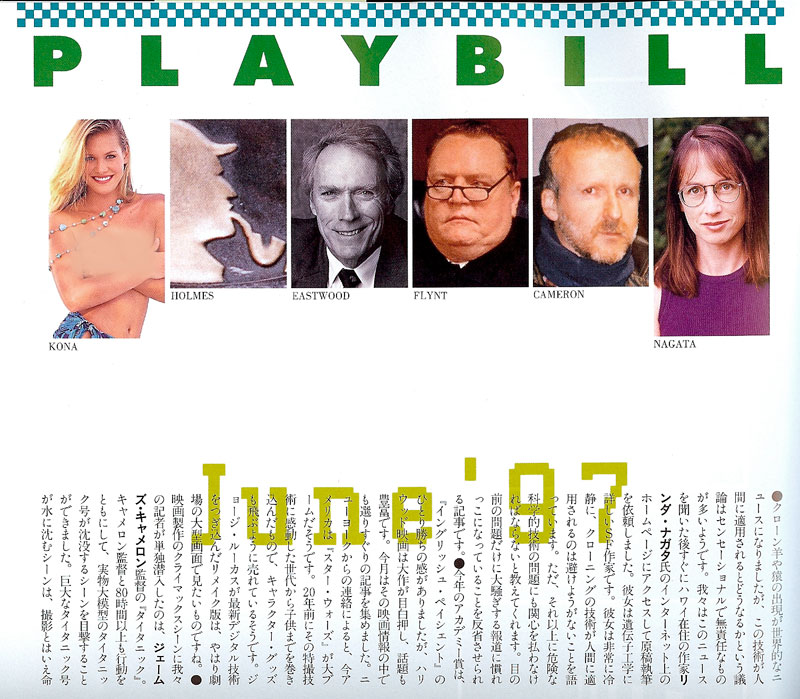
No, no, that’s not me on the left. Look over to the right . . . Yep! I’m the one opposite Kona.

Playboy, Japanese Edition, June 1997

This is the Japanese edition of Playboy from June 1997. I re-discovered it while searching through storage boxes.

Notice that I’m in the company of Sherlock Holmes, Clint Eastwood, Larry Flynt, and James Cameron. One of us is a fictional character. One of us is NOT rich and famous. You guess.

Because people only read Playboy for the articles, I should mention that my article was on cloning. I believe this was the era when Dolly the Sheep was famous.

So yeah–my picture was in Playboy.

Writing Goals for 2011

Saturday, January 1st, 2011

1. Publish my indie novel, The Wild, in both print and ebook versions, and PROMOTE!

2. Complete a draft of a new novel,

3. Release ebook versions of Limit of Vision and Memory.

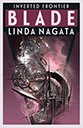
4. Release print-on-demand versions of Tech-Heaven, The Bohr Maker, Deception Well, Vast, Limit of Vision, Memory, and my YA novel Skye Object 3270a.

5. Finalize and market my first screenplay.

6. Write a second screenplay.

7. Keep up with this blog

8. Meet lots of great people in the reading and writing communities!

That doesn’t sound too hard, does it? Hmm, except that part about promotion. That’s always the trick isn’t it?

Remind me to check back here next year to see how well I did.

And how about you? What are your reading or writing goals for 2011? Do share! I’d love to hear from you. And best wishes for 2011!

Getting it All Down

Tuesday, September 14th, 2010

It’s usually agreed there are two kinds of writers. First are those who blaze through an initial draft with minimal planning and editing, powered by a passion that lets the ideas keep flowing—or so I understand the process. Then there are writers like me who plot and think and second-guess and polish (and despair) and who refuse to move on until the base is solid.

So in the latest project, which is a short piece outside of any genre I’ve worked in before, I decided to be the other kind of writer, the one who just writes. I did cheat a bit. I had a pretty decent outline of the intended work to guide me. But from there it was a matter of throwing words down, and when the words didn’t come I went to Write or Die, and punched out brainstorming dialog until I had some ideas to work with.

Was it a helpful process?

Well, yes, up to a point. I got three-quarters of the story down in what for me qualifies as a very short time. But then I hit a wall. When it came time to link up the plot threads and write a coherent, meaningful climax and conclusion, I couldn’t do it. The base was not solid. The story had changed en route. I desperately needed to go back and re-define the theme, the motivation, the goal. So that’s what I’m doing now, and after that I’ll tackle the ending.

But the work was not wasted. I’m guessing 80% of what I’ve got will still be there when this next draft is done. And writing fast was actually a lot of fun.

Galaxies – A French Science Fiction Journal

Tuesday, September 7th, 2010

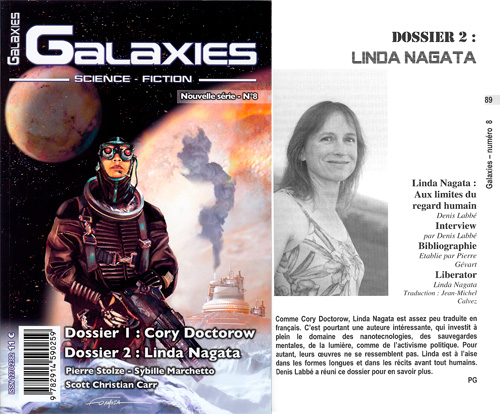
This one’s a little late, but I didn’t want to let it pass without notice. Over the summer the French science fiction journal Galaxies published an issue that included a “dossier” on yours truly, encompassing a review, an interview, a bibliography and a French translation of my short story Liberator, originally published in The Magazine of Fantasy & Science Fiction.

Galaxies is a beautiful publication, very nicely designed and put together, and I’m honored to appear there. Sadly, my forebears stopped speaking French long, long ago and I’ve never taken it on myself to learn, so I can’t read a word of it.

In closing, a note to all you budding novelists out there—try to publish a few short stories, because down the line someone, somewhere will ask to re-publish one as a means to introduce a new set of readers to your work. I’ve only ever written a handful myself, but they’re nice to have around.

The Galaxies cover and first page of the dossier.

The Galaxies cover and first page of the dossier.

Draft 3 of The Wild is Done

Thursday, August 12th, 2010

Just over a year ago I announced that I wasn’t satisfied with the responses I was getting from readers on my novel-in-progress The Wild, so I was going to undertake yet another revision, primarily of the story opening. Later in the year I talked about the butterfly effect and writing—how the partial revision I’d originally envisioned had turned into a complete re-write of the entire manuscript.

The re-write turned out to be a stuttering, sputtering process, with periods of productivity interrupted by long periods of nothing much getting done. But late in the game things finally started to click. I was suddenly immersed in the process, and completely neglected my other projects, with the happy result that Draft 3 was finally finished yesterday.

Hoorah!

The next step is to send it to a few test readers, to see what sort of reaction it gets. I’ll confess I’m nervous. The last two drafts didn’t fare too well. Let’s hope this one does better!

In the meantime, I get to start something new.

What I Learned From Inception

Monday, July 19th, 2010

I enjoyed and admired the movie Inception, and highly recommend it. I also learned a couple interesting things from it, from a writer’s perspective. (I don’t think there are any spoilers in the following, but if you’re like me and want to know as little as possible about a movie once you’ve decided to see it, than come back later . . .)

* The tech doesn’t have to be explained. The script successfully handles lots of tricky concepts, but says not one word (that I can recall) about how the architecture of shared dreams is communicated, and that’s okay. I don’t need to know. I just need the “What if”—what if we could do this. Coming from a hard science fiction background, this was enlightening.

* World building isn’t always necessary. So far as I could tell, the story was set in the present, in the world we live in, except that this dream technology exists. There’s no attempt to extrapolate what the world might look like ten or fifteen years hence when this technology is maturing, or to explore what other effects it might have on society. The story is tightly focused on itself and not at all interested in the world at large, which works great in this movie.

And a minor bonus lesson:

* Titles are tricky. I love one word titles, but “Inception” was hard to get my head around. Exception? Incision? Invictus? What the hell was it again?

If you can remember the title, go see it, and let me know what you think.

Brainstorming

Tuesday, March 16th, 2010

I thought that somewhere, somewhen, I had written about the brainstorming method that has served me well over the years, but after spending way too much time looking back over blogs and searching emails, I can’t find it, so I guess it’s safe to talk about it again.

The subject came to mind after reading the blog of a fellow Maui writer, Toby Neal:

At the time I listened to this lecture I’d begun Hawaiian Orchid and was about halfway through it. I was stalled, losing interest and faith I could finish it, and out of ideas. But I wrote a question on a 3X5 card: “Who’s the bad guy?”

It wasn’t two hours later when I had the answer! I ran to my computer and feverishly typed out the entire showdown scene. I’d never been so galvanized. But it was way too soon in the book, so I began writing down other questions, or even just the glimmer of an idea, like, “Gunfight Scene” which I thought would be cool to have but had no idea how to do, write, or work in. The ‘answers’ would appear, almost like magic.

I like the sound of this technique and I intend to try it out sometime soon. The method I’ve used is similar but it’s a step closer to traditional brainstorming. Very simply, it involves sitting down with a pen and paper and writing down questions about the story and the characters, and then trying to answer them. Absurd answers are fine, so long as they are answers. Oh yes–and the pen keeps moving. Try not to stop writing. This is where it becomes the same as traditional brainstorming. The big difference is that instead of writing anything that comes to mind, the mind should stay focused on story problems. If answers aren’t coming to the question just asked, try asking different questions!

This technique doesn’t always work, but when it does, it works really really well. I don’t think I could have written my early novels without it.

Oh–and despite often-heard opinions to the contrary, typing works just as well as handwriting for me–sometimes better.

Same but different

Sunday, March 14th, 2010

Yesterday I finished up current changes on another chapter of The Wild, leaving only a couple of chapters to go before the end. But a quick survey of these last pages revealed something I hadn’t quite realized before–or had refused to notice. All the plot devices I used before, all the motivations, even the loose ends that get tied up in the climactic scenes–all of these have to be changed.

The characters will remain the same, as will the location and even the ultimate result, but the details of how it all happens–just about every part of that will need to change.

At first I was extremely annoyed. But then I drew up a list of all the plot elements that now need to be included and it turned out that there was a lot to work with. Next I went on a long walk. I don’t usually get ideas while walking or working in the garden and such, but sometimes it helps, and this was one of those times. Short scenes started coming to mind, events, motivations . . . I even called home a couple times to leave some ideas on the answering machine so I wouldn’t forget them. I’m feeling better about it now. I’m even starting to think I could have a much better ending this time around.

Techniques for Avoiding Writing #1

Friday, February 26th, 2010

There are all sorts of ways–many of them sounding almost legitimate–to persuade yourself not to sit down and spend time actually writing. For example, yesterday I was up early as usual. I had finished my compulsive reading on the Internet and, feeling virtuous, I booted up the laptop fully intending to dive right into the novel. But then it occurred to me that my husband would show up for coffee and breakfast at any moment and then I would be distracted . . . so there was really no point in getting started on writing just yet. I figured I might as well spend the next half hour working on one of the websites . . . and then of course that half-hour turned into the entire day and I never did open up the writing file.

So technique #1: Let yourself be distracted by legitimate, alternate work!