Linda Nagata: the blog at Hahví.net


Re-Thinking Cover Art: Using Stock Photos

December 1st, 2011

Stock photos are the cover art solution for many indie publishers.

With royalty free stock photos, you pay a one-time fee for the right to use a proffered image–but you don’t have exclusive use. Anyone else can pay for the right to use the image too, so it’s possible you’ll see your cool cover idea repeated somewhere else. Personally, I think the odds of this are pretty long, so it’s not something I worry about.

Royalty-free stock is traditionally considered cheap—“just a few dollars” is what you’ll usually hear. I’m here to tell you it ain’t necessarily so. If you’re purchasing a standard image at a low-cost agency and you’re only doing an ebook, then yes, you could probably get what you need for $25 or less.

But if you need a photo in print resolution, the price jumps, and if you want to buy rights to a premium photo, the price jumps again, into the $100+ range. From the point-of-view of the photographer selling the rights, this doesn’t sound like much, but for struggling authors gambling that a particular cover design will work, it’s a real investment. And often, just one image won’t do. A good cover might need to combine multiple images, with the cost rising with each addition.

The most expensive image I’ve flirted with was over $400 at Getty Images. Thankfully, the design idea I was toying with didn’t work out.

The great thing about most stock sites is that you can download a low-resolution, watermarked image that can be used to try-out a design idea. The really bad thing about some stock sites is that you can’t make your purchases in cash. You have to buy sets of “credits” and of course you will always end up buying extra credits to cover the required amount . . . and eventually these credits will expire and the stock site will have just taken an extra skim of your money. It’s a very consumer-unfriendly system.

Did I mention that I loathe stock photo websites?

The pricing system is only part of it. The frustration of searching for just the right image is far worse.
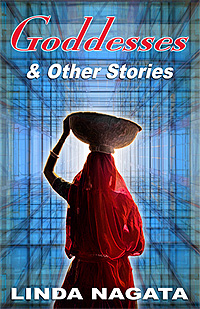
Cover for Goddesses & Other StoriesI’ve wasted untold hours looking for images to illustrate an idea I’ve got in my head. Often these searches end in complete failure. I know other people who’ve done well with stock photo images, but for all the time invested I’ve had only two real successes: the background image in the cover of my YA science fiction novel Skye Object 3270a was purchased from a stock site, as were the two images I combined for the cover of my story collection Goddesses & Other Stories.

One huge problem with most image searches is that a search might result in 60,000 matches, but many of the same images will then be shown time after time, on page after page, making the effort to browse seem futile.

A second huge problem is that so many of the photos of people feature models so polished they look plastic, mugging for the camera in bizarrely tasteless ways. This might work for the lowest level of advertising, but it’s probably useless for your book cover.

So yes, stock photos can be used to make great covers, but if I have the opportunity of working with an artist, I’ll take that path every time.

Next: cover art reveal >>

Re-Thinking Cover Art: The Cover Concept

November 30th, 2011

In the last post I talked about the current cover for my fantasy novel The Dread Hammer and why I’m now in the process of replacing that cover. This time I wanted to talk a little more about the actual process of coming up with a cover concept.

As the publisher of this book, I feel it’s my responsibility to give the artist some guidance on the cover. Unfortunately, I’m not an artist, but we do what we can, we do what we must.

My strategy is this: I develop some sort of a concept in my head. Sometimes, (rarely), I already know what I want. Other times, I go to Amazon or Goodreads, and look at hundreds of covers, picking out relevant ones with some aspect that appeals to me. This is how I came up with an initial concept for the new Dread Hammer cover.

One option I never consider is a complex, highly detailed scene, such as an alien cityscape. There are three reasons for this. First, it would be impossible for me to visualize such a scene well enough to describe it to the artist, and also, I couldn’t afford to pay her for the amount of work involved. Finally, since my books are primarily sold online, the detail and artistry would be lost within the thumbnail. So I make it a point to use large, fairly simple concepts.

Once I have a concept in mind, I go out on the Internet and try to find images that convey some piece of that concept. Sometimes these images are from stock photo sites, sometimes they’re from Google image searches. All of them are placeholders. Using Photoshop, I cut out the parts I want and paste them together, twisting, bending, stretching, and re-coloring as it strikes my fancy. It’s the electronic version of pasting together magazine photos like kids do in school. I’m not a visual thinker, so I really need to see things laid out to decide if an idea is going to work or not. None of these images will appear in the final product, so copyright is safe.

The huge drawback of this method is finding relevant images to work with. I have abandoned concepts because I can’t find the right images and so have no way of illustrating the idea in my head. But we do what we can.

In the past, I haven’t gone looking for a lot of feedback during this developmental phase, but this time around I’ve been showing these mockups to people, and the feedback has been enlightening–and frightening. Everyone has a different opinion on what works and what doesn’t. Opinions from people who’ve read the book are entirely different from people who haven’t.

Amusingly, the most consistent point of contention is the weapon to show on the cover. Since it’s stated in the back cover copy and in the first few pages of the book, I don’t think it’s a spoiler to say that the Dread Hammer is a god, not a weapon, while our violent protagonist, Smoke, uses a sword by choice. Naturally, I want to include a bloody sword on the cover, but several people want to see a war hammer instead, since it matches the title. Oh, conundrum!

Soon, I’m sure, I’ll come up with an acceptable idea. Then the concept gets handed off to the artist who will take my sorry little mockup as a jumping-off point to create an original piece of art . . . and then we get to do it all over again for the sequel, Hepen the Watcher.

Next time: Using “royalty free” stock photos.

Next: using stock photos >>

Re-Thinking Cover Art:
The Dread Hammer

November 29th, 2011

The option to change your mind is one of the great advantages of indie publishing.

Of all the steps involved in turning a polished manuscript into a book, the hardest by far is cover design. The purpose of a cover is to catch the attention of people who might read and enjoy the book. To my mind a cover should convey the “flavor” of the story, along with something of the setting and genre in an intriguing fashion that will draw in readers who might like the book but have never heard of you or it.

The Dread Hammer is a fantasy novel, but it’s hard for me to say what sort of fantasy it is. Despite swords and magic, it’s not like traditional heroic fantasy, or sword & sorcery, or a quest novel, or urban fantasy, or any subgenre that I’m aware of. It’s darkly humorous, unconventional, and, at 65,000 words, it’s very short compared to most fantasy novels. I consider it “quirky,” so I decided to put a quirky cover on it.

The image I had in mind was of the main character in an active pose, done in a style of art commonly seen in computer games. I wanted this style because it was different (for a book cover), and a little campy. I hoped it would communicate the quirky nature of the book while being eye-catching enough to pull in the curious.

Original cover for THE DREAD HAMMERI can’t draw to save my soul, but I do know enough Photoshop to be dangerous, so my method of developing a cover concept is to scour the web for relevant images, slap them together in Photoshop, and amend until I’m sort-of happy with the layout. In the case of The Dread Hammer I put together an extremely rough guide for my artist Sarah Adams, and she gave me back an entirely original digital painting that was exactly what I was looking for. Click the image to see a larger version. This is an impressive piece of work.

But now, seven months after publication, I’m reassessing my initial concept. This is the great advantage of indie publishing. The book is mine, and if I want to change my mind and try different things, I can. So I’m making two big changes: the cover, and my name.

A number of people have persuaded me that publishing under a pen name was never a good idea, so I’m going to re-issue the book under my own name—easy enough.

But changing the cover—that’s hard. What’s wrong with the existing cover? There’s nothing at all wrong with the art itself. I think Sarah did a wonderful job. But sales are slow. I’m not reaching my potential audience, so I’ve begun to think of new ways to frame and present the book—especially important because the sequel, Hepen the Watcher, will soon be ready to follow.

So what do I think is not working with the existing cover? I have no hard data at all, not even anecdotal data, except this one thing: several people have mentioned that the book looks YA—as if it’s aimed at the young-adult market. It’s not. It has adult themes involving family dynamics, personal choice, and personal obligation. It’s also got some fairly graphic sex and lots of very graphic violence. As the tagline says, it’s a “fairytale of love, war, murder, marriage, and fate.”

Besides the YA issue, I’ve come to feel the current cover makes it hard to take the book seriously. This is a guess on my part. No one has told me this. And yes, the story is darkly humorous—but I want it to be taken seriously as literature that is worth one’s time to read.

So I’ve gone back to Photoshop and started patching together new cover concepts. My current goals:

1. Emphasizing the idea of a classic “fairytale”
2. Establishing a general genre setting
2. Creating a visual tension through the intrusion of graphic violence in an idyllic setting

This still leaves an abundance of questions! Which character, if any, should go on the cover? What style should be used? And believe it or not, the biggest question so far has been what weapon to display!

Next: the cover concept >>

Meet Toby Neal!

November 29th, 2011

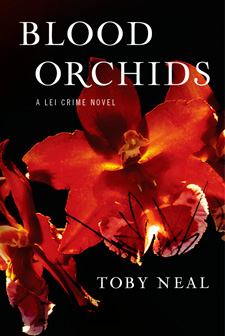
Cover of BLOOD ORCHIDS by Toby NealToby Neal is a friend of mine and a fellow Maui writer who has just published her first novel.
Blood Orchids is a police procedural set in sleepy Hilo town on the Big Island and featuring the intrepid cop, Lei Texeira. It’s the first in a series of four novels, with the next books scheduled to appear in 2012.

Blood Orchids is also a first for me–it’s the first book not my own which I helped produce. I did both the ebook creation and the interior layout for the print book as part of services offered through my company Mythic Island Press LLC.

Here’s the back cover description of Blood Orchids. The ebook is only $2.99 right now at Amazon and Barnes & Noble. Check it out!

Hawaii is palm trees, black sand and blue water—but for policewoman Lei Texeira, there’s a dark side to paradise.

Lei has overcome a scarred past to make a life for herself as a cop in the sleepy Big Island town of Hilo. On a routine patrol she finds two murdered teenagers—one of whom she’d recently busted. With its echoes of her own past, the murdered girl’s harsh life and tragic death affect Lei deeply. She becomes obsessed—even as the killer is drawn to Lei’s intensity, feeding off her vulnerabilities and toying with her sanity.

Despite her obsession with the case and fear that she’s being stalked, Lei finds herself falling in love for the first time. Steaming volcanoes, black sand beaches and shrouded fern forests are the backdrop to Lei’s quest for answers—and the stalker is closer than she can imagine, as threads of the past tangle in her future.
Lei is determined to find the killer—but he knows where to find her first.

Book View Café–New Release

November 22nd, 2011

Science Fiction Satire

Tritcheon Hash by Sue Lange
Copyright © 2011

Tritcheon Hash is a test pilot in the year 3011. She’s got it all: brains, guts, and a fast jet. But can she survive a mission to planet Earth?

“Against a vivid sci-fi backdrop, Lange brings a light touch to heavy material, with a fast-paced, funny story to boot.” – Kirkus

“Funny, perceptive and hard-hitting by turns – welcome to a new and witty voice in sf satire.” -John Grant, co-editor, The Encyclopedia of Fantasy

BVC is giving away 5 free copies of the book. Send an email to media.relations@bookviewcafe.com for a chance to win the book.

Introverts

November 21st, 2011

I stumbled on this Atlantic essay via twitter**: Caring for Your Introvert: The habits and needs of a little-understood group, written by Jonathan Rauch. By the end I was wiping away tears of laughter because so much of it is so true.

Do you know someone who needs hours alone every day? Who loves quiet conversations about feelings or ideas, and can give a dynamite presentation to a big audience, but seems awkward in groups and maladroit at small talk? Who has to be dragged to parties and then needs the rest of the day to recuperate?

Yes, I’m an introvert. Not a big surprise there, I suspect. Most writers are. I think a lot of people who might otherwise make great writers fail at it because they can’t abide sitting alone for hours on end, day after day. We introverts get pretty twitchy if we don’t get to spend hours alone.

When I decided on a career switch back in 2000, I took up programming for two specific reasons: So I could make lots of money, and not have to talk to anyone. Of course I was wrong on both counts, but hey, it was a plan.

I’m not antisocial. I like going out for drinks, talking to people, hearing what they’re up to. One-on-one and one-on-two situations are great. But where I absolutely flounder is in large groups: cocktail mixers, conventions, that sort of thing.

Conventions! (Cue burst of scary music.) Genre conventions involve multitudes of people all of whom apparently know each other and admire each other, while I know none of them. Combine this with my congenital challenges with facial recognition and my woefully inadequate reading of well-known works in the field, and I become a deer in the headlights, not knowing which way to turn.

The ability of other people to navigate a group astounds me. I’ve been in groups of women in which two will begin talking intimately about a matter of mutual interest within two minutes of being in the same room. Naturally, I’ll assume these women already know each other, only to discover later that they’ve just met and were only making conversation. How do you do that? How do you know what to say that connects you immediately to a perfect stranger? It’s like studying an alien life form.

But I’ll keep up the study, because after all, amongst others is where I live. Just please be understanding if I need to flee back to my cave after a few hours out in the world.

**tweet originated by @julietgrames and retweeted by @innaj

How to Start a Revolution

November 20th, 2011

Yesterday I was privileged to watch the new documentary film How to Start a Revolution. It’s an exploration of the ideas and real-world implementation of Gene Sharp’s thoughts on non-violent resistance contained in the book From Dictatorship to Democracy.

If that sounds dryly academic, it’s not. The film is fascinating and deeply moving—a wonderful antidote to the shallow, toxic reporting on world events that makes up so much of cable news.

Who is Gene Sharp? I confess I never heard of him before watching this film, but I’ll remember him now. He’s a quiet scholar who’s spent many years thinking and writing on effective, non-violent means to political reform.

If you have a chance to see How to Start a Revolution, please go. I think the DVD is due to be released before long.

Writing Mantras

November 18th, 2011

Other writers will tell you they have such a surplus of story ideas, they will never live long enough to write them all. Sadly, that’s not me. Usually I have just the current project. Sometimes there’s a hazy next-project, but often not. My present situation is unusual because I have two new novels-in-progress, and a draft of a short story.

The short story was inspired by a resolve to write more short fiction. It’s not that I wanted to write this short story. It’s just that I wanted to write A short story. Something—anything—sf-nal. So I had no hot, spicy kernel idea to get me inspired. All I had was a vague notion of setting, but after brainstorming that from several angles, a plot eventually appeared and I started writing.

But very soon I wanted to stop.

The internal editor was on overdrive. The story felt dry, mechanical, lifeless, not up to snuff. It was hugely tempting to toss the whole thing out and pretend I’d never started it, but I don’t repeat writing mantras for nothing. The two that kept me going were:

(1) finish what you start (Heinlein rule #2)
(2) avoid the “book as event” trap—the idea that every story has to be a cutting-edge award winner

I powered through the draft. It came out around 5,000 words.

Here’s where I’m supposed to tell you that perseverance paid off, it all turned out well, I love the story, etc. Maybe I’ll be able to say that in a future post. I haven’t actually looked at the story since finishing the first draft—but I do have a first draft. It’ll get better on revision. Then I get to apply another handy writing mantra:

(1) Put your work in front of someone who might buy it. (Heinlein rule #4)
Corollary: Let other people reject your work

This business never gets easier.

Percolation

November 16th, 2011

The problem with the word-count-per-day goal — that is, swearing to oneself to write a thousand or two-thousand words everyday — is that to be successful you have to have a pretty good idea of what happens next in your story.

It’s no problem at all to write a thousand or two-thousand words of useless rambling thoughts. It’s also fairly easy to write a thousand or two-thousand words when you know exactly what comes next, and it’s a scene you’re feeling, and the voice of the characters and tone of the story is firmly established in your mind.

But what happens when you have no clear idea of the next scene? I’ve got eight published novels, with four more in various stages of development, but I still find myself in this situation all the time — even when I have a rough plan, even when I can see some of the scenes I want to hit down the road. Somehow I have to figure out an interesting way to get the protagonist from where s/he is, to, well, somewhere else, and stir in some conflict and/or mystery while I’m at it. But all too often I feel utterly clueless on how to do this.

So I sit down to just write — you know the formula: trust the subconscious, type away, something will come. Hrmmm…

Does this work for you?

Very rarely, I’ll discover useful plot lines this way. Mostly though, it doesn’t get me anywhere. So I wander about the house. Check email. Check ebook sales stats. Check twitter. Check facebook. Check G+. Shut off the wi-fi and try to write… I can spend hours like this, and then quite often, around three in the afternoon, a switch gets flipped on and suddenly I’m writing useful words!

Sometimes the switch doesn’t get flipped to “on” until nine or ten o’clock at night. In the past year I’ve had some extremely useful midnight writing sessions.

It’s pretty clear that, for me at least, ideas need to percolate. I wish it weren’t so. I wish I could sit down and know what comes next, and write it, and then move on to another project. I wish I didn’t squander so much time that could be put to productive use doing other things. But it is what it is, and I’ve been dealing with the process long enough that, despite the frustrations, I can remain fairly confident that the words will eventually come.

Does any of this sound familiar? How do you deal with the question of what comes next?

My Favorite USPS Stamp &
#buyabooktoday

November 15th, 2011

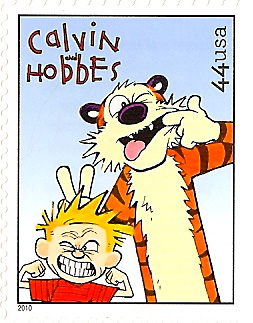
Calvin-and-Hobbes-stampI just want to say I love this stamp. Makes you want to send a snail-mail letter to Mayor Bloomberg, doesn’t it?

Also, twitter tells me it’s #buyabooktoday. Who gets to make this stuff up I don’t know, but here are some books that I’ve read and enjoyed in the past months: My Book Raves