Linda Nagata: the blog at Hahví.net


Short Story Collection:
Goddesses & Other Stories

November 14th, 2011
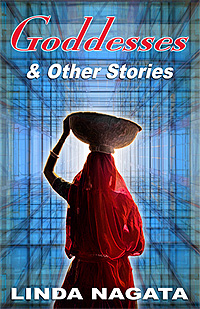
Book cover for Goddesses & Other Stories by Linda NagataThanks to some concentrated pressure encouragement from reader Phil Friel I have finally put together a collection of my short stories under the title Goddesses & Other Stories. In the collection you’ll find all of my published short fiction–all ten stories–including the Nebula Award winning novella Goddesses.

Goddesses has been out for a while as a single, but I’ve now replaced that book with the collection, mostly so I could recycle the cover (must be practical).

The new volume contains just over 100,000 words of fiction, with individual pieces varying in length from 3,000 to 32,000 words, all originally published between 1987 and 2000.

So if you’re interested in short fiction–or you just want to have a look at a writer’s early efforts–please consider Goddesses & Other Stories. As of today, the ebook is available at all the Amazon stores and Barnes & Noble. It’ll be available from Book View Café at the imminent launch of the new ebookstore.

Here are links:
Amazon USA
Amazon UK
Amazon DE
Amazon FR
Barnes & Noble

And here is a list of included stories:
Spectral Expectations (Analog 1987)
Career Decision (Analog 1988)
In the Tide (Analog 1989)
Small Victories (Analog 1993)
Liberator (The Magazine of Fantasy & Science Fiction 1993)
Old Mother (The Magazine of Fantasy & Science Fiction 1995)
The Bird Catcher’s Children (The Magazine of Fantasy & Science Fiction 1997)
Hooks, Nets, and Time (The Magazine of Fantasy & Science Fiction 1997)
The Flood (More Amazing Stories 1998)
Goddesses (Sci-Fi.com 2000)

Island Football

November 13th, 2011

People who aren’t sports fan just don’t understand. I know this is so, because I used to be one of them. For most of my life, I paid little attention to sports. Sure, I enjoyed watching the occasional football game, but even when the final score was a disappointment it wasn’t personal. Then I got hooked on University of Hawaii Warrior football in the Colt Brennan years.

For those of you not acquainted with our little team, Colt Brennan was the quarterback who led us to a Western Athletic Conference championship, a win over Boise State, and a trip to the Sugar Bowl. Those were the glory years.

We haven’t done all that badly since then, but this season has been frustrating to say the least, and last night’s game against the Nevada Wolfpack was an extremely painful loss–a bizarre mix of wild luck combined with fumbles, interceptions, pointless penalties, and a star quarterback with a broken leg.

My son thinks I’m weird to get so wrapped up in what’s happening on a football field. Sorry kid. Life is no fun without emotional involvement. I’m a football dilettante. Don’t ask me about play formations or any of that, but I’ve been in the stands of Aloha Stadium screaming my throat raw and feeling the balcony shake under me. I’ve stood in front of the TV shaking my fist and yelling “WTF were you thinking??” I’ve traveled with my husband — only a couple weeks ago — to Moscow, Idaho just to watch a Warriors’ away-game. I think it’s a tribal thing. This is a small state, and this is our team (and my alma mater!).

When it doesn’t go well I’ll get as angry and critical as the next fan. But on the day after, I have to say that I can’t imagine how hard it must be to play your heart out in front of a demanding, critical audience, and still not quite measure up — not to your own hopes and expectations and not to those of your fans — and yet to come back the next week and play your heart out again.

Even a non-sports fan can admire that.

Signed Copies Available

November 13th, 2011

Just wanted to mention — if you’re interested in a signed copy of the Mythic Island Press LLC edition of the The Nanotech Succession books, I finally have copies of all four available. Christmas presents anyone?

If you’re interested, click here and scroll down a bit.

Thanks!

Daylight Savings

November 9th, 2011

We don’t do daylight savings in Hawaii, and given that I haven’t lived in the mainland United States since I was nine, it was a new — and disorienting! — experience to undergo the “conversion” last weekend while visiting in the great state of Washington.

The concept is easy for those of us sitting out here in the middle of the Pacific. After the winter change, the west coast is only two hours away, and the east coast only five. (It’s a three and six hour difference in the summer.)

But when one actually undergoes the change…what time is it, anyway? All clocks immediately become suspect. Did someone reset that digital display? Did someone adjust the analog dial on the wall? And who resets all the clocks in hotel rooms? I expected the staff would do it, but that didn’t happen at our airport hotel. Who resets the clocks in all the rental cars? That’s probably a crowd-sourced effort, but after the switch I just ignored the clock in our car. I was a bit unsettled when, on our flight back to Maui, the pilot kept saying we would arrive at 1:40pm when in fact we were due to arrive at 2:40pm, and did arrive at 2:40pm. Seriously, who resets the pilots? Isn’t time kind of important to navigation? (I’m sure they navigate with GMT, or GPS, but still…)

Both my Netbook and a wristwatch that I carry in my purse are set to Hawaii time, so I could always calculate the proper time, but those are crutches. There is one, true reference that I trust to provide me with correct local time, and that is Verizon Wireless, of course! Thank goodness for my cell phone, which is clever enough to reset the time when driving from one timezone to another and has no problem at all with daylight savings.

The winter conversion did illuminate a minor mystery to me. During the first part of our trip I was marveling at how long daylight lingered, given that it was so late in the year. Then on Sunday night, darkness suddenly fell an hour earlier, and all seemed normal again.

Personally though, I’m glad to live in a state where clocks can keep the same time all year round.

Book Rave: Anthony Pignataro’s Small Island

November 6th, 2011

Confession: The only reason I grabbed a Kindle sample of this book was because it was written by a Maui author–not someone I know, but there aren’t all that many of us, and I’d like to be familiar with who’s out there.

Small Island, falls, I think, in the thriller genre. It features a former army officer working as a bartender on Maui’s westside, who reluctantly gets drawn into a personal investigation of illicit goings-on on the island. I started this book feeling pretty skeptical, since one of the prominent characters was described as a former porn star, but the author handled that aspect quite well, and I’m pleased to report this turned out to be an impressively good book.

This isn’t my genre. I really don’t know how Small Island compares to other PI/thrillers, but I enjoyed it. It explores a seedier side of Maui than the one I live in, but the descriptions mostly rang true to me. I thought the writing was smooth and effective and the character portrayals had just the right depth.

So if a book set in modern Maui appeals to you, do give Anthony Pignataro’s Small Island a try.

Divided Loyalties

October 24th, 2011

So last night, on the way back to Maui from Honolulu, an idea for a new novel came walking into my head. Right now it’s feeling like a Trey Shiels novel — fast, dark, and a little over the top — but science fiction not fantasy.

Of course I’m already writing a novel, one that I’m sure will ignite! catch fire! start writing itself! at any moment now.

And I’m partway through a short story that I’ve spent a lot of time and effort on, and I really ought to get that finished.

And for years I’ve had a rule that I have to finish the current project before starting the next.

But of course 2011 has been a year for changing the rules.

Hmm….

Why Science Fiction Short Stories
Are Really Hard to Write

October 20th, 2011

Your assignment: write a science fiction short story set off Earth, in another time.

Your story should do the following:

(1) Present to the reader an unfamiliar storyworld that is internally consistent and coherent, including an implied past and future.

(2) Present to the reader a specific setting within this storyworld, making sure it includes unfamiliar yet reasonably plausible technology.

(3) Utilize two or three unique and interesting characters. If not human, describe both the general and specific appearance of these characters, as well as their origin and biology. Please avoid caricature! If human, you need only describe your characters’ specific appearance, relying on the reader’s knowledge for general principles. In either case, communicate your characters’ motives and personalities in a manner relevant to the mood and tone of the story.

(4) Develop a fast-paced, action-packed story arc suited to the motives and personalities of your well-developed characters and utilizing the story’s plausible technology as an essential element. Be sure there is an external plot: something must happen. Equally important, include an internal plot: your primary character should have an issue or two to overcome!

(5) Include a theme that adds layers of meaning to your story.

Your assignment should be accomplished in 3000 words or less. Bonus points are awarded for stories achieving levels of “cool,” “awesome,” or “mind-blowing.”

Competitive Productivity

October 18th, 2011

Well over a year ago, before I was truly “all in” on making a return to a writing career, I was having a rare, face-to-face conversation with another writer who made a comment roughly on these lines: “So many younger writers these days seem to make a living by writing book after book after book, staying alive by constantly producing.” I think I groaned, said that I could never do that and wouldn’t want to; that writing was just too damned hard, and I needed at least a year to finish a book.

Yeah.

Times change and it’s good to be adaptable. My writing speed has picked up and I’ve produced a good amount of work this year, but nothing close to the output of some of the writers in my twitter stream. Mind-boggling daily words counts, revision, copyedits, conventions, blog postings, book promotions and contests, charitable efforts, social media . . . I stagger in fatigue just thinking about it.

It’s fairly clear that I’m a slacker. On the other hand, I’m also inspired. Let’s call the phenomenon “competitive productivity.” If so many other writers (even some with day jobs!) can spend so many hours every day on writing-related tasks and produce results then what’s my excuse?

No excuses.

Thanks for the inspiration, y’all.

Special Promotion: $2.99 for The Bohr Maker

October 17th, 2011

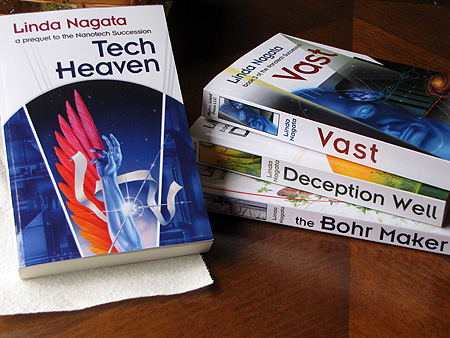
The Bohr Maker is Book 1 of The Nanotech Succession. It’s straight-up science fiction–a fast-paced adventure in a nanotech-saturated world, and also a Locus award winner for best first novel.
If you haven’t read it, now’s a great time to give it a try. For a limited time only the ebook is priced at $2.99 at both Amazon and Barnes & Noble.

If you’ve already read it and you enjoyed it, I’d really appreciate it if you’d help spread the word about this promotion to anyone you think might be interested. Tweet it, like it on facebook, mention it on G+…whatever works for you.

And there’s more…

Book 2 of The Nanotech Succession, Deception Well is also on special during this time, with the ebook priced at only $3.99.

Find the ebooks here:

Barnes & Noble

Amazon USA

Amazon UK

Amazon DE

Amazon FR

Thanks!

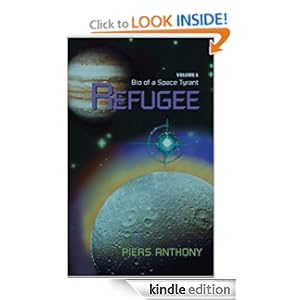
Book Rave: Bio of a Space Tyrant, Vol 1: Refugee

October 16th, 2011

Rating books from one to five stars is useful for developing a quick consensus on how good a book is, and every author loves to get four and five star ratings. But as a reader I find star ratings problematical. I can greatly admire a book without loving it. I can be utterly intrigued by a book while feeling ambivalent about it. Should I give such a book three stars? Four? Five?

Bio of a Space Tyrant, Volume 1, Refugee by Piers Anthony is the present example. Someone, somewhere–on twitter or G+ or facebook–mentioned this book and, wanting to read some older science fiction, I picked it up. The copyright date is 1983.

I’ve never read anything like this before. The story takes place on and around the moons of Jupiter. Science and technology are often carefully and clearly explained in a style that feels dated and yet works very well. Bio is a first person tale, told from the point of view of a fifteen-year-old refugee fleeing political oppression, and has clear parallels to real-world stories of refugees fleeing Cuba or Haiti.**

At its core, Bio is a brutal, horrific tale, made readable because of the detached, analytical tone of the young narrator as he comes to terms with the worst of human nature and struggles to retain a belief in the best of human nature. There is an obsession with rape and male violence throughout, with every bit of it discussed and analyzed, and none of it remotely titillating. Despite all this, the book is not nihilistic. It’s very much concerned with love, loyalty, human relationships, and doing what you have to do to survive.

Still, with a book like this I can’t say, “Go read it! You’ll love it!” because it’s not that kind of book. But I can say that I was fascinated by this story almost from page one and that I knew I’d be blogging on it long before I finished. Oh, and I’ll be starting in on volume 2 very soon.

So if you’re up for something powerful and different and, yes, grim, go read it–and let me know what you think.

** This paragraph was written before I had quite finished reading the novel. In a postscript within the book, Piers Anthony confirms this was the case.