Linda Nagata: the blog at Hahví.net


The Coin

September 20th, 2011

In a comment to a recent blog post, J. Daniel Sawyer suggested flipping a coin to make plot decisions and thus keep things moving. Today I’ve been attempting to firm up a short story idea, coming up with a list of characters and deciding on the specific setting. At first I was having a hard time making decisions–should the story be in setting A or setting B? should the antagonist be male or female? etc., etc. At this point in story development, when everything’s still wide open, it’s hard for me to make firm decisions on which way to go, because each decision narrows future possibilities, and if it’s the “wrong” decision, I’m writing myself into a hole.

So to keep things moving I fetched a coin from my purse. It’s sitting on the table next to my laptop, but I haven’t used it yet. Evidently my muse doesn’t like the idea of deciding things on a coin flip, because ever since that coin showed up, I’ve been able to make decisions that eluded me before.

But the coin continues to sit there, just in case. Writing is so often a series of head games.

Chameleon Check

September 18th, 2011

In the category of “odd regional habits” I’ve taken to giving the driveway a quick glance to make sure it’s clear of chameleons before backing the car out. I think we’ve only ever run over one in the driveway, but one was more than enough.

Photo by Ron Nagata

These are Jackson’s chameleons. Like most everything else commonly seen in Hawaii, they’re not native to the islands, but were brought in as pets and then escaped or were released. They started showing up in our neighborhood maybe fifteen years ago and they’re quite common now.

Male Jackson's chamelon; photo by Ron Nagataq

Usually they’re in the shrubbery or up in the trees, but now and then they come down and stagger across the driveway with a rather comical gait. Once, we even found a confused looking individual clinging to the back tire of the car.

Female Jackson's chameleon

The males are like mini-Triceratops, with three horns. Females are horns-free. They’re fascinating animals to watch, with their prehensile tales and their long sticky tongues. They’re mostly green as adults, but they’ll sometimes turn a darker color when feeling stressed. The babies are a brown color, like the little one in the photo below:

Baby Jackson's chameleon

They get to be four to six inches long, not counting the tail. That’s big for us. Our other reptiles are little skinks, geckos, and anoles, all quite small.

Vast Trade Paperback at Barnes & Noble

September 15th, 2011

The new print-on-demand trade paperback of Vast just showed up at Barnes & Noble. Vast was the first book I ever considered reprinting on my own, so this is a long-awaited moment, but it’s puzzling too.

The list price I set for the book in US markets is $13.95, which is on the low end for a book of over 450 pages. I can do this because the printer allows a 20% “discount.” This means the wholesale price is only 20% less than the list price. For most books in bookstores, the discount is 45% to 55%, leaving a lot more room for the bookstore to make a profit–which is why you’ll never see my print-on-demand books in physical bookstores. They simply can’t make a profit on it**.

Anyway, Vast has debuted at BarnesandNoble.com with a 28% discount off the list price, meaning you can buy it for $10.04. Given that B&N will owe the printer $11.18 for every copy they sell, this seems unwise, and I don’t think it will last long.

I’ll admit I’m confused and a little concerned, but you aren’t going to find the book cheaper than this until and unless it makes its way to used book stores.

Find Vast, at BarnesandNoble.com

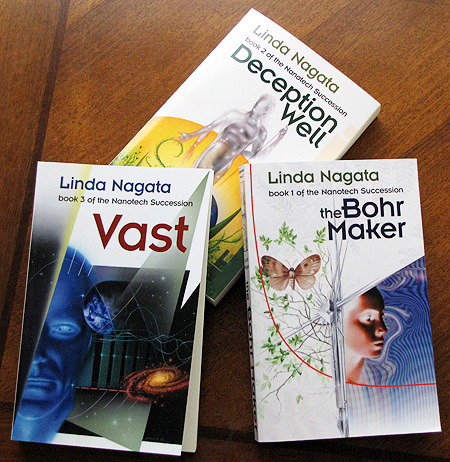
The Nanotech Succession: Books 1-3

Books 1 - 3 of The Nanotech Succession now available in new trade paperback editions. With thanks once again to Bruce Jensen for the cover art!

**Some booksellers, like Powell’s Books, get around the low discount by offering the books at a cost higher than the list price. I don’t have the price showing on the book. I think this is why they can do this. Of course this still doesn’t mean the book will actually be in the store.

But Where Is The Plot?

September 14th, 2011

So, maybe ten months ago a scene popped into my head and I was intrigued—enough to keep thinking about it, figuring out how this situation had come to be, deciding what would come after, coming up with more characters and, eventually, more worlds because if the plot hasn’t quite emerged the solution is to add more stuff. Right?

Imagine you’re putting together some crazy Lego sculpture. Every tower is a nifty worldbuilding element. Clip some Lego bridges in between to connect them. Sometimes those towers need to lean a little right or left to make those bridges fit. Sometimes the bridges start to look a little spindly, but never mind that! Keep building. It’ll get more solid as more stuff is added.

But all the while an uneasy feeling is building that maybe this is getting a little out of hand?

Hesitantly, you step back, gaze at the whole, and think, WTF? There is no shape to it, no solid structure, no pleasing design, no sense of direction. A sort-of storyworld has been snapped together, but where is the plot? Whose story is this? What’s it about? Why should the reader care?

So the whole thing gets shoved into the closet because there are other projects going on anyway.

Later, you take it out again. Pull down several towers, rebuild many of the bridges . . . after a while it’s not utter chaos anymore. In fact, this has turned into a cohesive, interesting storyworld, and yet . . . where is the plot?

How is it possible to have this much storyworld without also having an obvious story? There are lots of subplots, but where is the big one?

This is where I am right now. For years I’ve had a personal rule that I need to know how a story ends before I start it, and I have no idea how this story ends, because it can go in several different directions and I’m entirely undecided which one is right. Despite this, I’m tempted to start, just to get a feel for the work, to see what suggests itself, and just maybe to uncover an answer to that essential question: Where is the plot?

Now at Book View Café
Limit of Vision

September 13th, 2011

My novel Limit of Vision is now available at Book View Café. Book View Café is a professional authors cooperative offering DRM free ebooks in multiple formats to readers around the world. You’ll find Limit of Vision available in both epub and mobi formats.

Here’s the book description:
“LOVs” are a tiny artificial lifeform containing bioengineered human neurons. Three young scientists illegally use implanted LOVs to enhance their cognitive abilities–but when the experiment goes wrong, the consequences are bizarre and unforeseeable. A space station module containing the last remnants of the LOVs crashes to Earth in the Mekong Delta, and the sole surviving scientist, Virgil Copeland, finds himself in a race to recover them–and avoid arrest. He meets Ela Suvanatat, an independent journalist infected by LOVs when she arrived first at the crash site. Together, they will ride the whirlwind of a runaway biotechnology leading to the next phase of human evolution.

Grab a sample and check it out!

The Next Novel–Hepen the Watcher–Is “Done”

September 8th, 2011

Hepen the Watcher is the novel I’ve been working on over the summer. It’s the sequel to The Dread Hammer, and Draft 2 is now done.

Here are the statistics:
Started: May 1
1st draft done: July 19
2nd draft done: September 7
Length: 81,000 words

I note the dates because a year ago I would have laughed at the idea of me writing an almost publication-ready novel in a little over four months. This is a new way of writing for me–see my prior post here–and I like it a lot.

For Hepen the Watcher, the first draft included the entire story from beginning to end, but with unpolished text, some incomplete sections, and notes or to-do’s embedded in the manuscript.

Draft 2 is a much cleaner affair, and ready for beta readers to look at. I’m dangerous when I get a nearly finished manuscript in my hands, and left to my own devices it would be a quick re-read away from publication–but I’ll attempt to be grown up and get some feedback on it first.

But it does feel nice to be done.

Book View Café–New Release

September 6th, 2011

Over at the Book View Café blog, Sherwood Smith has some interesting–and unsettling–thoughts on young adult and middle grade science fiction, starting with the question “Where is it?” The post provides a great summary of where we are, and the comments have some very interesting points to offer.
Cover for BARBARY by Vonda McIntyre
The main subject of the post though, is the release of Vonda McIntyre’s middle grade science fiction novel Barbary. Here’s how Sherwood describes it:

This book is solid science fiction, but it does not follow the old formula at all. At the center is 12-year-old orphan Barbary, who has been kicked around foster homes for a while. Now she’s got a ticket to a space station, to be adopted by her mother’s best friend—and this family has a daughter Barbary’s age, Heather.

But Barbary can’t get on the shuttle—she keeps getting kicked off by V.I.P’s for no reason that anyone will explain. Something weird is going on in space, but Barbary doesn’t care about that because she has a secret that she is terrified will be revealed—she has to get on that shuttle. So she tries to scam her way on board, and so the story begins.

If you’ve got a middle grade reader, check out Vonda’s Barbary at Book View Café.

Stylesheets

September 6th, 2011

If you’ve ever had a manuscript professionally edited, you’ve seen a copyeditor’s stylesheet. Among other things a stylesheet is a list of character names and place names, and serves as a key to how these should be spelled. What’s the need for this? Well, it’s not uncommon for a writer to wander from the path and start using different terms and different spellings over the course of a 200-500 page manuscript.

For the last two novels I’ve started putting together my own stylesheet, and it’s been extremely valuable. My stylesheet does a lot more than serve as a spelling reference, though. I copy character and setting descriptions into it, write notes on the society, and include whatever else might be useful to help me develop a consistent story world. Categories that I’m currently using include characters, place names, expletives (very useful, this one), society, and available-character-names (used if I have to name a new character on the fly).

I don’t do a whole lot with the stylesheet during the first draft because everything’s so fluid at this stage. Even so, the stylesheet is hugely useful when I find myself thinking “What did that uniform look like again?” or “How did I describe that character?”

During the second draft I get much more consistent about adding terms and names, along with the page numbers of first occurrence.

Draft 3 is the “polishing” draft. I go through the manuscript and add to the stylesheet any names/terms I missed before, noting where they originated. This way it’s easy to see if the character or concept is launched later in the novel than it should be, and if so I can go back and layer the idea in earlier. This is also the time when I skip through the manuscript, tracking certain concepts to make sure they’re consistent throughout.

Sidebar: the other advantage of skipping through the manuscript is that seeing the parts out of context can expose awkward phrasing or things that just don’t make sense.

So if you’re working on your own novel, consider a stylesheet. Don’t obsess over it or spend loads of time on it that would be better devoted to your novel, but if you’re like me, you might find this a valuable organizing tool. And you’ll get extra use out of it if you’re writing a multi-volume work.

A New Cover for Limit of Vision

September 3rd, 2011

When I first started re-publishing my backlist of novels, I created new covers myself for all the books. It seemed like the thing to do in those long-ago, pioneering days of winter 2010-2011.

The situation has improved considerably since then. Thanks to Bruce Jensen I was able to re-use the original cover art from The Nanotech Succession books, and Jenn Reese created a new cover for Memory.

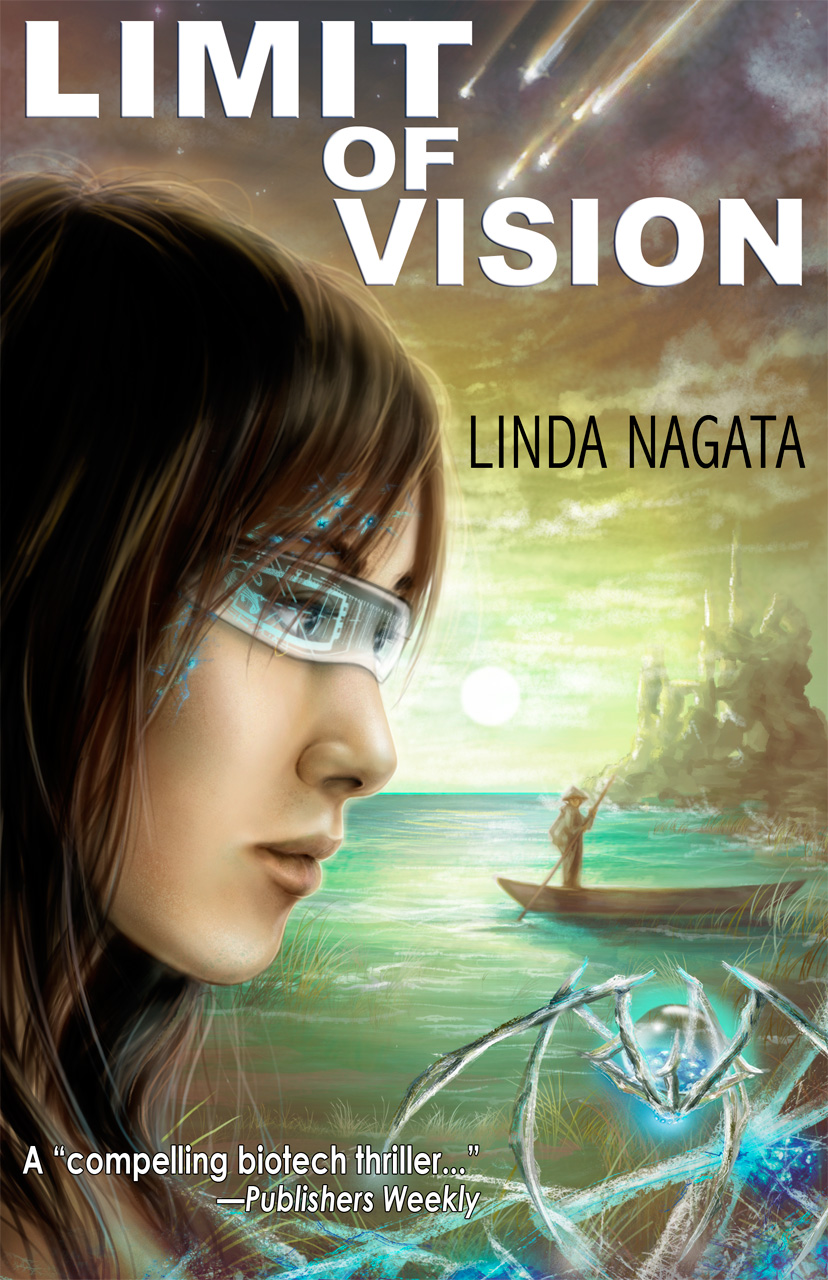
Limit of Vision was the last novel to still have a cover by me, but it’s now stepping up in the world. Maui artist Sarah Adams has just finished a digital painting that will soon be on the ebook, and will also appear on the new print version at some future date.

Here it is. Click the image to see a larger version in a new window. And let me know what you think!

Limit of Vision is probably my most obscure science fiction novel, which is too bad. In my admittedly biased opinion, I think it’s a very worthy book.

If you’ve never heard of it and are curious to know more about it (or to see the original Tor cover) visit the Limit of Vision page on my website.

If you’d like to sample the book, you can find it at these vendors:
Amazon.com USA
Amazon UK
Barnes & Noble

For would-be readers outside the USA, UK, or Germany: avoid the hefty international surcharge by buying from Book View Café. Check back here or on twitter/facebook/G+ for an announcement on when Limit of Vision will be available from BVC.

Two Volcanoes

September 1st, 2011

I’ve lived in Hawaii most of my life, but there are lots of things I’ve never seen and done, so the husband and I have been making an effort to fill in some of the experiential holes. We’re just back from the Big Island, and volcanoes, of course, were one of the highlights of the trip.

For those not familiar with Hawaii, all the islands are volcanoes, but only on the “Big Island,” (more properly known as “Hawaii”) are there active volcanoes. Hawaii island really is much bigger than all the other islands. It’s made up of five volcanoes: the very old Kohala Mountains, dormant Hualalai, dormant Mauna Kea (site of the world-famous astronomical observatories), intermittently active Mauna Loa, and continuously active Kilauea.

On this trip we visited Kilauea Caldera, the very top of the ~4,000′ mountain, which is in a rainforest, and part of Hawaii Volcanoes National Park. For decades the primary site of eruption has been a vent called Pu`u O`o, much farther down the mountain, but the caldera area has been more active lately. Here’s what we saw, one evening in the park:
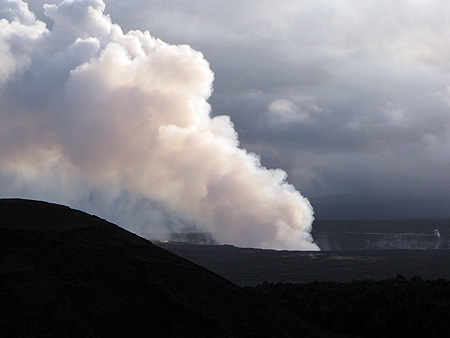
Steam/fume cloud rising from Halemaumau, Kilauea Caldera, August 2011

Steam/fume cloud rising from Halemaumau, Kilauea Caldera, August 30, 2011

This level of steam/fumes is new in my experience. Lava can’t be seen, but after sunset the red glow of lava can be seen in the steam cloud.

Half-an-hour drive away, this was the view from our hotel room in Hilo, looking toward 14,000′ Mauna Kea. (Kilauea would be off to the left, far outside the photo.)
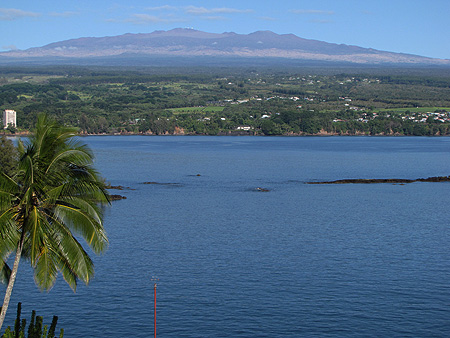
Mauna Kea, seen from Hilo.

Near the 13,000′ level on Mauna Kea is a tiny, but permanent water feature known as Lake Waiau. It’s by far the highest elevation lake in Hawaii, which has very few lakes at all:
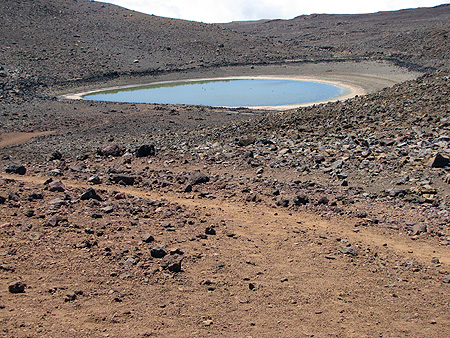
Lake Waiau, Mauna Kea, August 31, 2011

Lake Waiau, Mauna Kea, August 31, 2011

We went to see the lake, since it’s such an odd geological feature. We’ve been told the water used to be crystal clear, but sadly, it no longer is. We can only guess that someone threw nutrients into the water.
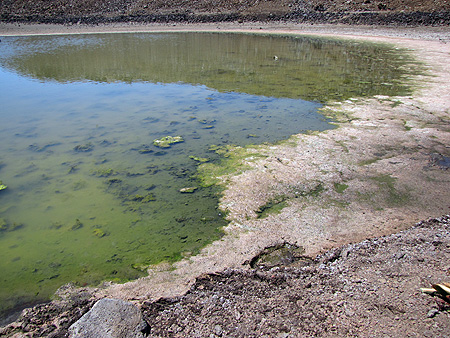
Algal growth in Lake Waiau

Algal growth in Lake Waiau

At any rate, while having lunch, the cloudbank on the Hilo side pulled back and we were left looking at this . . .
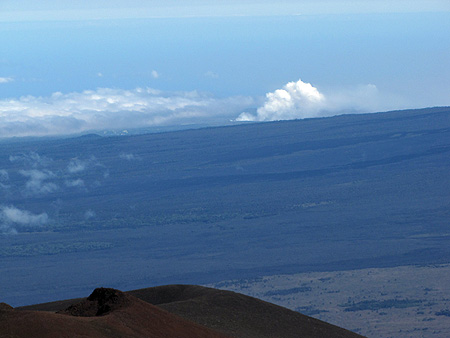
Pu`u O`o from 13,000' level of Mauna Kea

Pu`u O`o from 13,000' level of Mauna Kea

. . . and after a minute we realized that plume was not a wildfire or a cloud–it was a volcanic vent. It took a few more minutes to realize that a higher elevation “cloud” rising over the ridgeline . . .
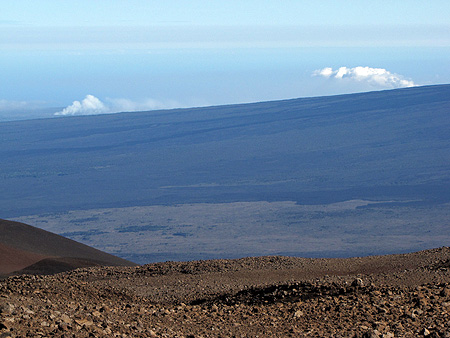
Halema`uma`u and Pu`u O`o seen from 13,000' level of Mauna Kea

Halema`uma`u and Pu`u O`o seen from 13,000' level of Mauna Kea

. . . was actually the plume from Halema`uma`u Crater in Kilauea Caldera, where we had just been the evening before. So we were looking at both eruptive sites of Kilauea Volcano. I have to admit I found this a little bit unnerving, because from where we were sitting Kilauea Volcano looked so very active. It’s easy to imagine earthquakes shaking the whole island–which does happen. But the sight was awe-inspiring too.

We all learn to live with the dangers inherent in our lives, but I have to give special acknowledgment to people on the Big Island who live every day of their lives with this very active volcano just a few miles away. Then again, after spending a few days in and around beautiful Hilo, I can easily understand why people fall in love with the windward side of the Big Island.