Linda Nagata: the blog at Hahví.net


Goddesses @ 99¢

October 15th, 2011

Let the price experiments begin!

Ninety-nine cents is the lowest price allowed by Amazon and Barnes & Noble for an ebook.** For a novel, 99¢ is basically a giveaway price, a means to try to move a lot of copies in the hope that a book’s ranking will improve and that the author will develop a fan base, but–given that the author gets only 35% minus a penny or two for a transaction fee–it’s no way to make a living.

(Full disclosure: ebooks priced at $2.99 and higher pay 70% to the author, which is why you rarely see anything priced between rock bottom and $2.99–you’re either giving it away or you’re not.)

For a short story though, especially a reprint, 99¢ is a reasonable price from a reader’s perspective, and useful to the author if a sample of a higher-priced work is bundled with the short story.
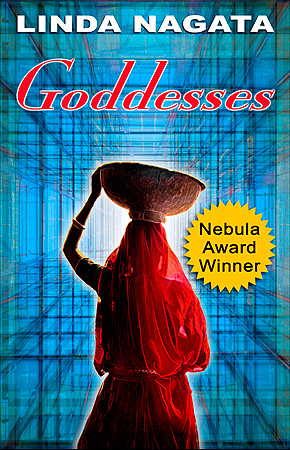
Short stories have a word count up to 7,500, according to standards set by the Science Fiction & Fantasy Writers of America. My story Goddesses is not short. In fact, it’s a 30,000 word novella, but it still makes a good subject for this price experiment. I’ve had it at $2.99 for most of the year, to take advantage of the 70% royalty, but yesterday I dropped it to 99¢ just to see if it makes any difference at all. Frankly, I’m not expecting much, but if anyone is interested in the statistics let me know and I’ll try to remember to post them here as time goes by.

So if you haven’t seen it yet, check out the Nebula-award-winning novella Goddesses–just 99¢ and available from these vendors:

Barnes & Noble
Amazon USA

Prices may have not filtered through to Amazon’s non-USA markets just yet, but here are the links:
Amazon UK
Amazon DE
Amazon FR

** Yes, there are free ebooks, but an author can’t set the price to free. The only way to do it is to figure out how to sell the ebook for free somewhere else and hope Amazon’s search engines find out. Then Amazon will automatically reduce the price of the book to match.
One Year In—Was It Worth It?

October 11th, 2011

It was one year ago, October 2010, when I started “indie publishing,” determined to get my backlist out into the world again, and hopefully make a little income on the side to support my writing habit.

That first month began with a stint of designing book covers for The Nanotech Succession novels. I started with the covers because I figured that would be the hardest part of the ebook creation process. I spent a lot of time, had a lot of fun, and then later tossed them all out and replaced them with the vastly superior Bruce Jensen covers that the books now enjoy.

In the year since, I’ve published ebook versions of my six backlist novels, one novella, two short stories, and two original novels. I’ve also done print-on-demand versions of the four Nanotech Succession novels, The Dread Hammer, and my young-adult novel Skye Object 3270a.

Was it worth all the time and effort?

Looking only at return on investment thus far, the answer has to be “No.” Whatever pixie dust it takes to get sales rolling has not been sprinkled on me yet. I could have made far more money putting in the same hours at a minimum wage job.

But looking at it emotionally? Then the answer is “Hell, yes, it was worth it!” I feel like a writer again. I’m proud of the work I’ve done, I’m happy to have it available, and I have a lot more confidence in my future as a writer than I had last year. Confidence is a good thing. I don’t write well when I’m stressed, worried, and unhappy.

If you’re a midlist writer putting up your backlist and you too are feeling underwhelmed by sales, remember this: all this prep work is an investment, and investments don’t necessarily pay off in the first year. Being set up, poised, and ready for the day the buzz starts murmuring your name (or your pen name) is a good position to be in.

My goal now is to write more and try to generate that buzz. Part of that strategy is to knock on the doors of traditional markets and try to get back inside—but with eyes wide open this time. My newly adopted buzzword for the upcoming year: “Hybrid writer”—a combination of indie and traditional publishing with the united goal of making a living wage.

Aliens Among Us?

October 11th, 2011

Along the little country road down to South Point, on the island of Hawaii, are isolated homes surrounded by windblown pastures–and then there is this:

We’ve all seen eccentric homesteads, but this looked like a bit more than even the most devoted communications hobbyist might come up with. Fortunately for our curiosity, there was a small sign on the corner of the property identifying it as part of the “Universal Space Network.”

Being a science fiction writer I’m inclined to take such claims literally. Naturally, my first comment was, “Wow. Impressive. The Universe is a really big place.”

Sadly, the Universal Space Network does not seem to be truly Universal. The network doesn’t seem to include alien worlds, but only this familiar one. According to the website, it’s a US-based company, evidently specializing in satellite tracking…which makes a nice cover story anyway! Personally, I find it more fun to imagine aliens huddled inside that little green house, communicating with their home worlds across the star lanes.

South Point

October 10th, 2011

At South Point, Hawaii. Notice the rock wall behind us, and the lighthouse in the background. I forgot to bring my hat on this trip, thus the bandanna–which worked quite well in the extreme wind.

The farthest point south in the United States lies at latitude 19°–slightly south of Mexico City, on the parallel that passes through the lower Yucatan Peninsula and Haiti/The Dominican Republic. This is the southernmost tip of the Big Island of Hawaii, and is known simply enough as “South Point,” though sometimes it’s called by its Hawaiian name Kalae which is an equally simple nomenclature meaning “the point.”

Over the weekend the husband and I visited South Point as another “bucket list” item. Getting to South Point isn’t a difficult trek–the road from the main highway is narrow, but it’s smoothly paved most of the way. Part way down there’s a “rough road” sign. Being from Maui, this made us laugh. At the end, the road is “patch paved” but it’s still not bad.

This is me, about as far south as I could go:

The area is hot, dry, and extremely wind-blown with severe offshore currents.

Farther down the coast there’s supposed to be a green sand beach. We didn’t venture that far, but we did see patches of green sand strewn on the shore. I can only guess that the density of the olivine particles is different enough from the lava and coral bits that they tend to drop out of the waves at the same time to make these patches. At any rate, I’m fascinated by the close up view of sand:

Several people were fishing from the top of a cliff, using scaffolds to (I presume) raise and lower the lines. The lines are held by floats, which seem to be pulled out to sea by the current.

The wind blew powerfully from the shore out to sea. Standing at the top of the seacliff, the ocean did not look flat, but looked much higher just a tenth mile offshore–a very strange effect.

The Nanotech Succession: Print Version

October 6th, 2011

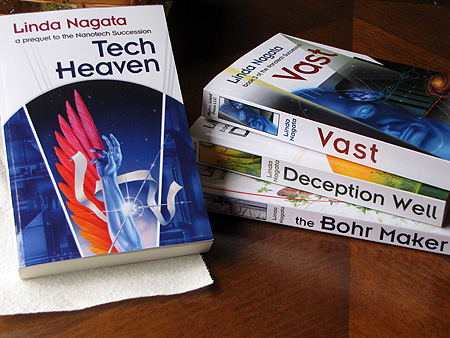
I just wanted to announce that all four books of The Nanotech Succession are now available as trade paperbacks–at least in the USA. Three of the four are presently available in the UK and Australia, while the fourth–Tech-Heaven–will hopefully show up in those markets in a week or two.

The books are print-on-demand, produced by Lightning Source and published under my own imprint, Mythic Island Press LLC.

I was so very lucky with these books to have Bruce Jensen prepare the front covers. They are beautiful!

Here’s the series, all together:

Prices vary by vendor, but here are general links to my print books:
Amazon.com USA
Amazon UK
Booktopia (Australia)
Barnes & Noble (USA)
Powell’s Books (USA)

Exercise & the Creative Brain

October 4th, 2011

If you follow me on twitter, you’re probably aware that I like to exercise. I’ve always been into fitness, I’ve just gotten more consistent and have pushed myself harder in the last couple of years. In a recent article at Fast Company, The Creative Brain On Exercise, Jonathan Fields tells us why fitness for writers and artists is a good idea:

…exercise isn’t just about physical health and appearance. It also has a profound effect on your brain chemistry, physiology, and neuroplasticity (the ability of the brain to literally rewire itself). It affects not only your ability to think, create, and solve, but your mood and ability to lean into uncertainty, risk, judgment, and anxiety in a substantial, measurable way

Consider me a sample of one. Lately I’ve been asking myself, “Why am I in such a damn good mood?” It’s not like I’m a Joe Konrath/Bob Meyer indie-publishing success story. Nevertheless, I am in a good mood most of the time, and 2011 looks like it will be one of my most productive years ever. I think exercise has a lot to do with that.

I’m not all that disciplined. I don’t exercise everyday, but I do a lot more now than I did a couple years ago. If you’re interested, here’s an older post on the book that got me going again.

Let me know if you exercise, if you’d like to exercise, if exercise is a drug that works for you. It’s good to have a sample size larger than one!

(Hat tip: I found the Fast Company article via Andrew Sullivan’s blog.)

Writing Short

October 2nd, 2011

After I started selling novels, I stopped writing short fiction, for two main reasons. First, I was better at novels. And second, the short stuff took me way too long to write. It didn’t seem like it was worth the investment of time.

But in this year of “trying new stuff” and “writing faster” I wanted to try writing short again, so I plotted a story. To make it easy on myself I set it in The Nanotech Succession story world and used a minor character from my novel The Bohr Maker as the protagonist–but the story is independent of the book and takes place some years before.

Psyching myself up, I figured “4,000 words–how hard could that be?” I knew the story would likely be much longer than that, but 4,000 words sounded so un-intimidating.

(Do other writers play these head games? I have no idea.)

And then I applied the “Write the first draft fast” approach. Four days later I had a 7,500 word story which I dumped raw onto my local writing group the day before we were due to meet. They were very good natured about it. Several more days went into revision, the story turned into a short novelette of 8,900 words, and now it’s ready to go to market.

Naturally I hope it sells, but after all these years of no short stories, simply having written it feels like a win.

Point of View: First Person

October 1st, 2011

A couple weeks ago I blogged about a new novel in the early stages of development, and the frustration of coming up with a coherent plot. I’m happy to report I did come up with a nice plot skeleton that I can definitely work with, but there was another question I needed to answer after that: what point of view to use?

I wanted to write the story in first person. My initial conception of the novel suggested first person, so I sat down and wrote the opening chapter—and I didn’t like it at all. Partially, this was because I didn’t feel like I had the character’s voice right, but more importantly there was a structural issue of how and when to introduce information.

After experiment and consideration, I realized that if I opened in the main protagonist’s point of view/first person, he would either have to withhold key information to maintain the intrigue, or I would have to give up on intrigue and engage in lots of info-dump to get the reader up to speed. Of course neither option was acceptable.

So I re-wrote the opening from the point of view of another character, and I think it works much better. So it looks like it’s going to be third person, multiple viewpoint, which is what I’ve used for most of my novels.

In contrast to these struggles, last week I outlined a short story and then set out to write it—in first person. I was deep into the story before I realized that I hadn’t even thought about what point of view to use. The story simply demanded first person, and in this case it worked out fine.

The Search for Middle Grade Science Fiction

September 21st, 2011

My assignment: find five books similar to my own middle-grade science fiction novel Skye Object 3270a.

Why? Book View Café is going to be doing a Library Thing Early Reader promotion when the book launches at BVC.

I never guessed how hard this simple assignment would be.

I wanted to find books that were recent, popular, science fiction, set in space, with similar-aged protagonists. Here’s the list I finally came up with, which includes books from the ’90s and books not set in space and, I’m sure, some significantly older protagonists:

The Prometheus Project: Trapped – Douglas E. Richards
Quarter Share – Nathan Lowell
Jumper – Steven Gould
Alien Secrets – Annette Curtis Klause
Singing the Dogstar Blues – Alison Goodman

I know there are more books of the type I’m looking for being published among the indies, but I wanted titles a goodly number of readers might recognize. It’s kind of disturbing though, just how rare this sort of book seems to be.

UPDATE: Right after I posted this, @SPrineas on twitter suggested Catherine Jinks’ Living Hell which is definitely space-based; @cbmawn suggested Scott Westerfeld’s Succession; and @jennreese suggested PJ Haarsma Softwire series. So there are books out there, leaving the question: Why are they so hard to find?

Book Rave: Cold Fire by Kate Elliott

September 21st, 2011

Last fall I wrote enthusiastically about Kate Elliott’s Cold Magic. I’ve just finished Cold Fire, the second book in the trilogy. Consider this post my emphatic thumbs-up!

Cold Magic was set in glacial Europe. In complete contrast, Cold Fire takes place mostly in the Caribbean, in a world that is like Earth, but is not Earth in many critical ways. I loved both the setting, centered around the tropical city of “Expedition,” and the wonderfully detailed culture of that city. I loved the way the lead characters adapted and bloomed in this new world.

As in Cold Magic there are all sorts of adventures to be had along the way, not least of which is the evolving relationship within our protagonist’s forced marriage.

And the ending? I need to drop back in time and borrow from a unrelated third party for the appropriate response:

BANG-A-RANG!

Oh, and I hear you can order a signed copy of Cold Fire from Powell’s Books.