Linda Nagata: the blog at Hahví.net


Archive for the 'General' Category

Anecdotal Evidence

Friday, July 23rd, 2010

This is my personal observation on the nutrition/weight-loss wars. To be upfront, I’ve never had much of a problem with weight and I’ve always been fairly physically active, but over time I got to be maybe ten to twelve pounds heavier than I needed to be. No big deal, and I wasn’t emotionally invested in losing the weight, but when I started working out at the gym it seemed logical to think that I would lose some weight— and I did. Maybe three pounds. That was it. And I work out hard. I run the treadmill. I’m the one breathing hard over increasingly heavy weight. Didn’t matter. Two years passed, and I didn’t lose another pound. However, I was only working out two, or at most, three days a week, and continuing to eat as I had for years, which was sort of middle-of-the-road okay.

Then I picked up a terrific book called Younger Next Year by Chris Crowley and Henry S. Lodge, M.D., which can be summarized thus: “Exercise hard one hour a day, six days a week and don’t eat crap.” So together my husband and I cut down on the crap and started working out more, and lo, I dropped a couple more pounds.

Shortly thereafter we embarked on a deliberately low-fat diet, while continuing the exercise regimen, and after a few months I stepped on a scale and laughed, knowing the damn thing was broken. But a second scale concurred exactly with the first. Those twelve pounds I wasn’t worried about losing? They had just gone away.

I credit it to the diet.** Our focus is on low-fat and high fiber/whole grain, and for myself, I think the food is great. I don’t feel like I’m suffering or deprived, but I will concede it’s challenging to eat out and still stick to the rules. Also, meal prep can take longer, but not all that much longer.

It works for me. Just thought I’d share.

** When I say “diet” I mean “what I typically eat” and definitely not “going on a diet.”

This is An Album by the Black Keys

Tuesday, July 20th, 2010

Holy crap!

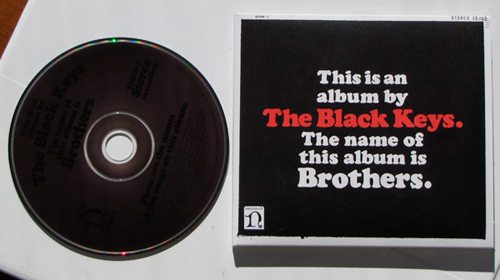
A few weeks ago I picked up a new CD by The Black Keys. I was rather amused to open it and see that the back of the CD was utterly black. I held it up to the light. I looked around the inner rim. Nope. No writing. No song titles. Nothing. Okay, well I guess this is novel, post-modern, whatever.

So I finally popped it into the iMac this morning, imported the songs into iTunes, and popped it out again. To my *shock* the back of the CD was now gray, with all the usual sorts of black writing on it. Oh cool! I thought. First-use reveals the writing!

But as I sit here the CD, warmed up a bit in the drive, is cooling off and the impenetrable black finish is returning, flowing in slowly from the outer perimeter. I’m entertained.

Maybe this is an old trick to you more worldly types. Then again, you more worldly types don’t buy CDs anymore, do you?

Titles can just be seen behind the black finish.

The Other Project

Monday, November 9th, 2009

I’ve spent the last few weeks deeply immersed in the website project mentioned in my October 10th post. This is a task that is better finished sooner rather than later, but there’s no deadline, no real pressure to get it done. Nevertheless I’ve been absorbed in it. Pleasantly absorbed.

I can’t point to any one thing that is inherently fascinating about programming a database-driven website. Step-by-step, maybe it’s kind of boring. And it isn’t exactly fun sitting in a chair all day staring at a screen, trying to figure out why stuff isn’t working, and trying to remember all the contingencies that have to be accounted for, and waiting for a page to load, (and listening to the dog sigh and grumble because I have become the most boring companion imaginable). Yet overall it is a deeply satisfying process.

Evidently I have a need to engage in long, complex projects. Whether it’s painting the house, landscaping the garden, programming a website or writing a novel . . . there’s a lot of satisfaction in the process, at least when progress is being made.

The promise of progress is one reason programming makes such a great escape from writing: everyday I know I’ve accomplished something. I may spend an hour trying to figure out why something isn’t working, but after a few hours I know I’m closer to the finished product.

Writing doesn’t share that same sense of momentum, of fair reward for time spent. Twenty hours spent trying to compose a chapter might just be twenty wasted hours. In the back of my mind I’m always aware of this, so it’s easy to get distracted.

But now I’ve reached a good pause-point on the website, so tomorrow the plan is to get back to The Wild. Wish me luck. I really need to get this (re)-rewrite done so I can try my hand at something new.

Books & Postage

Wednesday, October 14th, 2009

For a number of years I’ve been selling my out-of-print books via my website. I had a large initial stock – at least of the Bantam books – because my former editor moved her office to a different floor, and in the process she discovered several cases of my books in a storeroom and was nice enough to send them to me.

Selling these books is not exactly a lucrative enterprise given the time, trouble and postage it takes to mail them – especially from Hawaii – but I would much rather the books were read than not, and it’s really gratifying that people will seek me out.

I’ve also found that as time goes by more and more of my orders are from Great Britain, Australia and New Zealand. This is really flattering, because these buyers are willing to pay additional postage of $22 or more. But the paperwork!

Generally I am not one to bash the US Postal Service. In my experience they almost always do a great job, and generally speaking it’s just as efficient and far cheaper to send something to or from Hawaii by Priority Mail than by one of the delivery services.

But with international packages a customs form needs to be filled out. Recently the USPS decided that this should be done online. If I don’t fill it out online, then the clerk at the post office will have to take my hand-filled form and enter it into the computer there. But the online form requires a phone number, both mine and the recipient’s. Well, mine is an unlisted home number not for distribution, and I may or may not have the recipient’s via PayPal. However, I have to enter something or the form won’t submit, so a string of zeroes has to do. Naturally it turns out the final form says “phone number if available.” Maybe the website and form should get on the same page?

But here is my primary complaint: the form is 4.75 inches high, there are five copies, and each copy prints out on a separate sheet of letter-size paper! Two forms could easily fit on one sheet of paper, but no. Apparently a decision was made to waste resources. So instead of the post office paying to produce a five-sheet form of very thin paper of the correct size, everyone using this form must now waste 2.5 pages of much heavier, letter-size paper.

I will be very interested to hear what our postal clerks have to say about this when I go to mail my package tomorrow.

Coming Too Late to the Party

Thursday, October 8th, 2009

I don’t watch much television. Or maybe it’s more accurate to say I don’t deliberately watch a lot of television. My standard operating procedure is to turn on the tv, proceed through the 75 or so channels, decide that it’s all a wasteland, and turn it off. Showing up at a designated time to watch a particular show is a little more commitment than I can deal with.

But a few days ago I stumbled across an article with a title something like “The Best Series You Didn’t Watch.” (To my frustration and perplexity, I haven’t been able to relocate the article, though I thought it was in the New York Times.) The show was NBC’s Kings. Needing a diversion, I started watching it on Hulu . . . and a handful of days later I’ve watched all of the first and only season. The show has been canceled, and yes, it was really good.

There are enough reviews on the web that I’m not going to say much on what it’s about except that it takes much of the Old Testament story of Saul (herein Silas) and David and recasts it in a fictional modern setting, with lots of extra details not in the original source.

I enjoyed the characters, the story, the intensity, and the questions on ethics and power, and divine favor and approval. I often read interesting books, but it’s been years since I’ve read a book that keeps me up into the wee hours because it’s so gripping I can’t put it down. Well, this was a series that kept me up long past my usual bedtime. I’ll probably pick up the DVD.

In the meantime, I’m reading the Book.

Pick Books You Like

Saturday, August 29th, 2009

Finally, a subject I feel passionate about that is too long for Twitter alone! What has set me off is a New York Times article Students Get New Assignment: Pick Books You Like. To which I say YES! It’s about time!.

I have strong feelings on this subject, but not from my own experience—for years my joking explanation of my vast ignorance of “good literature” was that I grew up in the Hawaii Public School System. Since those long-ago days Hawaii schools have truly improved in many ways, but I had big problems with the way literature was taught when my two children were in high school.

As I recall, middle school (and possibly down through elementary school) had a great system. At the beginning of the school year the students would receive a huge list of hundreds of books. They would simply pick a book off the list, read it, take a little computerized test to show they had read it, and do it all again. There were all kinds of books on the list and it wasn’t a challenge to find something each child could really get into. (Well, except maybe my son, but more on that later.)

But by high school, at least in the advanced classes, there were assigned reading lists. This wasn’t necessarily a bad thing. I made it a habit to read most of the assigned books and discovered some real gems that I would never have picked up on my own. Barbara Kingsolver’s The Poisonwood Bible and Chiam Potok’s The Chosen come immediately to mind. The most amusing—not the book itself, but the way it played out—was Snow Falling on Cedar. This one was assigned as summer reading for my daughter’s incoming freshmen class. Neither she nor any of her friends showed any sign of starting in on it until I read it and reviewed it. “Wow, very nice story, but I’m pretty stunned the teacher would assign a book with such graphic sex to a ninth grade class.” Hmm . . . suddenly, the book was being read by lots of soon-to-be freshmen. The second-level punch line is that the teacher who assigned the book wasn’t there when class started. The new teacher read the book later in the semester and was stunned.

So those were the good experiences. The bad experiences were teachers who assigned dreadful “classics” and in too many cases analyzed them to death. Let me say that I have essentially no experience with “analyzing” books. I am not an English major. If English majors want to while away their time looking for themes and hidden meanings, well, have fun. But please let’s not inflict this (it’s tempting to say “perversion”) on high school kids. I have no objection to a good discussion, sharing insight, that sort of thing. But spending days and sometimes weeks tearing a book apart, diagramming it, acting it out, making more or less of it than it really is, does no student any good. I recall a nearly endless wrestling with The Masque of the Red Death that was horrifying to witness as a parent and called into doubt the psychological state of the teacher.

Personally, I felt the best way to go about teaching high school literature was to read a book, talk about it, move on. Even better if people could read books they like.

Okay, back to my son. He has never, from earliest days, had much interest in reading fiction. Gaming manuals, no problem. Non-fiction, that’s fine. Forums, sure. Even choose-your-own-adventures worked pretty well, but beyond that, it was pretty hard to find a book that he felt was worth reading. The astonishing thing about him is he has the vocabulary of someone who has read extensively his whole life. I don’t know how he managed that.

Being a writer, of course this bothered me (and continues to bother me!). I worked very hard to find books he could enjoy. I wasn’t snobby about it. He was very much into Michael Crichton’s Timeline for example. And I even got him to read my own Memory. (“Hey, it’s dedicated to you. You have to read it.”)

As an aside, he would also write the most scathing book reviews I have ever encountered.

But after all that hard work he wound up in an advanced English class in high school with a reading list that wouldn’t exactly make me want to keep running back to the library for more. The worst of the lot—and I know I am about to offend a lot of people who think this is a scintillating, truly wonderful novel—was Ralph Ellison’s The Invisible Man. As I said, I tried to read the books my children were assigned, but I couldn’t get more than a few pages into this one. My son impressed me hugely by reading the whole thing—but except for some Star Wars novels he has probably not read much fiction since. I am not saying I blame his English teacher and Ralph Ellison for this, but I do consider it a contributing factor.

Reading fiction needs to involve some pleasure for the reader. Even if the book breaks your heart or makes you cry, you still get the pleasure of a good story, along with the company of characters you appreciate. And of course not everybody will find this pleasure in the same book. So English teachers! We appreciate you–your bravery and fortitude far exceed mine–but please do not force our impressionable youth to read books they despise. We want to instill a life-long love of reading, not a life-long loathing.

So here is one enthusiastic vote for student choice!

Strange Intersections

Sunday, March 1st, 2009

This is a story with no conclusion; it is just a description of an odd coincidence that still leaves me puzzled.

Recently I re-discovered a CD that was released in 2000 by Nina Gordon, a singer I had never heard of before (or frankly, since). My daughter had purchased it because we were both entranced by a song on it, “Tonight And The Rest Of My Life.”

Move on a few weeks in time…my daughter, avidly interested in Greek mythology, is reading an English translation of “Gods and Heroes” by Gustav Schwab. The book she holds in her hands was purchased by my great aunt, in 1946, as a Christmas gift for her husband. It is one of the very few items from my family that I possess.

So what’s the connection? On page thirty-nine, Zeus has decided to wipe out the human race. My daughter reads the following “[Zeus] was just about to do this by scourging all the earth with lightning, when he held back for fear the sky might catch fire and burn the axis of the world.” She is astonished and comes to show me the quote, because in Gordon’s song, the fourth and fifth lines are
“And the sky might catch on fire
And burn the axis of the world.”

Well, we were very impressed that the songwriter – apparently Gordon herself – had seemingly read the very same book, and been fully taken by the imagery, but we were more impressed that the allusion was revealed to us by such a slim chance.

The meaning of the song is open to interpretation, but the chapter the quote comes from is “Pyrrha and Deucalion.” It is a tale of the Flood, only this one is caused by the Greek gods, who are disgusted at the state of humanity.

So today, instead of doing the useful things I had planned, I let myself be distracted, and spent some time with Google book search exploring some of the other song lyrics [ link ]. Here’s what I found:

On page thirty-seven, the afterlife of the Greek heroes is described as being “…on the Islands of the Blest gleaming in the dark sea.” In the song we have:
“Gleaming in the dark sea
I’m as light as air”

Again on page thirty-nine we have “…only the south wind was allowed to issue forth. Down to earth he flew with dripping wings, shrouded in darkness as black as pitch.” In the song we have:
“Down to the earth I fell
With dripping wings”

On page forty, at the height of the flood: “Everything was sea, shoreless sea.” In the song:
“I open up my eyes
I realize that
Everything is shoreless sea”

And then on page fifty-five, in a completely different story, the tale of Europa, “Soon the land vanished from sight, the sun set, and in the vague shimmer of night, the girl saw nothing but waves and stars.” In the song:
“Everything is waves and stars
The universe is resting in my arms”

What does it all mean? As I said at the start, this is a story without a conclusion. A small part of me is troubled by it, wondering if this is beyond fair use, but mostly I feel the song is a beautiful rendition and interpretation of imagery and concepts that begin in the book.

I am curious to know if the allusions were deliberate, or if they emerged from the stew of the unconscious. I think most writers must worry about this at times – I certainly have – that something read years before might suddenly appear in our own work, and we have no idea it wasn’t original to us. Ah well, life is full of risk!

Oh, and one more coincidence…according to Wikipedia the Nina Gordon album was recorded on Maui, where I live.

Mexico City

Thursday, February 26th, 2009

I’ve been eyeing this blog with guilt the past few months. It’s easy to come up with minor topics, but when I’ve let things slide this long, it feels like I should offer an exceptional topic as I get back into the habit of posting.

So here it is: I have been invited to participate in the 25th Festival de México en el Centro Histórico, in Mexico City. This is an annual arts festival involving music, performance, film, other visual arts, and literature. This year the literature track is focused on science fiction, which is where I come in.

I have never been to Mexico City before, so I am looking forward to this. I’m scheduled to give a talk on Tuesday, March 17, and participate in a round table discussion on Thursday, March 19. I will have some illustrious company, so it should be interesting.

Here is the link to the literature section of the festival website: http://festival.org.mx/programa/tipo/g/17. Google can provide reasonable translations.

My contacts at the festival have been wonderfully helpful and gracious in preparing for this trip, and my thanks go out to them.

Be Lazy: Get Hacked

Tuesday, May 20th, 2008

Like most people, I put off upgrading WordPress until forced to — usually by a hacking exploit which is what happened this time. I cleaned out the database and everything looks okay, but in this world you never know. It could happen again in the next few minutes.

That’s an hour and a half that could have been devoted to writing, gone.

Sigh.

Bodhisattva

Monday, May 21st, 2007

I sat next to a bodhisattva today, on a twenty minute inter-island flight. I had an aisle seat, she was sitting beside me, and her companion had the window. It was impossible not to eavesdrop on an energetic and animated conversation that began with a deep examination of their personal emotional needs, their experience with channeling, insight on her past lives, their struggles to find the perfect romantic partner, and other subjects that discretion suggests I not repeat here.

Then, perhaps halfway through the flight, he leans toward her and asks her to accept what he is about to say with an open mind. “I truly believe you are a bodhisattva.” She laughs pleasantly and agrees. The talk moves on.

Far be it from me to claim expertise on any religion, but I do happen to know that a bodhisattva is a Buddhist figure, commonly conceived as one who is on the way to becoming a Buddha, but “delays his own final and complete enlightenment in order to save all sentient beings out of his enormous compassion.” (dictionary.com) So a bodhisattva is a very powerful spiritual being. As an example, the Dalai Lama is considered by many to have this status.

I admit I tried to sense a spiritual aura… just in case. Perhaps I am just deaf to such things. Still, I imagine spirituality as something conveyed more in emotion than in words. The talk-talk-talk of the bodhisattva and her companion was quite incredible to me — both for its simple abundance, but also that such confessions and discussions should be made in a public place.

Perhaps in their enthusiasm, they simply forgot I was sitting beside them. But even enlightened beings might do well to remember the value of a little discretion.