High Surf on Christmas Day
December 25th, 2009We went early to check out the big waves on Maui’s northshore. It was a gorgeous morning with not too much traffic. A great way to start Christmas Day!
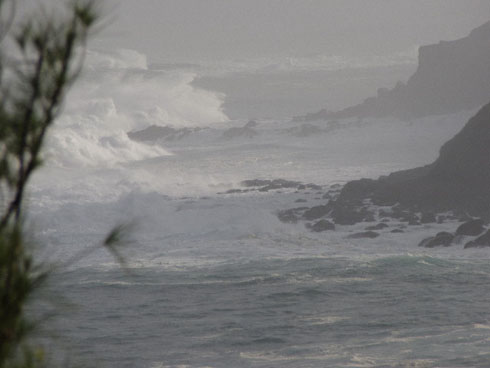
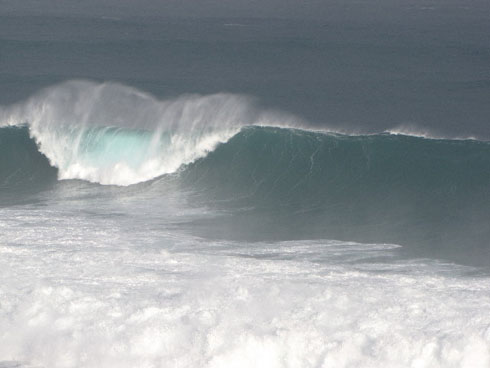
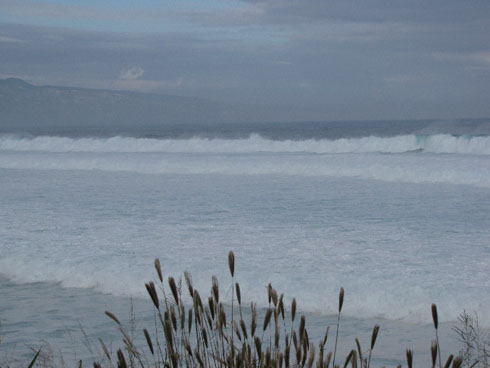
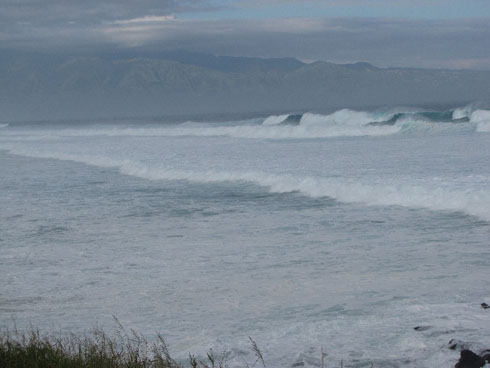
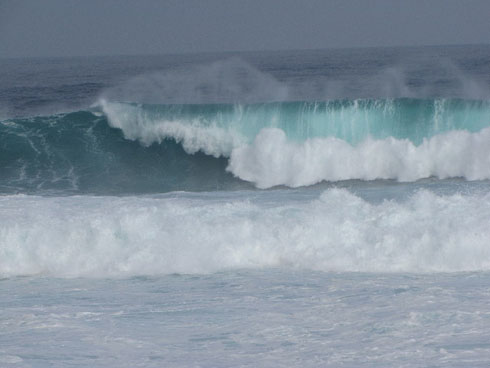
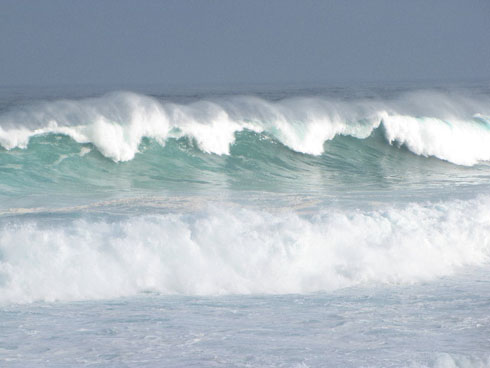
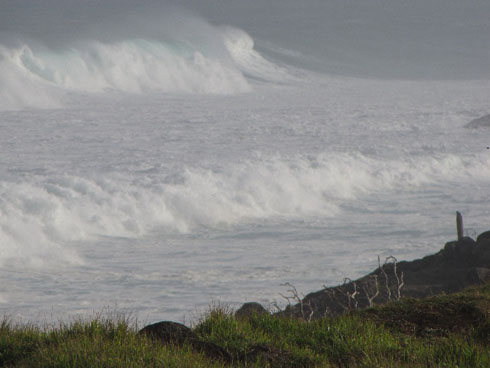

We went early to check out the big waves on Maui’s northshore. It was a gorgeous morning with not too much traffic. A great way to start Christmas Day!
Last night–sadly!–I finished reading King’s Dragon, first in the series Crown of Stars by Kate Elliott.
This is not a new book. It was published in 1997, but back then I wasn’t reading heroic fantasy. Such a pity — because now that I have finally read it, I have to say it’s been a truly long, long time since I flat-out enjoyed a book as much as this one. This is the sort of book that got me hooked on reading in the first place—which is not to say it’s juvenile. Not at all. It’s intricate and smart, with lots of suspense and great pacing, and filled with likeable, admirable characters to whom ethics matter. Just my cup of tea.
I picked up the book because it was pointed out to me that Kate lives in Hawaii. I don’t keep up at all with science fiction and fantasy these days, so this was news to me. But I thought it was only right that I should have some familiarity with Hawaii SF&F writers (as few as we are).
As it turns out, Kate is far more productive than I am and has published multiple series. I started with Crown of Stars because it happened to be available on the local library shelf—sort of. I actually picked up another book in the series, not realizing it was a series, and promptly returned that and ordered volume 1.
It is so nice knowing I have much more to look forward to. The only thing that irritates me is that I don’t have the next book in hand. Yet.
Click here to follow Kate Elliott on Twitter
Minor updates on 07/09/2013
Phone call from my daughter: Mom, the comments on your blog are broken.
Oh.
Fixed now!
Nanowrimo is well underway. For those unfamiliar, this is a writing exercise, held in November, with the goal of producing a 50,000-word novel in a month. The idea, as I understand it, is to just write, without concern for the inner editor, letting the unconscious creative spark take over. You won’t have a publishable novel at the end of it, but you might have a good framework to build on, with some great scenes, and you will at least have something.
My daughter persuaded me to sign up for Nanowrimo last year. That lasted for about two hours and this year I refused to go near it. I’m not recommending against Nanowrimo. It’s just not the way I write.
There are writers who always write in the Nanowrimo style, pouring out chapter after chapter without pause or revision until they reach the end, and then going back to re-write it all later. And then there are writers like me who insist on a polished chapter 1 before going on to chapter 2, and if something in chapter 2 changes things, then of course one must go back to chapter 1 and revise accordingly. While I admit this is mostly personal style, for me there is also a logical reason for doing this—because naturally everything that happens in a given chapter is dependent on what happened, or what was introduced in prior chapters. So that when I do go back and change some plot thread at an earlier point in the story, the repercussions are always more than I initially hope. This is the writer’s version of the butterfly effect, and this re-write of The Wild is turning out to be a profound demonstration of it.
The idea behind this re-write was to change the opening to better set up the story, change some motivations to provide better conflict, and change some of the plot to do the same. But once those butterfly wings start stirring the air, the winds can get very erratic.
I had hoped to make big changes in certain sections while holding onto other parts—and significantly the last quarter of the book—pretty much “as is.†So of course I have wound up re-writing almost everything. Oh, I’ve preserved some scenes and lots of paragraphs, but I bet if I went through and highlighted new stuff versus old stuff (and no, I’m not obsessive enough to actually do this) it would probably be 70% new, even though it’s telling essentially the same story.
The really painful moments are when I am forced to dump favorite scenes because they no longer fit in.
But onward. I’ve figured out the major plot points and motivations for the next to last section and have even managed to recycle some of the more dramatic moments. Now to outline it, and then to write it. It’s still possible I could pull this off in a way that will require only minimal changes in the last section. That’s the goal, but I’m not making bets on it.
I’ve spent the last few weeks deeply immersed in the website project mentioned in my October 10th post. This is a task that is better finished sooner rather than later, but there’s no deadline, no real pressure to get it done. Nevertheless I’ve been absorbed in it. Pleasantly absorbed.
I can’t point to any one thing that is inherently fascinating about programming a database-driven website. Step-by-step, maybe it’s kind of boring. And it isn’t exactly fun sitting in a chair all day staring at a screen, trying to figure out why stuff isn’t working, and trying to remember all the contingencies that have to be accounted for, and waiting for a page to load, (and listening to the dog sigh and grumble because I have become the most boring companion imaginable). Yet overall it is a deeply satisfying process.
Evidently I have a need to engage in long, complex projects. Whether it’s painting the house, landscaping the garden, programming a website or writing a novel . . . there’s a lot of satisfaction in the process, at least when progress is being made.
The promise of progress is one reason programming makes such a great escape from writing: everyday I know I’ve accomplished something. I may spend an hour trying to figure out why something isn’t working, but after a few hours I know I’m closer to the finished product.
Writing doesn’t share that same sense of momentum, of fair reward for time spent. Twenty hours spent trying to compose a chapter might just be twenty wasted hours. In the back of my mind I’m always aware of this, so it’s easy to get distracted.
But now I’ve reached a good pause-point on the website, so tomorrow the plan is to get back to The Wild. Wish me luck. I really need to get this (re)-rewrite done so I can try my hand at something new.
I did a Career Day presentation at the local prep school today. It went more or less like this:
When Mrs. Hart asked me to participate in your career day and talk about what it’s like to be a writer, I agreed at once. Then I assured her that by the time I was done talking I would have convinced everyone present that they did NOT want to be a writer. So beware.
I write fiction. Novels, to be specific. So when I talk about being a writer, what I really mean is being a novelist. Making a living writing non-fiction is a whole different world and honestly I know almost nothing about it.
In its essence, the typical workday of a writer is utter simplicity. You sit down in front of your computer and you write. Or you try to convince yourself to stop surfing the web and start writing. Or you start thinking about all those other things you really need to get done and since you’re not making any progress on your writing anyway you might as well do them. And wow, the house sure is dirty.
In other words, it takes a lot of self-discipline and a lot of focus–we could say “obsessiveness‖to be a successful writer, because whether you finish a project or not all comes down to you and your own personal drive. In typical employment–in an office environment, or in the field–you have to account to someone for your time and your production, you have deadlines, and evaluations, and concrete tasks to complete. If you don’t show up for work on time, somebody notices. Even if you run your own business, you are accountable to your employees, your creditors, your clients. But when it comes to writing, you are almost always on your own. You might have a supportive spouse who reads all your work at the end of each day; I’ve heard of writers who do, but I don’t know any. Maybe you’re under contract and you have a deadline–but knowing that a manuscript is due in 18 months isn’t a real strong motivator for sitting down today to work. So that’s a big part of the job–just showing up at the computer and writing until the book is done.
Another big factor in a writer’s day is isolation. Most writers spend hours and hours everyday on their own. Personally, this doesn’t bother me. I’ve always been something of a hermit. But a lot of people find it really hard not to be able to stop and chat with someone every now and then throughout the day. Perhaps that’s what MSN is for, or writing in a coffee house . . . though I’m sure I couldn’t manage to get anything done in a coffeehouse. But the isolation is something to consider.
There’s also the dilemma familiar to most self-employed people: when is it okay to stop working and relax? You don’t have fixed hours. If you didn’t get very far with your writing during the day, should you work into the evening? Should you spend all your weekend writing? If you have a day job, do you do anything besides write in what is amusingly known as your “spare†time? If you’re single and unattached, the answers to these questions might be easier, but if you’ve got a significant other, a spouse, children, you owe them something of yourself.
The next big issue: Money. Well, money and ego. You will need to deal with these every day. Money you will rarely see, and as a consequence your ego will be frequently bruised. Yes, it is possible–though it’s not common–to make a lot of money as a writer. But even a successful writer is not going to get a paycheck every two weeks. Could your ego handle going two years without an income? Could your bank account handle it? Could your spouse? When you’ve spent two years writing a novel that sells for $20,000, is it time to start thinking of a career change? Can your ego handle not being a stellar breadwinner?
Novel writing is a sole-proprietor business, and like any other, it has expenses. Right off the top is a standard 15% commission to your agent. So that’s $3000 out of your hypothetical $20K advance. And since you’re self-employed, you get to pay all of your social security tax instead of just the half that an employee would have to pay. No health care plan, of course. But you do get to deduct the cost of some equipment . . . assuming of course that you have an income.
Then there is research! I think research is often seen as one of the romantic perks of being a writer. If you’re going to set your novel in Europe or Australia or even Seattle, you have to know what it’s like to be there, right? If you’re doing a historical novel, you need access to great libraries with lots of material on your subject. Or you will need to interview people who know about the science or profession that you want to write about. You will want to see where they work, you will want to ride along with them in the squad car . . . .
And most of this absolutely demands travel, which costs a lot of money. So, even though you have a great idea for a novel, can you afford to research it? My agent used to encourage me to move from science fiction into techno-thrillers. This was really good advice, except that I couldn’t afford it–the research, that is. Of course this is the great advantage of science fiction and fantasy–you get to just make stuff up.
As a writer, it’s important that you maintain a social circle–regular people are great of course, but you also need to know some other writers or excellent readers. Your book is unlikely to sell unless it is very close to being “publishable†when the editor sees it–editors don’t really do a lot of editing–so it’s very important that you have reliable readers to point out the problems in your manuscript. Just make sure your readers are also eager to point out all the good stuff too, because no artist wants or thrives on only negative feedback. (And if a reader gives you ONLY negative feedback, they are not the right reader for you.)
Like so many other industries, publishing is undergoing huge changes. When I started publishing, there wasn’t a lot I could do–economically–to promote my work. I would make a few cents in royalties for every paperback that sold, and at that rate of return it didn’t make sense to take out ads or travel the country promoting my book. (Some authors do get book tours paid for by the publisher, but this is rare.) These days there is a lot more an author can do by way of self-promotion. Of course you must have a website, a blog, and a twitter account. You’ll be way ahead of the game if you can get gigs as a public speaker–especially if you can get paid for it. But always be ready to attend community events like this one. You can offer online writing workshops. And you can even self-publish.
Self-publishing used to be looked down on. People would think “Oh the only way she could ever get that book published is to publish it herself.â€
There certainly are advantages to having a publisher. The big one is that a publisher will (usually) pay you money up front–though with small press publishers this isn’t always the case. Also, publishers will (sort of) edit the book, they will have it copyedited, they will typeset it, take care of the layout, the cover, the printing of it. They will get it to the distributors, and if all goes well they will get it into the bookstores. They will send out copies to publications likely to review it. They will clip the reviews and gather great quotes for the paperback version. All this saves the writer a lot of time that can instead be spent writing (or avoiding writing).
On the other hand, your publisher may decide to publish a paperback original, instantly removing your book from the consideration of a lot of reviewers and awards. They may put a lousy cover or a horrible title on the book and you will have no way to stop them. They may forget they are editing your book and not contact you for six months. They may accidentally destroy all the warehouse stock of your book. They may print so few copies of your book that there is no way, mathematically, that it could ever be viable in the marketplace. Most editors will tell you they care about the books and the authors they work with, but the truth is that publishing works on the shotgun principle. Fire off a bunch of books, and hope one of them hits the target. Editors care, but they don’t care anything like the order of magnitude that you care about your book.
So for the clever, new-media savvy entrepreneurs out there who are not shy about self-promotion, self-publishing is worth looking at. If you can get a contract, consider it carefully. But remember that a contract with a New York publisher is no longer the only game in town.
There is another big advantage of being a writer: once you start to get known, you may find yourself involved in odd, and sometimes lucrative, side projects. For example, a year ago I was working with a Japanese media company, doing story development for a proposed docudrama on nanotechnology. Last spring I was lucky enough to be asked to deliver a presentation at a cultural festival in Mexico City. I have a friend who wound up founding a company doing creative promotions after being asked to work on an Internet game developed to promote the movie AI. I have another friend who has become a very successful speaker and instructor, with long-term engagements in Europe and Toronto among other places. Not that’s romantic.
Of the group of writing friends I started with years ago–most of whom are award-winning writers–the sobering fact is that none are actually making a living writing novels, though all are still involved in writing, one way or another.
Someone once said, regarding young writers, “If you can be discouraged, you should be.†Those are words of wisdom. On the other hand, despite everything I have just said, I love being a writer. The freedom, the flexibility, the self-fulfillment are all great benefits. If you want to be a writer, go for it, but have a back up plan. Have a day job. Be adaptive. Be creative. Develop a thick skin.
And good luck.
For a number of years I’ve been selling my out-of-print books via my website. I had a large initial stock – at least of the Bantam books – because my former editor moved her office to a different floor, and in the process she discovered several cases of my books in a storeroom and was nice enough to send them to me.
Selling these books is not exactly a lucrative enterprise given the time, trouble and postage it takes to mail them – especially from Hawaii – but I would much rather the books were read than not, and it’s really gratifying that people will seek me out.
I’ve also found that as time goes by more and more of my orders are from Great Britain, Australia and New Zealand. This is really flattering, because these buyers are willing to pay additional postage of $22 or more. But the paperwork!
Generally I am not one to bash the US Postal Service. In my experience they almost always do a great job, and generally speaking it’s just as efficient and far cheaper to send something to or from Hawaii by Priority Mail than by one of the delivery services.
But with international packages a customs form needs to be filled out. Recently the USPS decided that this should be done online. If I don’t fill it out online, then the clerk at the post office will have to take my hand-filled form and enter it into the computer there. But the online form requires a phone number, both mine and the recipient’s. Well, mine is an unlisted home number not for distribution, and I may or may not have the recipient’s via PayPal. However, I have to enter something or the form won’t submit, so a string of zeroes has to do. Naturally it turns out the final form says “phone number if available.†Maybe the website and form should get on the same page?
But here is my primary complaint: the form is 4.75 inches high, there are five copies, and each copy prints out on a separate sheet of letter-size paper! Two forms could easily fit on one sheet of paper, but no. Apparently a decision was made to waste resources. So instead of the post office paying to produce a five-sheet form of very thin paper of the correct size, everyone using this form must now waste 2.5 pages of much heavier, letter-size paper.
I will be very interested to hear what our postal clerks have to say about this when I go to mail my package tomorrow.
I’ve embarked on a new programming project. The good thing about it is that it gives me something productive to do when the writing is not going well.
Of course, the bad thing about it is that it gives me something productive to do when the writing is not going well.
For me, it’s not always a good idea to have viable alternatives for my time. Sitting in front of the computer for four or five hours and producing nothing is incredibly frustrating, but if it’s ultimately followed by a break-through, I guess it was worth it. However if I have some other project to turn to, odds are I won’t stick with the story for very long if I’m not “in the flow.â€
I wish I knew what makes the difference between those times when I am completely immersed in writing and all those other times when I am ready to go try something else for awhile. I wish I could manufacture the first state-of-mind, which would make me ever so much more efficient!
That’s all right. The specifics for the current section of The Wild are coming together day by day, and eventually they will all be set down and I’ll move on. I’ve been writing long enough to at least be confident of that.
I don’t watch much television. Or maybe it’s more accurate to say I don’t deliberately watch a lot of television. My standard operating procedure is to turn on the tv, proceed through the 75 or so channels, decide that it’s all a wasteland, and turn it off. Showing up at a designated time to watch a particular show is a little more commitment than I can deal with.
But a few days ago I stumbled across an article with a title something like “The Best Series You Didn’t Watch.†(To my frustration and perplexity, I haven’t been able to relocate the article, though I thought it was in the New York Times.) The show was NBC’s Kings. Needing a diversion, I started watching it on Hulu . . . and a handful of days later I’ve watched all of the first and only season. The show has been canceled, and yes, it was really good.
There are enough reviews on the web that I’m not going to say much on what it’s about except that it takes much of the Old Testament story of Saul (herein Silas) and David and recasts it in a fictional modern setting, with lots of extra details not in the original source.
I enjoyed the characters, the story, the intensity, and the questions on ethics and power, and divine favor and approval. I often read interesting books, but it’s been years since I’ve read a book that keeps me up into the wee hours because it’s so gripping I can’t put it down. Well, this was a series that kept me up long past my usual bedtime. I’ll probably pick up the DVD.
In the meantime, I’m reading the Book.
Finally, a subject I feel passionate about that is too long for Twitter alone! What has set me off is a New York Times article Students Get New Assignment: Pick Books You Like. To which I say YES! It’s about time!.
I have strong feelings on this subject, but not from my own experience—for years my joking explanation of my vast ignorance of “good literature” was that I grew up in the Hawaii Public School System. Since those long-ago days Hawaii schools have truly improved in many ways, but I had big problems with the way literature was taught when my two children were in high school.
As I recall, middle school (and possibly down through elementary school) had a great system. At the beginning of the school year the students would receive a huge list of hundreds of books. They would simply pick a book off the list, read it, take a little computerized test to show they had read it, and do it all again. There were all kinds of books on the list and it wasn’t a challenge to find something each child could really get into. (Well, except maybe my son, but more on that later.)
But by high school, at least in the advanced classes, there were assigned reading lists. This wasn’t necessarily a bad thing. I made it a habit to read most of the assigned books and discovered some real gems that I would never have picked up on my own. Barbara Kingsolver’s The Poisonwood Bible and Chiam Potok’s The Chosen come immediately to mind. The most amusing—not the book itself, but the way it played out—was Snow Falling on Cedar. This one was assigned as summer reading for my daughter’s incoming freshmen class. Neither she nor any of her friends showed any sign of starting in on it until I read it and reviewed it. “Wow, very nice story, but I’m pretty stunned the teacher would assign a book with such graphic sex to a ninth grade class.†Hmm . . . suddenly, the book was being read by lots of soon-to-be freshmen. The second-level punch line is that the teacher who assigned the book wasn’t there when class started. The new teacher read the book later in the semester and was stunned.
So those were the good experiences. The bad experiences were teachers who assigned dreadful “classics†and in too many cases analyzed them to death. Let me say that I have essentially no experience with “analyzing†books. I am not an English major. If English majors want to while away their time looking for themes and hidden meanings, well, have fun. But please let’s not inflict this (it’s tempting to say “perversionâ€) on high school kids. I have no objection to a good discussion, sharing insight, that sort of thing. But spending days and sometimes weeks tearing a book apart, diagramming it, acting it out, making more or less of it than it really is, does no student any good. I recall a nearly endless wrestling with The Masque of the Red Death that was horrifying to witness as a parent and called into doubt the psychological state of the teacher.
Personally, I felt the best way to go about teaching high school literature was to read a book, talk about it, move on. Even better if people could read books they like.
Okay, back to my son. He has never, from earliest days, had much interest in reading fiction. Gaming manuals, no problem. Non-fiction, that’s fine. Forums, sure. Even choose-your-own-adventures worked pretty well, but beyond that, it was pretty hard to find a book that he felt was worth reading. The astonishing thing about him is he has the vocabulary of someone who has read extensively his whole life. I don’t know how he managed that.
Being a writer, of course this bothered me (and continues to bother me!). I worked very hard to find books he could enjoy. I wasn’t snobby about it. He was very much into Michael Crichton’s Timeline for example. And I even got him to read my own Memory. (“Hey, it’s dedicated to you. You have to read it.â€)
As an aside, he would also write the most scathing book reviews I have ever encountered.
But after all that hard work he wound up in an advanced English class in high school with a reading list that wouldn’t exactly make me want to keep running back to the library for more. The worst of the lot—and I know I am about to offend a lot of people who think this is a scintillating, truly wonderful novel—was Ralph Ellison’s The Invisible Man. As I said, I tried to read the books my children were assigned, but I couldn’t get more than a few pages into this one. My son impressed me hugely by reading the whole thing—but except for some Star Wars novels he has probably not read much fiction since. I am not saying I blame his English teacher and Ralph Ellison for this, but I do consider it a contributing factor.
Reading fiction needs to involve some pleasure for the reader. Even if the book breaks your heart or makes you cry, you still get the pleasure of a good story, along with the company of characters you appreciate. And of course not everybody will find this pleasure in the same book. So English teachers! We appreciate you–your bravery and fortitude far exceed mine–but please do not force our impressionable youth to read books they despise. We want to instill a life-long love of reading, not a life-long loathing.
So here is one enthusiastic vote for student choice!